|
Home
Back to
Index
Previous
Next
Arconsat:
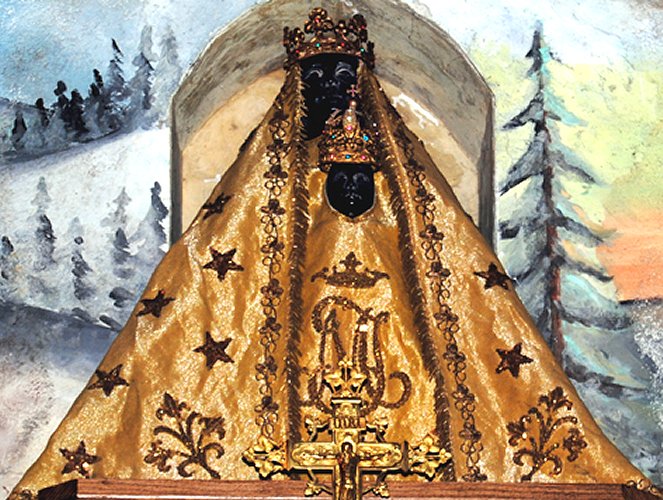
Our Lady of the Fields
(Notre-Dame des Champs)
Our Lady of Arconsat
(Notre-Dame d’Arconsat)
63250 Arconsat, in the village church St-Blaise, in
an area called Black Forest (Bois Noirs), department Puy-de-Dôme,
region Auvergne, 14th century(*1), 70 cm, before
a background of 1976 frescos depicting her legend.
|
|
According to the website of the diocese
of Clermont Ferrand, the village Arconsat began as a monastery founded
by St Martin around the year 350 A.D. However, as is typical for Black
Madonna sites, the area was already sacred in pre-Christian times. There
is a sacred well, plus sacred “fairy” and “druidic”
stones where the Druids used to offer sacrifices.(*2)
These stones are also healing stones with powerful magnetic fields. The
Association of French Dowsers (Association des Radiesthésistes
de France) claims they are as strong as the magnetic fields of Chartres
cathedral.(*3)
In the 8th century a Romanesque church was built. When it was destroyed
(I don’t know when) the Black Madonna was pulled from the ruins.
The present church was built in 1866.
The origins of Our Lady of the Fields have been hotly debated.(*4)
By all accounts her history is a very lively one. A couple of versions
have been passed down in the village from generation to generation. Here’s
what a certain Marie-Thérèse Planche was told by her grandmother
(I paraphrase.):
|
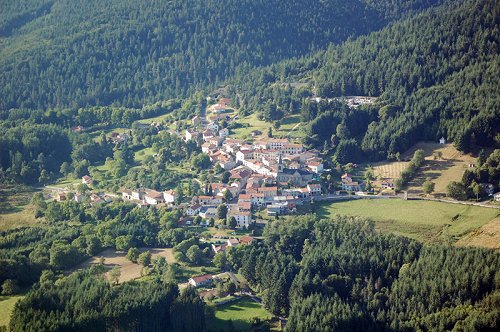
Arconsat in the Black Forest (Bois Noirs) |
“Some say that the Black Madonna of Arconsat was dug up from the earth
and may have been an ancient statue of Demter or Cybele. Since there was this
uncertainty as to her legitimate Christian origins, she was placed on the outside
of the church in a niche above the entrance. Eventually though, she was consecrated,
crowned, and placed on an altar inside the church.
Some claim that she was sculpted by a monk from the monastery with which this
village began. Others believe that Pierre the Hermit had brought her home from
the Crusades and gave her to his friend, the abbot of Arconsat.” (*5)
My sense is that she is a copy of her famous sister Our
Lady of Le Puy III, whose sanctuary lies about 100 km to the South. I say
this not only because she looks a lot like her, but also because only the heads
of Mary and Jesus are fully sculpted, the rest of their bodies are of a rough
pear shape, without any detail, because those bodies were always going to be
covered by robes. I have seen many copies of Our Lady of Le Puy and other Seat
of Wisdom Madonnas that consisted only of heads and mantel all sculpted or cast
out of the same material. Since the faithful never get to see those statues
without robes on, they wouldn’t recognize them any other way. But I have
never heard of an original Black Madonna, whose body wasn’t fully sculpted.
Only copies are produced that way.
That doesn’t mean this Madonna can’t be special. Many miracle working
Black Madonnas are copies of their more famous mother-statues. (see e.g. Czarna,
Poland).
This Madonna certainly has plenty of miracle stories to her name. Before the
Revolution her reputation for granting healings and other graces was already
firmly established. But during the time of The Great Terror she really showed
her power. It is said that the revolutionaries were drawn to the church of Arconsat
because of its big bells, which they wanted to melt down to make cannons. Entering
the church, they pillaged many sacred objects and found the Black Madonna curious
enough to want to take her with them. When they placed her on their ox drawn
wagon however, the vehicle could not be moved. No matter how hard the men beat
those poor animals, they couldn’t move an inch. It seemed like the wagon
was glued to the road and rooted in the earth. A woman came by, shouting insults
at the Virgin and made a gesture like she was kicking her. With that she fell
and broke her leg.
All this angered one of the revolutionaries to the point where he took his bayonet
and jammed it into Our Lady’s shoulder. Blood ran from the wound! At that
point the leader of the band was fed up with this statue and ordered her burnt.
A pyre was made from church benches and stalls. The Black Madonna was placed
in its center and the whole thing burnt to the ground. But when the flames had
died down, in the middle of the coals sat the statue all intact! Finally impressed
by this series of miracles, the looters gave up on taking or destroying the
statue, but not without one last ruse: They offered it to some people from Forez,
a neighboring village, in exchange for the performance of a folk dance. The
people from Forez danced, received their gift, and promised to return it to
its rightful owners once peace would return to the land.
Years later, when churches were allowed to reopen for worship, the people
of Arconsat tried in vain to reclaim their treasure from the people of Forez;
they were unwilling to give her up. So one night two bold boys from Arconsat
went and stole their Black Madonna back. They fled with her across the fields
and through the woods and pastures. It was the month of August. The next day
they were hiding in a field of wheat with nothing to eat or drink in the summer
heat. They could endure the hunger, but when their thirst became unbearable,
they asked the Madonna to give them some water. Right away a spring bubbled
up at the feet of the Virgin. It is there to this day, between Cervières
and St. Thomas. They call it the fountain of the Black One (la font de la noire).
Its water is always good to drink.
A certain Jean Olléon in his book “Mégalithes et traditions
religieuses et populaires en Livradois et Forez”, 1992, gives an
even stranger account of the recovery of the Virgin: "Several villagers
from Arconsat went to recuperated the statue and fled in haste. However, the
alarm was given and the men of Forez threw themselves on their heels. It was
a beautiful sunny day, but when the pursuers almost caught up with the people
from Arconsat, a thick fog lifted, which allowed the latter to escape.
They resumed their march, but taken by thirst and hunger, they had to stop.
They implored the Virgin for help. Immediately, from under the statue a source
sprang up. It has never dried up and is called the "Fountain of the Virgin".
Jean-François Faye, the author of the article “the Black Virgin
of Arconsat” (La vierge noire d’Arconsat) comments: “These
are undoubtedly stories to Christianize a spring that was sacred long before
the advent of Christianity.” I’d have to agree and I’m
glad they Christianized it somehow so that its reputation and ambiance of sacredness
could be maintained.
_____________________________________
*1: Ean Begg in "The Cult of the Black Virgin" Arkana, London:
1985, p.169, claims 12th century, but I trust the French websites more.
*2: http://www.montoncel.com/ginich.htm
*3: The website of a charming, simple little hotel
in the area even claims that somebody was healed of cancer by laying on these
stones. A natural form of radiation I suppose.
*4: See again the website
of the diocese
*5: “La
légende de la vierge noire d’Arconsat” on the website
of the Friends of the Black Forest