Bielefeld
Black Madonna
St. Jodokus-Kirche in the old center of town, Klosterplatz 1, about 1220, wood, faces covered with silver plating. The faces are evenly blackened by the oxidized silver, not like in this photo distorted by flash and lighting.
photos: Ella Rozett
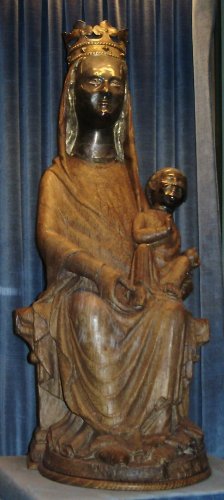
This "Gnadenbild" (image of grace) originally stood in the Neustädter Marienkirche (Mary Church), which was run by a 'chapter of 12 canons', i.e. a community of priests who governed the secular and religious affairs of the diocese. After the Reformation seven of them became Lutheran and five remained Catholic. In a rare experiment of religious tolerance following the "Thirty Years War", they decided in 1672 to continue to lead the diocese together and to worship in the same house of God. Apparently this worked more or less for a while, but in 1715 a "Mary chapel" was added to the church in order to serve as a separate space for the Catholic canons and house the Black Madonna . And so the image of grace stood for a hundred years in the Catholic section of the Lutheran-Catholic Mary Church.
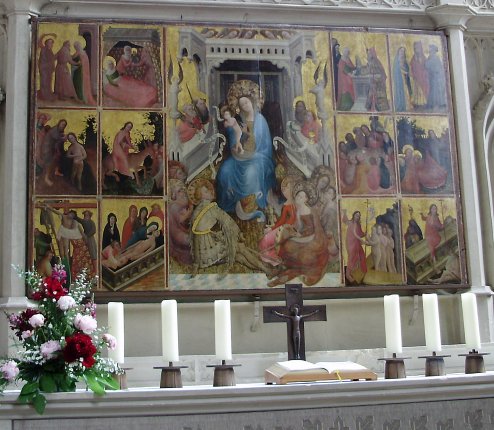
| In 1818 the chapter of canons and their interfaith arrangement was dissolved. The Mary Church became one hundred percent Lutheran and the Catholics moved their Black Madonna to the church of the Franciscans, the Jodokus Church, just a few blocks away. But the spirit of Mary still blows unusually strong in the Lutheran church bearing her name. She is very present in the big Mary-altar' and her 'Mary chapel' is designated as a space of silent prayer. An otherwise very academically sounding booklet about the history of the church, which is sold in the entrance, ends with a Hail Mary!(1) On the altar stands a curcifix. None of this is normal for a Lutheran church, but usually deemed Catholic. |
 |
So while the Bielefelder Lutherans are somewhat "Catholic",
the Catholics seem to have strived to be more Protestant. They have struggled
a bit with their devotion to the Mother of God, which many, even Catholics,
perceive as old fashioned superstition. In 1912, apparently in an attempt
to end the adoration of the Black Madonna, she was moved to the diocesan
museum. Yet in 1954, one man by the name of Heinrich Sunder managed to
bring her back into her previous home in the Jodokus Church. By now (2009)
she is once more the place most faithful come to when they need consolation.
No image in Bielefeld is honored with more flowers and candles and witnesses
more tears being shed before it.
__________________________________
*1: Joachim Wibbing, Neustädter Marienkirche Bielefeld,
DKV-Kunstführer Nr. 282/3, 3rd edition, Deutscher Kunstverlag, München,
pp. 2-4, 13-15 + 18.