Chatillon-sur-Seine:
Our Lady of All Graces,
Our Lady of St. Bernard,
Our Lady of the Castle.
In the church Saint Vorles. Chatillion-sur-Seine is 45 minutes NW of Dijon, Côte d'Or department, Burgundy region, replacement for 12th century original that was burnt in the 18th century, 78 cm.
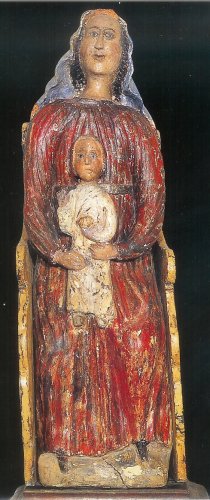
Although neither town, nor church, nor statue are beautiful, this plain, formerly Black Madonna became one of the most influential ones in Europe.
|
It all started with the famous "lactation miracle" of which there are several renditions. Here is one: When St. Bernard of Clairveaux (1090-1153) was still a sickly boy in cloister school, he suffered one day from a dangerous infection. Seeking relief, he went to pray before the Black Madonna. He was reciting the prayer 'Hail Star of the Sea' and when he came to the part: "Show yourself a mother!" the image suddenly came alive and squeezing her breast, let three drops of milk fall onto his lips. Not only was he instantly healed, body and soul, but his heart was enflamed with such love for the divine Mother that soon he would enkindle a burning devotion to her all over Europe. He expressed his experience with an inspired theology that earned him the title 'Marian doctor of the Church.' During one famous sermon he called Mary our 'Aqueduct Of Divine Grace' saying: "This stream [Christ] from the heavenly source [God the Father] descends to us through an aqueduct [Mary]; … The aqueduct itself is always full, so that all may receive of its fullness, yet not the fullness itself. … an Aqueduct which, receiving the fullness of the Fountain from the Father's heart, has transmitted it to us, if not as it is in itself, at least in so far as we could contain it."(1) |
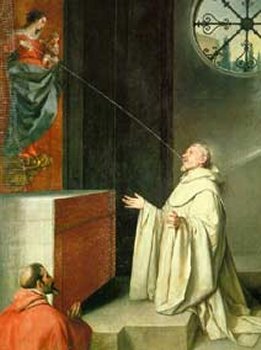 Alfonso Cano, the Vision of St. Bernard, 1650 |
Presently people say, while receiving milk from the heavenly Mother,
Saint Bernard was initiated into supreme consciousness and adopted as
the son of God and Mary. The more medieval wording was that Mary filled
him with all divine graces and purified all his sins. Hence her title
"Our Lady of All Graces".
As the fame of Saint Bernard spread and his theology justified great Marian
devotion, Christians all over Europe started dreaming about being suckled
by the virgin-mother for the salvation of their souls. Maybe they tapped
into an ancient urge and experience of being nurtured at the breasts of
a heavenly mother. Since pre-historic times the divine was portrayed as
a woman offering her breasts to all God's children.
|
|
|
|
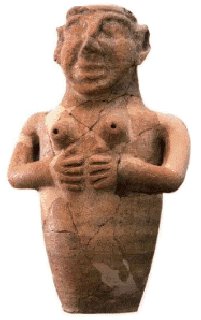
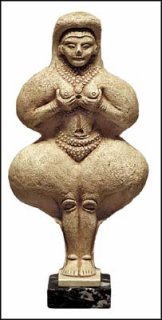
Middle: Ishtar/Innana the Middle-Eastern goddess venerated since the 3rd millennium B.C. She is often mentioned in the Bible. Her titles include: Mother of the Fruitful Breast, Queen of Heaven, Light of the World, Creator of People, Mother of the Gods, River of Life.
Right: The 'Virgin of the Milk' by Pedro Machuca, Spain, 1517 A.D. Mary and Jesus squeeze her breasts for the salvation of many; some milk spills onto her dress and souls in purgatory hope it'll trickle down to them.
Christians honored Mary's mother's milk from the first century on. They held as sacred a white powder that was scraped from the walls of the shelter in Bethlehem where Jesus presumably was born. Later that white powder from the stable of the nativity was thought to be Mary's dried milk. Three "drops of this milk" eventually made it into a medallion that emperor Charlemagne (742-814) used to carry into battle.(2)
After Bernard's 'lactation miracle' and with the help of his theology,
Mary's milk started flowing all over Europe. After all the saint had prophesied:
"we approach the altar of God and pray, and, if we persevere, despite
our own dryness and tepidity, grace will overpower us, our bosom will
swell, love will fill our hearts…and the milk of sweetness will overflow
everywhere in a torrent."(3)
Most of the important Marian shrines eventually claimed to possess vials
containing a few drops of the Virgin's milk. (The reformer John Calvin
mocked that even a milk cow or a wet nurse couldn't have produced as much
milk as the Holy Virgin!) A new type of Madonna appeared in many churches
and chapels: Maria lactans or virgo lactans, the nursing
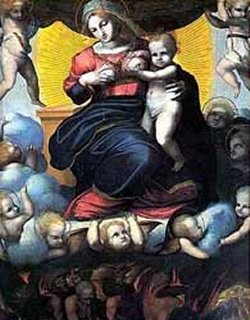
virgin bearing her breast. Paintings showed her not only squirting milk
at Saint Bernard but her motherly love overflowing so abundantly that
even the thirst of ordinary Christians and souls in purgatory was quenched.
Jesus got the milk of graces flowing, but now it flowed for all.
Modern thinkers criticize that the very idea of a holy virgin-mother constitutes an attack on a healthy, natural relationship to the human body and sexuality. Yet here we see examples of great comfort with the human body and a wonderful way to use sexual impulses in a transformative way (like tantra). Saint Bernard's great appreciation of sexual imagery in the service of enlightenment and divine union is further apparent in his almost exclusive predilection for the Song of Songs, this erotic love poem in the Bible.
|
Over time however, the barrier between the Most Holy Virgin and
ordinary sexual desire became thinner and thinner and the Church
more and more uncomfortable with all those big, round, supposedly
lactating breasts. The breaking point was reached in the fifteenth
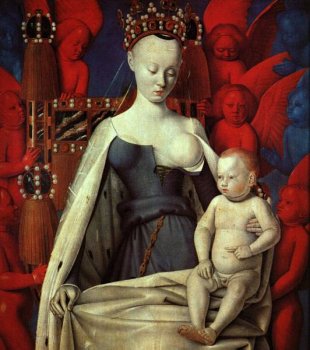
century when King Charles VII of France commissioned a painting
of his mistress as the Virgin with Child. Baby Jesus looks uninterested,
even discontent with the breast he knows to be dedicated to the
French rather than the Heavenly King. The painting caused enough
of a scandal that the Church began to dissuade images of bare breasted
or lactating Madonnas and so they became rare. |
 |
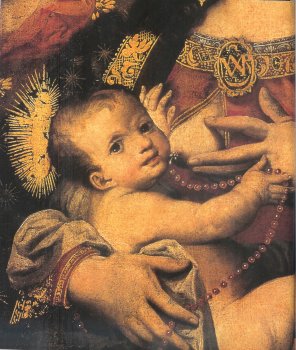
| Rome of course, is far away from many parishes who are not so concerned about Papal wishes. And so many artists still happily portrayed lactating Madonnas. Here is a particularly beautiful one whose milk is transformed into rosary beads. (Detail on the right.) What a wonderful contemplation to think you are being nourished with divine mother's milk when you pray the rosary! According to the artist, each Hail Mary contains a drop of Mary's saving milk. | 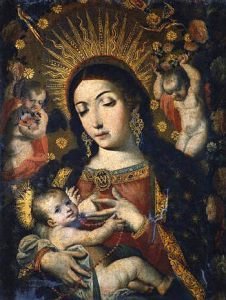 'The Virgin of Belén' by Bolivian painter Melchor Pérez de Holguín early 18th century. |
 |
|
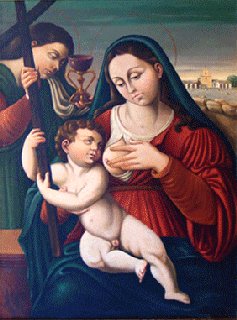
Here is a modern painting from 2004 by the Spanish artist Vicente
Valls. It hangs in the church St. Michael the Archangel in Burjassot,
Spain. It seems to draw a parallel between on the one hand the sacred
blood of Christ, which flows from the chalice and sanctifies the
disciples of Jesus, forming their halos, and on the other hand the
milk of Mary poured out not just for Jesus but for all. - This may
all seem very strange and improper, even disgusting to American
Puritan sensibilities, but it really is no less weird and no less
spiritual than meditating that one is "washed in the blood
of Christ" or eats the body of Christ. It's all about union, union with God in body and spirit.
|
 |
According to Ean Begg Our Lady of Saint Bernard was hidden during the Revolution, but others say she was burnt and replaced. Either way, many miracles have been attributed to this very special Madonna in all her incarnations.
*1: St. Bernard of Clairvaux, Sermon For the Feast of the Nativity of the Blessed Virgin Mary (also called On the Aqueduct Of Divine Grace). In: Sermons for the seasons and principal festivals of the year, volume 3, The Carroll Press, Westminster, MD 1950, p. 284ff.
*2: Marie-France Boyer, The Cult of the Virgin: Offerings, Ornaments and Festivals, Thames & Hudson, London: 2000, pp.26-30
*3: Quoted in on line article of the National Museums Liverpool: ‘Rest on the Flight into Egypt’ Here's the URL, but you're better off googleing it. http://www.liverpoolmuseums.org.uk/picture-of-month/displayPicture.asp?id=173&venue=2
*4: E.g. in Rho, Italy a painting cried tears of blood in 1583, in La Salette, France an apparition cried tears in 1846, in Syracuse, Sicily a statue cried tears in 1953, in Akita Japan a statue cried tears in 1973, in Naju, South Korea a statue cried tears of blood in 1985, in Cuenca Ecuador a statue cried tears in 1988. For many more examples in modern times visit: www.crystalinks.com/weepingstatues.html
*5: Op cit. www.liverpoolmuseums.org.uk