Cusset:
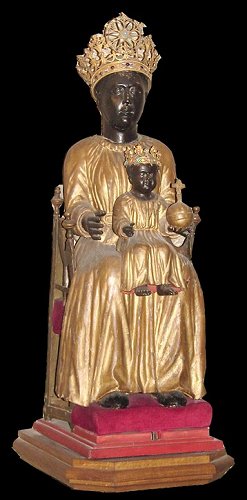
the Black Virgin of Cusset
Department Allier, region Auvergne, in the parish church of Saint Saturnin in the town square, open daily 8a.m. to 6 p.m., 10th century, 70 cm, painted wood. (Only 3.5 km from the Black Madonna of Vichy, which is in the church of St. Blaise near the main park.)
|
The original Black Madonna of Cusset was found in the 10th century next to a spring of the local Benedictine nunnery that had been founded in 882. According to Ean Begg, someone decided that the statue should be taken to a town called Gannat, but when she came to Cusset, as so often, the Black Madonna made her own will known and refused to go any further. When no one could move her, people conceded and built her a church in Cusset. Her fame as a miracle worker spread quickly. Even kings came to her on pilgrimage, bearing royal gifts. In1629 she stopped the plague in her town. Nonetheless none of that could save her from the revolutionaries.
During the night of December 5th 1793 she was burnt on a public
funeral pyre. A courageous woman by name of Geneviève Tuchard,
the baker’s wife, could only save her hands from the ashes.(*1)
They are kept to this day in the church’s treasury. They were
dated to the 10th century, not 12th or 13th as Begg and others say.
Interestingly they are adorned with bracelets inset with precious
stones and a Roman symbol representing Athena-Minerva.(*2) Until the early 20th century
Our Lady of Cusset was carried in processions during times of general
emergencies, like droughts, etc. |
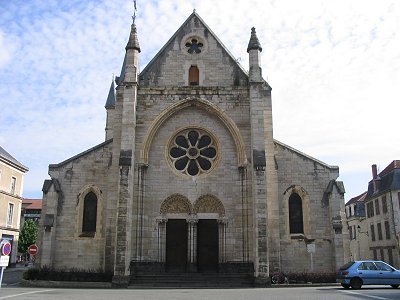 St
. Saturnin St
. Saturnin |
*1: Ean Begg says the head was also saved (The Cult of the Black Virgin, Penguin Books, London: 1985, p.184), but several French government sites only mention the hands. “Eglise de Saint Saturnin” and "Fragment de statue : mains de la Vierge noire à Cusset"
*2: Details and photo of Black Madonna from: “Saint-Saturnin de Cusset”