|
Foggia: Most Holy Mary Crowned One of the
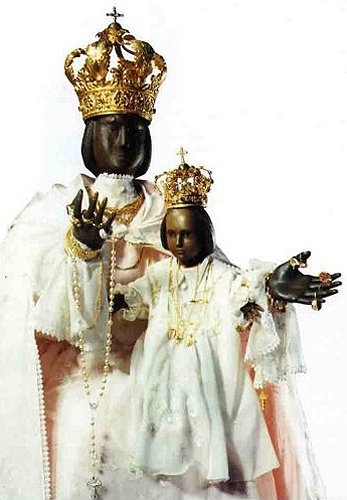
Poor In her sanctuary12 km outside of the city, in the region Puglia/Apulia, at least 11th century if not much older, natural wood. |
 |
There are at least two versions of the legend of the Crowned Virgin of
the Poor. Both are made available in print at the sanctuary.
One recounts that on the last Saturday of April in the year1001, the Count
of Ariano Irpino, after a day of hunting, spent the night in a rustic
cabin in the woods near the creek Cervaro. At dawn he was suddenly awakened
by his servants and fellow hunters urging him to flee with them. The men
were terrified by strange flashes of light in the woods, almost like a
fire. The Count got up, but though he was also scared, he did not flee
with his friends. Instead he was drawn to the strange phenomenon, and
cautiously went to the place where the flashes came from. Once he got
close, Count Ariano realized with amazement that there were no open flames,
but only a strange light. Then he noticed in the midst of it a superhumanly
beautiful Lady, shining with heavenly light.(*1)
The other version recounts that the same nobleman on the same hunting excursion was stalking a deer until he found it prostrating itself before a great Oak tree. The tree became luminous as if on fire in the midst of which Our Lady appeared.(*2)
Both accounts agree that Most Holy Mary told the frightened and awed Count: "Do not be afraid, I am the Mother of God." Then, pointing to a big oak, she showed him a statue of a brown Madonna sitting on a throne in the tree. The Mother of God said: "I want you to erect a shrine in my honor in this place, without gold or precious ornaments. I will make it famous through the many graces that the devotees will receive who will honor me here with a sincere and filial heart."
At that moment Count Ariano noticed a farmer, a certain Nicholas, nicknamed Strazzacappa, which means torn cape, a reference to his poverty. The peasant had been on his way to work in the fields with his ox when the animal went to prostrate itself before the apparition in the tree. Thus led by his beast, Strazzacappa came to witness the apparition and the words of the beautiful Lady.
When the splendid Lady and the bright flashes disappeared, the Count and the peasant, filled with divine love, hugged each other. This was unthinkable behavior under normal circumstances, yet at that moment they were united in the same happiness and in the one quest of building a chapel according to their Mother's wishes as soon as possible.
Clearly, the Madonna was sending a message of solidarity with the poor and social equality, first by insisting that her sanctuary be free of gold and precious stones and secondly by binding together in brotherly love a nobleman and a peasant. Hence her title 'Mary of the Poor'.
The 2001 brochure of the sanctuary recounts that once the apparition had disappeared, the two men witnessed not only two (as the other version has it) but scores of angels and saints crowning the enthroned dark Madonna statue. And so the statue remained as the physical presence of the Queen of Heaven. She was crowned "not by a cardinal, bishop or pope as is usual," says the church brochure, but by Heaven itself. (This is a recurring theme in Black Madonna legends. See e.g. Einsiedeln, Switzerland and Le-Puy, France. Feminists love it when the Madonna proves herself independent of patriarchal structures.)
News of the miraculous event spread like wildfire and the faithful came by the thousands from all around to see, to honor, and to pray to their Heavenly Mother. Now the miracles in the woods of the Crowned Madonna began to flow, as she had promised. The peasant had made a makeshift oil lamp from a copper pot (la caldarella, literally 'cauldron') and had hung it on the tree as an offering of light to the Virgin. The Mother of God sanctified this oil. It did not run out for many years even though countless pilgrims anointed themselves with it and obtained physical and spiritual healings. To this day pilgrims bring oil for the Madonna to bless in her cauldron.
Soon a church was built in the place of the apparition at the oak tree which held the statue of Mary among its dense branches. To this day one last piece of the sacred wood (sacra legna) remains in the crypt under the altar.(*3)
The ceaseless rush of the faithful called for someone to take custody
and care of the chapel. At first, some hermits volunteered to fill the
role. Later the monks of the order of St. Basil moved in and built up
the premises in order to accommodate the monks and pilgrims. Unfortunately,
for political reasons, the monks were forced to abandon the place in 1140.
It was left without care and custody until another religious community
was found, who settled there and again expanded the Church and the monastery.
This community then merged with the Cistercian order, which took as good
care of the sanctuary as it could but didn't have anywhere near enough
money to spend on it, especially after a terrible earthquake devastated
the area in the 18th century.
|
In 1929 the Italian government and the Catholic Church collaborated to take the sanctuary out of the hands of the order, give it to the Church as a whole, and secure funds for a major modernization. In 1950 the new basilica, a seminary, a center of spirituality and ample space for pilgrims was built. Over the centuries a long list of saints and distinguished visitors have come here as pilgrims, including St. Francis of Assisi, St. Thomas Aquinas, St. Francis of Paola, St. Anthony of Padua, St. Vincenzo Ferreri, San Bernardino of Siena, St. Alphonsus and St. Gerard. The Crowned Black Madonna however, is still the sanctuary of poor people: shepherds and peasants. |
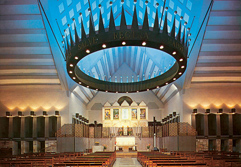 Though the architecture of the sanctuary is thoroughly modern Mary Beth Moser finds that it feels ancient. |
Don Mario Morra suggests that perhaps the statue had been hidden in her tree by devout believers in order to evade destruction during the iconoclastic struggles of the 8th century, an internal Christian clash over the use of images.(*4) But Mary Beth Moser brings forth evidence that the image may actually be a much older representation of the goddess Juno (or Hera as she was known by the Greeks).(*5) Christians certainly destroyed many Pagan images as they sought to convert their world. So it is quite possible that some of the most ancient Black Madonnas found in trees, caves, and in the earth were actually Pagan goddesses that had been hidden from Christians. Here are some clues that point in this direction in Foggia:
|
1. The Child Jesus in the Madonna's lap is a very
recent addition. It was placed there by Pope John Paul II in 1987.
Before that it was considered missing (disperso), but it may never
have been there. Holy cards as old as the 19th century portray the
original Black Madonna alone, without the baby. If Baby Jesus indeed
belonged with this statue and was lost, why would it take more than
a hundred years to replace him? An interesting old painting hangs
in the Chapel of the Apparition in the crypt below the altar. It
portrays the Mother as dark and the child as white. Christian art
tells sacred stories to those who can't read and to those who have
no written record of long ago events. We are in the latter category
and the story the images tell us is that a white Mother of God descended
from Heaven in order to reveal to us a dark Mother on Earth. The
white one left her baby, Jesus Christ, with the dark one. |
|
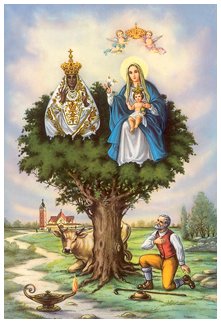
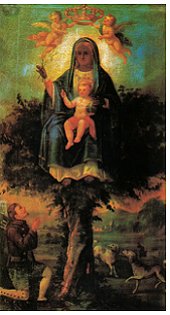
| If the dark Mother was enthroned alone, she was probably a Greco-Roman goddess, like Hera (on the right). Mary the Mother of Christ, when shown enthroned, was never portrayed without Jesus either on her lap or next to her. It seems to me that by placing a white baby Jesus in the lap of the dark mother, the Queen of Heaven christened the ancient Earth Goddess, uniting heaven and earth, Christianity and its predecessors. | 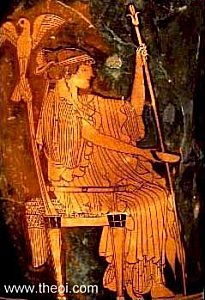 |
|
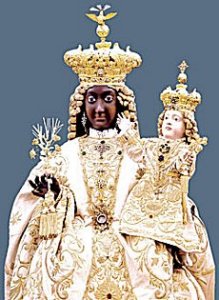
Some other Black Madonnas in Italy are portrayed with a white baby Jesus, e.g. the Madonna del Soccorso in the city San Severo, also in the province of Foggia (on the right). As the protector of the fields and crops she holds a bouquet of olives, grapes, and wheat. It seems to me that these images stress that Jesus came from a different place than Mary, maybe even from a different religion. He came from heaven; she came from the earth - and yet they now belong together, like yin and yang. 2. Other elements that point to a connection with the old earth goddesses are the Madonna's association with animals and sacred trees, such as the ox or the deer that help humans discover her, and the remains of the oak tree that are still preserved in the basilica. Pagan deities were often worshipped in sacred groves and forests and accompanied by sacred animals. The sanctuary of the Black Madonna at Capo Colonne in Crotone was built on the grounds of a temple to Hera, which was surrounded by sacred cattle and woods. |
 |
3. Another tradition this Black Madonna shares with her pre-Christian sisters is the ritual of being dressed in precious robes. L'Incoronata's robes are replaced once a year by pious women, a distant echo of goddess-priestesses.
4. One of the more sticky links of the Madonna to Pagan goddesses is the practice of blood sacrifice. Until the present, modern basilica was built, some of Mary's devotees performed 'tongue dragging'. I.e. if they were determined to purify a grave sin or negative karma, or if they were just asking for a big favor, they would drag their tongue along the ground into the church and down the aisle all the way to the statue, which they then kissed. A trail of blood would be left by this form of penance. - Not a pretty thought, but how transformative this ritual must be! To what degree must the ego and the rational mind be humbled to do something this crazy!
____________________________________________________________________
*1 Giovanni D'Onorio De Meo, L'Incoronata di Foggia, Edizioni
Santuario dell'Incoronata, Foggia 1975.
* 2 An April 1001 brochure of the sanctuary quoted
in Mary Beth Moser, "Longing for Darkness: Exploring the Power of the
Black Madonnas in Italy" Dea Madre Publishing: Vashon Island, 2005, p.89
*3 Just like in Halle, Belgium, the Church still holds on to its ancient
roots of nature worship, buried in the bowels of its crypts.
*4 Don Mario Morra, in an internet article on Maria Santissima Incoronata:
Signora di Sovrumana Bellezza (A Lady of Superhuman Beauty), in Rivista
Maria Ausiliatrice, 2004-4, on the website of the Salesian Brothers of
Italy: www.donbosco-torino.it
*5 Mary Beth Moser, op. cit. pp.90-94