Luxembourg-City:
In French: Black Virgin
(Vierge Noire),
in German and Luxembourgish: Black Emergency-Mother-of-God (Schwarze
Notmuttergottes / Schwaerz Noutmuttergootes)
(All three languages are spoken in that country.)
In a side chapel of the church St Jean
du Grund, Rue Sosthène Weis. Grund is a part of town. Around
1360, painted walnut wood, 1,20 cm
photos: Zwick Manuel
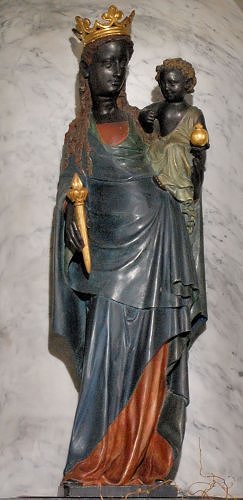
| As most Black Madonnas so this one too is deemed to be a miracle
working ‘image of grace’. Most people agree that she must
have been sculpted around 1360 by a member of the Cologne school of
sculpting. However, there are no documents proving this and so some
medieval chronicle claims that she was brought to Luxembourg from
the Middle East during the crusades, which supposedly is why she was
also known as the Egyptian Mother of God. Her titles have changed
several times in the course of the centuries. First she was simply
called Mother of God and Star of the Heavens. After the 30 Years War
she was invoked as the Queen of Peace. After patina and candle soot
had further blackened the already dark wood and the plague had struck,
she was worshiped as the Black Emergency-Mother-of-God (schwarze Notmuttergottes)
charged with protecting her children from the Black Death. Since the
faithful appreciate her darkness her skin was painted black in later
renovations.(*1) This Emergency Mother used to be housed in a nearby Franciscan monastery, but with the French revolution the community was outlawed and their buildings eventually destroyed. What is left of them is an open place downtown, nicknamed the “Knuedler”, after the knot on the Franciscans’ belt. For a while the Black Madonna was hidden from the revolutionaries in the convent Marienthal, a rich and influential nunnery during the Middle Ages, where the highest aristocracy had been educated. In 1805 the image of grace could be brought out into the open again and was housed in the parish church Saint-Jean-du-Grund. Since then she has been venerated especially during lent. With pilgrimages on each Friday of lent the faithful commemorate the sorrows of Mary and ask her for solace in their own sorrows.(*2) |
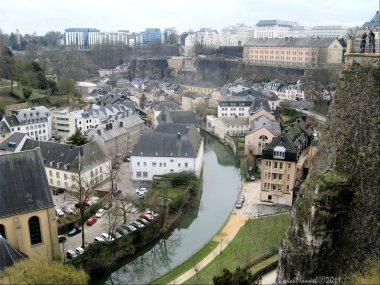 view of the church of the Black Madonna, bottom left |
_______________________________________________________________________________
*1: See Anne Schmit’s article in the online magazine “Telecran”:
“Warum
die Notmuttergottes schwarz ist”
*2: Information taken from “L’histoire
de la Ville de Luxembourg à la lumière des timbres-poste”
and other websites.