Madrid:
Our Lady of Atocha, Patron
of the Royal House of Spain,
Custodian of the Dominicans
In her church Royal Basilica Nuestra Señora de Atocha at Julián Gayarre 1, 28014 Madrid, 7th century? 25 inches, wood..
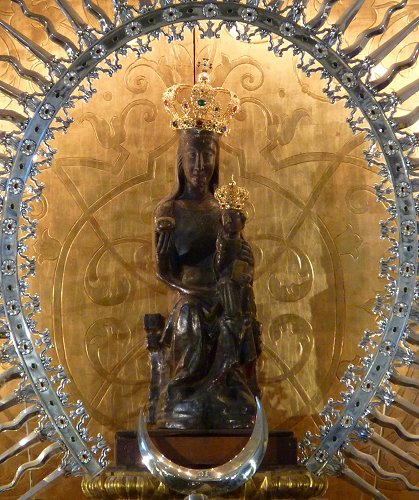
Ean Begg dates her to the 12th century, but the Spaniards say the earliest
written record of her is from the 7th century and that she is the oldest
statue in Madrid.(*1) In her right hand she holds
an apple out to the world. This marks her as the New Eve, obedient, but
still desirous of the fruit of wisdom. Jesus is the New Adam, and through
both of them the fruit of the tree of knowledge is freely given to all
who ask for it with a pure heart.
Jesus’ right hand is raised in blessing. The Dominican website of
the Basilica explains the meaning of her seat of wisdom position thus:
“it wants to confirm her teaching authority over the Church since
the death of her divine Son.”(*2) Hmmm…
I wish the Church submitted to her teaching authority more often!
Madridpedia.com and Begg explain Atocha as the name of a plant under which the statue was found. Spanish Wikipedia sees it as the corrupted Spanish pronunciation of the Greek Theotoca, i.e. Mother of God.(*3)
The legend of this Black Madonna says that she was sculpted by Luke the Evangelist and that the apostles Peter and James brought her to Spain. When their paths split and St. James went to Zaragoza, St. Peter brought the Lady to Madrid (which was called Mantua at the time.) Roughly six centuries later she disappeared during the Muslim occupation. One day the nobleman Don Gracián Ramirez de Vargas came to her church to pray before her, but found her gone. Disturbed, he organized a search party on the hill of St. Blaise and she was found in a thick tuft of a plant called atocha. Don Gracián decided to build her a fortified church in the spot where he had found her. As he and other Christian volunteers were still working on the building a great contingent of Muslims fighters appeared. Taking the construction for a fort, they got ready to attack. It didn’t seem like the Christians had a chance. Nonetheless the Don’s wife and daughters begged him to defend Our Lady to the last and promised to do the same. But as they prepared before the Black Madonna to sacrifice themselves to the enemy, Gracián couldn’t take the thought of strangers having their way with his women folk. Figuring that it was better for them to die at his hands than at the hands of a cruel enemy, who might enslave or kill them, he stabbed them all in the neck. Then he went into battle and surprisingly, beat the Muslim attackers. When he returned home and went before Our Lady in order to give her thanks for the victory and to ask pardon for his rash deeds, lo and behold the divine Mother had restored the women back to life!
Since 1523 the hermitage has been a Dominican monastery. Later the present
day basilica was built in place of Don Gracián’s hermitage.
This Black Madonna’s feast day is celebrated on the 1st Sunday of
October with a procession.
_____________________________________________________________________
*1: Ean Begg, The Cult of the Black Virgin, Arkana: 1985,
p. 256 and Madridpedia article: La
Virgen de Atocha, la talla más antigua de Madrid
*2: Basílica-Parroquia Nuestra Señora de Atocha, Historia
de la Basílica: La
imagen de la Virgen de Atocha
*3: Virgen
de Atocha