Magdeburg:
The miracle working Black Madonna
(Die wundertätige schwarze Madonna)
In the cathedral of Magdeburg, the capital of the state
Sachsen-Anhalt, about 2 meters, around 1280, painted wood.
photo: Ella Rozett
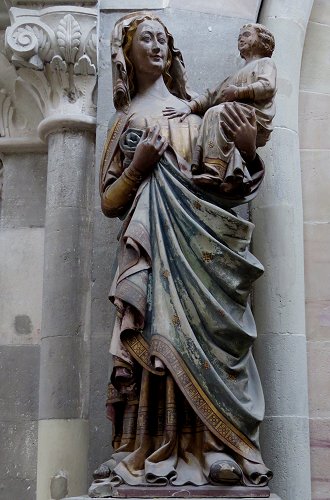
The cathedral of Magdeburg is a very important building in Church history. It was founded originally as a Benedictine abbey in 937 by Otto the Great (912 – 973), who was crowned the first emperor of the Holy Roman Empire in 962. He and his first wife are buried in the cathedral. Under his reign, Magdeburg blossomed into “a third Rome”. After a devastating fire in 1207, the cathedral was completely rebuilt and remodeled. This is when it became the oldest gothic building on German soil.
While much can be read about the cathedral, none of the guide books say more than one sentence about the miracle working Black Madonna: “She was greatly revered in the Middle Ages.” (*1) Why doesn’t anybody care to remember her history and miracles? Because the church became Protestant in 1567 and Lutheran theology is neither interested in Black Madonnas nor in any other miracle working statues. It calls such things idolatry and superstition. Much later, in the 20th century, 50 years of totalitarian, anti-religious regimes (first the Nazis then the Communists) would have wiped out any remaining memories of the history of this Dark Mother. - Not that she is that dark anymore. She must have been cleaned up at some point, but her hands still show that she was darker at one point and the main thing is: she still retains her title and reputation! No other statue in the whole, big church has candles burning before it, only the miracle working Black Madonna. It’s amazing that people held on to this much!
|
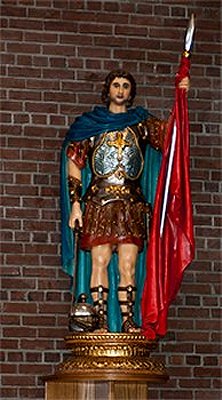
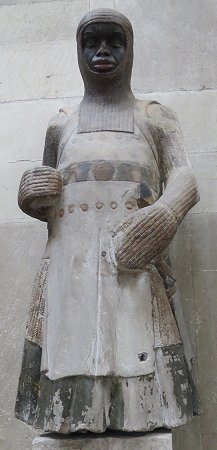
With Maurice being Egyptian, he could have been portrayed as much more light skinned, like this statue in Ottawa, Canada. But the German statue from around 1250, a time of blossoming of Black Madonnas, exaggerates Maurice’s black African features. As I’ve said in the introduction, Black Madonnas were often regarded as defenders of Christians in battle, especially (since the crusades began in 1096) battles against Muslim forces. To the Central European mind all Muslims were very black and exotic and one wanted someone who looked like them and knew them to help fight against them. St. Maurice and Black Madonnas seemed to qualify. I doubt that Otto the Great, who lived before the Crusades against
Muslims cared much about St. Maurice’s African heritage. He
just needed a soldier-saint to make him feel like one could kill
thousands in battle and still go to Heaven. Otto led his own kind
of crusade against the Pagans to the East, especially the Slavic
peoples. He converted them by the sword, just like the Muslims were
doing it in other parts of the world. |
|
|
|
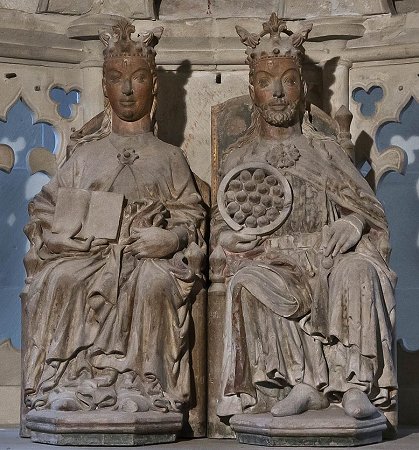
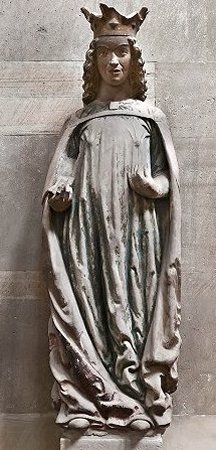
A little more peaceful Black Madonna theme that echoes in this church is the empowerment of the feminine. Besides St. Maurice, the cathedral is also dedicated to a female saint, Catherine of Alexandria. Both stand at equal distance from the emperor’s grave and are looking each other in the face with great openness and friendliness. Medieval legends describe Catherine as a 4th century princess with superb knowledge of all the sciences, arts, and philosophy. When she became a Christian and took on the emperor, it literally cost her her head, but she converted hundreds in the process.(*3) Throughout the Middle Ages, she held the place of a fully emancipated woman in the midst of a very patriarchal Church. (Joan of Arc was led by visions of Catherine of Alexandria.) The cathedral also houses a round memorial chapel to the emperor and his first wife, the pious Edith, who died too young. According to the guide book, this woman made a great impression on the imperial court and the people, an impression that lasted for centuries.(*4) I guess they say that, because this memorial chapel was built around 1250, centuries after her death and honors her instead of the emperor’s second wife. My guess is that the Church preferred her as a role model, because she was pious and kept out of politics, whereas Otto’s second wife Adelheid was very involved in the political affairs of her husband.(*5) Still, I like how the artist incorporated the spirit of both wives into this memorial. The couple is portrayed inside this round, feminine shape and as happy equals, with bodies and crowns of equal size, him leaning slightly towards her in a very relaxed and comfortable manner. |
|
| Here’s yet another powerful feminine image to be found in the cathedral: a type called "Anna selbdritt" (Anne threesome) in German and "Anne trinitaire" (Trinitarian Anne) in French. It depicts baby Jesus with his mother Mary and his grandmother Anne. When people ask me: “Where is the grandmother in Christianuty?” I tell them about this feminine version of the trinity, a gassroot invention of the faithful, that appeared in the 13th century and held out for several hundred years. | 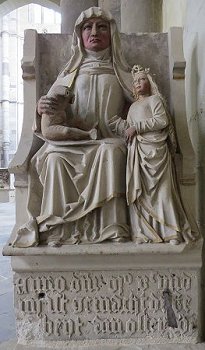 a stern German grandmother, |
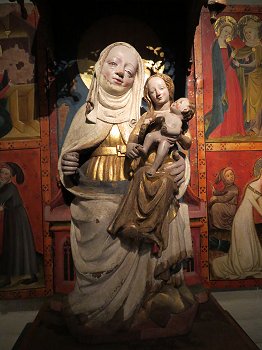 two much sweeter Swedish versions of the same type, both in the Stockholm Nationalmuseum |
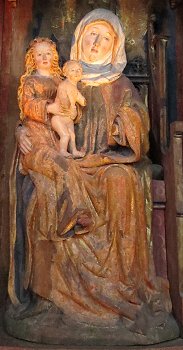 photos: Ella Rozett |
________________________________________________________
*1: Michael Sußmann, Der Dom zu Magdeburg,
Kunstverlag Peda, Passau: 2002, p.71
*2: Ibid., p. 12
*3: http://en.wikipedia.org/wiki/Catherine_of_Alexandria
*4: Ibid., p. 13
*5: Ibid. p.12