Maillen:
the Black Virgin
(La Vierge Noire)
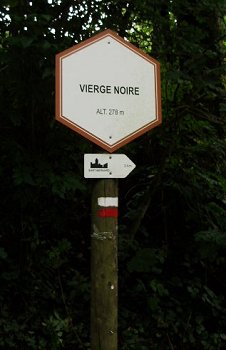
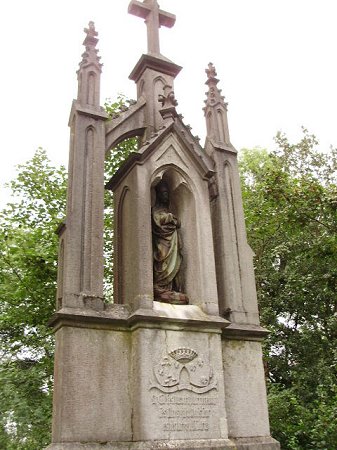
In the forest on the road between Maillen and Lustin. A few minutes from Courrière, about 15 km from Namur, on the Rue de Rendarche. There is a sign on either side of the street; one says “vierge noire” and on the other “Chateau d’Arche”. 1879, life size, bronze. Photos: Ella Rozett
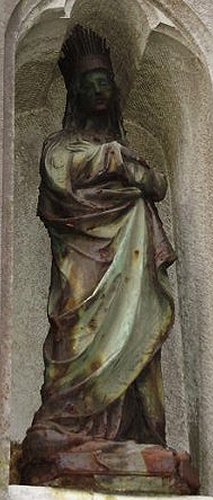
This shrine was erected in 1879 by the aristocrat who lived in the estate across the street from it: the Baron de Woelmont, whose coat of arms we find under the Madonna. When his wife lay deathly ill, he prayed to Mary and promised to build her a chapel if she but saved the baroness. She did, and he had her shrine constructed close to his home, but far away enough so that the villagers could gather there without bothering him or vice versa. It sits in the woods on a knoll above an ancient Roman road, on which one can still hike to the next village. The inscription under the coat of arms says: "Le ciel est ouvert pour recevoir les âmes qui ont mis leur esperence en Marie.” (i.e. Heaven is open to receive the souls, who put their hope in Mary.) I don’t think it is a coincidence that on the same day in 2012, on which I visited the Black Madonna of nearby Walcourt, I also visited the Black Madonna of Maillen and had a very similar experience. In both cases educated men claimed to know that these Virgins aren’t actually “black Madonnas” while the people claim that they are. Here the sign on the road clearly points to the “Black Virgin” in the woods, all the people of the village have known her as such for generations, but the “better educated” gentleman in the manor house next door claims she is not a Black Virgin, that she merely looks black because the metal she is made of oxidized. Well, the whole phenomenon of Black Madonnas didn’t spring from educated minds, but from the needs of the common people of a powerful dark Mother. The people never asked: “Was she black from the beginning?” On the contrary, they often talk about how she turned black in a fire or by other means, theologically speaking, by taking on the sins of her children. Their question is: “Does she have power to help us?” |
 |
 |
Notre-Dame de Foy
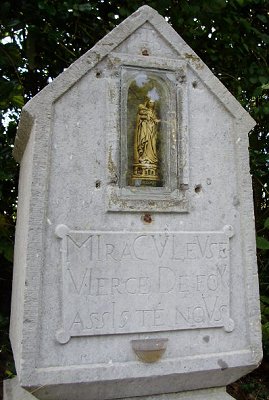
To the right of the manor house is a little way side shrine to “Our
miraculous Lady of Foy” as the inscription says. It refers to an
interesting Madonna only 20 km away in her village Foy-Notre-Dame. Some
also think of this Madonna as black. She was discovered on 7/6/1609 inside
an ancient oak tree that had been cut down. She was cast in a mold, probably
around the year 1400 in Uetrecht, Netherlands, then placed in a hollow
in the oak tree, which eventually grew around her, hiding her completely
from view.
Once the rediscovered statuette was washed and repaired, she was placed
in another oak next to her former home tree. There she led a quiet existence
for nine years, until the first miracle was attributed to her in 1616.
Two years later the first little chapel was built for her, which later
gradually became one of the most beautiful Baroque churches of Belgium,
sporting paintings of students of Rubens.
By 1627 more than 200 miracles had been recorded. Many copies of this
(black?) Madonna were carved out of the two trees that had housed her.
Especially the Jesuits ended up bringing these copies as gifts to all
corners of the world. And so Our Lady of Foy became quite famous. She
was canonically crowned by the bishop of Namur, in the name of Pope Pius
X, in 1909. Her feast day is September 8th, the birthday of Mary. *
|
|
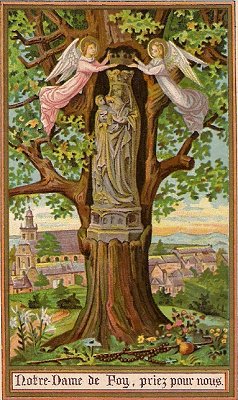 a picture telling the story |
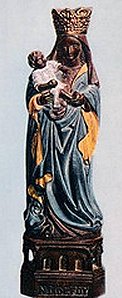 a copy portraying Our Lady of Foy as black |
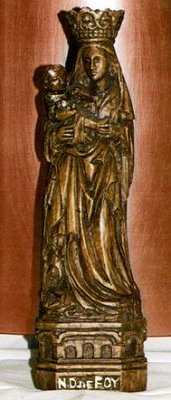 the original |
| The 12th century fortified manor house Chateau Ferme d'Arche, sits on Celtic remains, a Roman road is still its driveway. No wonder, perhaps, its owner, Henri Lechien, is a little arrogant. He's also very friendly and rents his place for weddings, seminars, etc. Visit their website: chateaufermedarche | 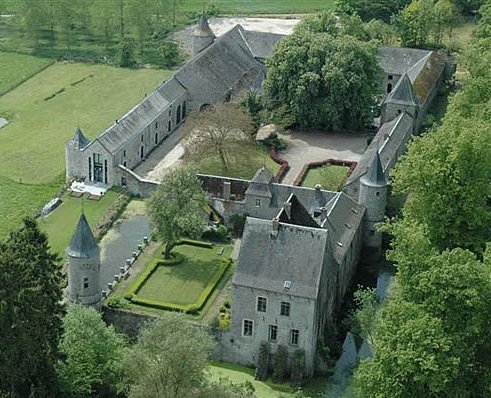 |
* Information taken from https://sites.google.com/a/pelefoy.be/sitepublic/un-peu-d-histoire-