Neukirchen-beim-Heiligen-Blut:
Our Dear Lady
In the church of this little village in the Bavarian Forest, 30 km East of Cham, near the Czech border, c. 1400, 78 cm, painted wood.
photos: Dr. Johannes Steiner: Our Lady the way she is usually robed and without her regalia.
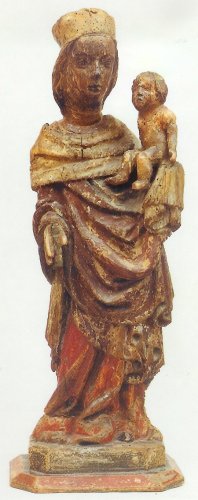
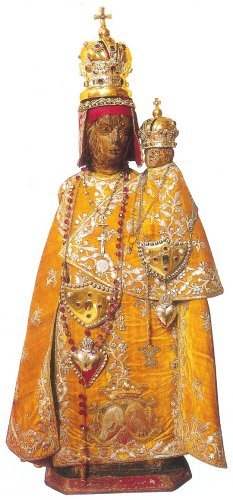
The story of Neukirchen-at-the-Holy-Blood begins with a sacred host (the
consecrated bread become body of Christ) found around the year 1400 on
a tree stump in Bohemia (now part of the Czech Republic).(*1)
A chapel was erected to house the host and it was given this Madonna for
company. A Bohemian artist seems to have sculpted her for the occasion.
I don't think he conceived her to be a Black Madonna, but since she is
very miraculous and darkened over time, she has earned the title and now
the people certainly perceive her as black.
Shortly after the chapel for the miraculous host was built, Jan Hus,
a Czech national hero, appeared on the stage of history. He wanted to
reform the Catholic Church and had the support of many Bohemian nobles.
But in 1415 the Church, at the Council of Constance, Germany, condemned
him as a heretic and had him burned at the stake. Then the Holy Roman
Emperor of the German Nation and the Pope launched a crusade against the
Bohemian reform movement, the 'Hussites' as in Jan Hus. Pope and Emperor
sent mostly German troops, which angered the Czech Bohemians even more.
United against these foreign invaders, the people rose up in arms against
anything Catholic. After 20 years of fighting a compromise was finally
accepted that allowed Catholic as well as Hussite churches to worship
in Bohemia as they pleased.
But during the Hussite Wars, our Madonna was in grave danger as Protestants
roamed the land destroying Catholic images. To save her, a peasant woman,
Susanna Halada, brought her in 1419 across the border into Catholic Bavaria
and hid her in a hollow tree. She did well, because the former home of
Our Lady was soon burned.
But even in Bavaria Our Lady wasn't safe for long. Around 1450 a Hussite
by the name of Krechma forayed into Bavarian territory looking for Catholic
enemies. What he found was Our Lady hidden in her tree. He threw her into
a nearby well, but after he had gone home, the Madonna, apparently miraculously,
left the well and returned to her tree. When the man came back and found
her there, he was enraged and threw her back into the well. But again
she returned to her rightful place. After she had escaped from the well
three times, Krechma knew he needed to find a different way to destroy
her. He pulled his sword and hit her on the head, trying to hack her in
pieces. But lo, fresh blood spurted from the wound! In panic at finding
the statue to be strangely alive, the Hussite wanted to flee, but his
horse couldn't move. He ripped the horse shoes off it, hoping this would
break the spell, but to no avail. Now he was shocked into the realization
that the Mother of God reverenced by the Catholics was real and most holy,
deserved and demanded his devotion. He repented and embraced the faith
of his childhood once more. Now he often came to the Black Madonna's shrine
as a pilgrim, not as an enemy.
The shrine quickly became so famous a holy site that the little chapel
was turned into a big church containing the well from which Our Lady freed
herself three times. A monastery was attached to it to take care of the
shrine and its pilgrims. In 1626 Neukirchen burnt down completely, but
was rebuilt. This may have further darkened the Madonna.
|
Since the Black Madonna is kept out of reach, high above the main altar, this copy of her with her assailant was placed where she can be touched and receive offerings. It shows not only the continuing devotion of her children, but also proves that they consciously perceive her as dark skinned, even though in the here cited publication she is not once called a Black Madonna, but always referred to as 'das Gnadenbild', the graced image.
b
|
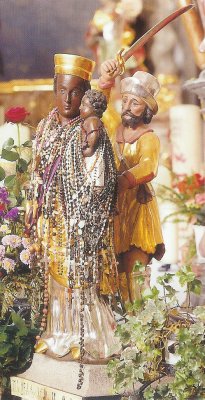 Photo: Roman von Götz |
*1: Story and photos are taken from a booklet sold at the sanctuary: Franz Dambeck, Josef Krottenthaler, und Ulrich Murr, Neukirchen beim Heiligen Blut: Pfarr-, Wallfahrts- und Klosterkirche, Verlag Schnell & Steiner, Regensburg: 2004