Venice:
Mesopanditissa
(Greek: Peacemaker)
In the church Santa Maria della salute, across the Canale
Grande from Piazza San Marco, Open 7-12 + 3-7, 12th Century?
photos: Madonna and child with and without adornments
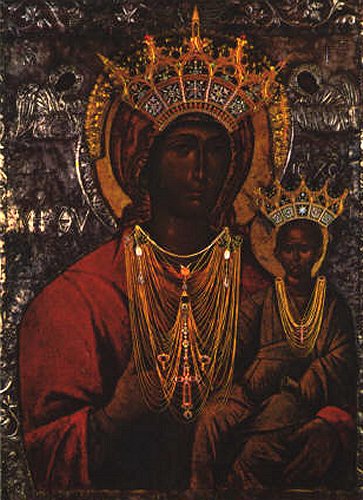
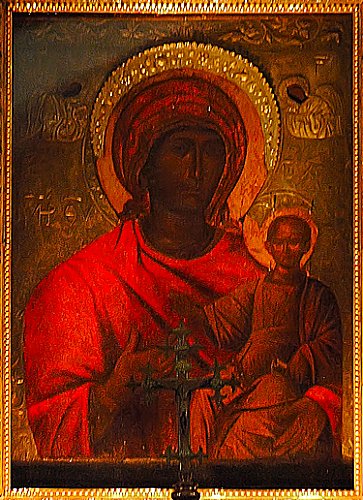
| This Black Madonna is one of the dozens
attributed by medieval legends to St. Luke the Evangelist, in my opinion
in order to protect them from inconoclasm. Indeed, tradition says
Our Lady the Peacemaker had to be saved from iconoclasts in Constantinople
and was brought to Candia, the capital of Crete. If that were true
she should be older than the 8th or 9th century, yet some date her
to around the year 1000, others to the 12th century. In any case we know that she spent a few centuries in St. Titus Cathedral in Candia, where she was revered as miracle working by both Greek Byzantine and Latin Catholic Christians. The latter had come with the Venician occupiers. (The city-state of Venice ruled Crete from 1204-1669.) The Black Madonna was charged with keeping the peace between these two fractions, who had battled eachother mercilessly in other parts of the Christian world. Each year Latin and Greek clergy would carry the icon in procession to both Latin-rite and Orthodox churches. And so all was well until the Turkish Muslims vanquished the Venicians in Crete in 1669. Again the Black Madonna had to flee from people who would have destroyed her and so she was taken to Venice in 1670. There the church Santa Maria della Salute had just been built in order to persuade Heaven to protect the city from the plague. A venerable icon was needed to adorn the main altar. Good timing! |
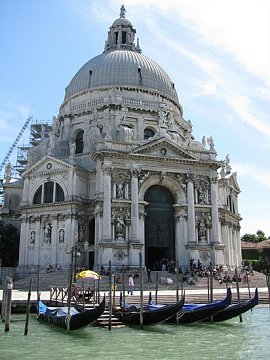 Santa Maria della Salute |