Zaragoza:
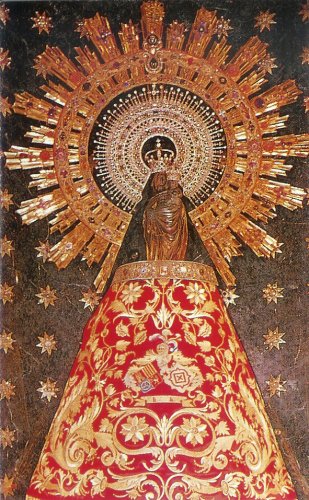
Our Lady of the Pillar
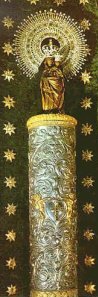
In the cathedral, Northeastern Spain, 39 cm, wood on 6 ft jasper pillar, encased in silver and gold.
|
The story of Our Lady of the Pillar begins in the year 40 A.D. with one of the twelve apostles. James the Greater, reputably Mother Mary's favorite apostle, came to Spain shortly after the ascension of Jesus to evangelize. When all his efforts only resulted in seven dedicated converts and many threats to his life, he despaired. Downcast he went to the banks of the river Ebro to pray. Suddenly he and his seven companions heard celestial singing and when they looked up they saw Mother Mary surrounded by angels. She smiled and said she had come to help. She took from one of the angels a six foot tall pillar on which appeared a small statue of the divine Mother. Then she instructed: "This place is to be my house and this image and column shall be the title and altar of the temple that you shall build." The Mother of God promised that she and her pillar would, "remain at the site until the end of time, so that the grace of God will work omens and marvels through my intercession for those who, in their hour of need, invoke my name." (*1) Mother Mary was still living in Jerusalem at the time, which means that this was an instance of bilocation, a "gift of the Holy Spirit" manifested by some of the greatest saints of all religions. Christians express it in terms of angels transporting the saint in an instant to a faraway place. |
 |
The Pillar:
One may wonder why Mary gave James such a big pillar on which to place
a small statue. What is the significance of the pillar? The Hebrew word
for pillar also means memorial stone. Since the time of the Jewish patriarchs,
pillars mark places of special importance that are to be commemorated
by future generations. But pillars or 'sacred poles' were also an ancient
Jewish symbol for the feminine face of God. They represented the Tree
of Life, which in turn was the image and title of the Canaanite Goddess
Asherah. Lady Wisdom, the feminine aspect or companion of God described
in the Old Testament, is also called Tree of Life (Proverbs 3:18). The
Bible acknowledges that a sacred pillar was placed in Salomon's temple
in Jerusalem and poles in other holy places to embody the feminine face
of God. The pillar was near the Ark of the Covenant, so that the God (who
speaks of itself in the plural and created humans in its image as male
and female (Genesis 1:27)) would not miss its female side. But around
622 B.C. King Josiah reigned and since he didn't distinguish between good
and bad pagan influences he destroyed everything he considered pagan.
(2 Kings 23:6 + 14) It seems that centuries after he pulverized all the
goddess poles of the Jews, Heaven itself brought the sacred pillar of
the Heavenly Mother and the Tree of Life (also one of Mary's titles) back
into Christian temples. God seems to prophesy to this in Revelation 3:12
when he says: "The victor I will make into a pillar in the temple of my
God and he (or she) will never leave it again."
After this first apparition of Mary, the Apostle James built the first
chapel dedicated to the Blessed Virgin. She answered many prayers with
miracles and so the conversion of Spain succeeded. Although the chapel
was later destroyed, as were several other churches on the spot, the statue
and its pillar have endured over the millennia and stand to this day in
a magnificent basilica.
__________________________________________________________________
*1: Quoted in: Roy Abraham Varghese, God-Sent: a History
of the Accredited Apparitions of Mary, p. 70 and Barbara Calamari
and Sandra DiPasqua, Visions of Mary, Harry N. Abrams, Inc., Publishers,
p. 125