Mother Mary and Buddhism
by Ella Rozett
Mother Mary is largely unknown in the Buddhist
world, the only exception perhaps being Maria
Kannon. The latter is a hybrid of Mother Mary
and the Bodhisattva of love and compassion whom
the Japanese call Kannon, the Chinese Kuan Yin,
the Tibetans Chenresig and the Indians Avalokiteshvara.
In Indo-Tibetan Buddhism this bodhisattva is male,
but in 8th-10th century Sino-Japanese Buddhism
it gradually became female(*1),
at least in appearance. A Hong Kong Chinese Buddhist
woman told me that the Chinese don't actually
consider Kuan Yin to have a female but a male
identity underneath the female form. Martin Palmer
and Jay Ramsay in their book "Kuan Yin: Myths
and Prophecies of the Chinese Goddess of Compassion"
trace the history of the male bodhisattva of Buddhist
scriptures to the female goddess of Chinese and
Japanese lay people. They confirm that those who
deal with sutras (Buddhist holy texts), i.e. monastics
and educated lay people, know that Kuan Yin is
male in the scriptures. They explain his apparent
sex change with various legends and some claim
that the bodhisattva will turn male again when
s/he enters nirvana. They also report that the
Japanese aren’t nearly as embarrassed by
their goddess’s gender as many Chinese seem
to be.(*2)
Because Mother Mary and Kannon have so much in
common, persecuted Japanese Christians of past
centuries secretly worshipped Jesus and Mary in
the form of Maria-Kannon with child. Today there
is a Christian-Buddhist Zen Center in Texas called
"Maria-Kannon". (see links)
Like Mother Mary, Kannon is an expression of
the feminine aspect of the divine, a personification
of love and compassion, a savior in calamity,
and a miracle worker. She appears to her devotees
as a lovely, gentle lady of heavenly beauty, sometimes
exuding the scent of sweet flowers. Much like
the Virgin Mary, the Chinese Kuan Yin is said
to have lived a human life of extreme self-sacrifice
and holiness before she ascended into heaven and
became a celestial Goddess of Mercy and Compassion.
Since her ascension she has been appearing as
“a woman in white” to those in need
of help. Her devotees respond to her loving care
by honoring her on her birthday and coming in
pilgrimage to her holy places on mountains, in
caves, and in temples. Here is an account of what
may happen there: “Huang Kuei-nien and some
companions undertook the pilgrimage to P’u-t’o
Sha. They went to the Cave of Tidal Sounds and
prayed with great devotion, chanting the name
of Kuan Yin. Suddenly they saw a brilliant light,
and Kuan Yin appeared, sitting on a rock above
the cave. So moved was Huang that he vowed to
dedicate his life to studying the Buddhist scriptures,
eating only a vegetarian diet, and refraining
from killing.”(*3)
All this sounds totally Marian to me.
Some trace the striking similarities between
Mary and especially the White Clad Kuan Yin back
to the historical influence of Christians in China.
Martin Palmer and Jay Ramsay tell the story of
Nestorian Christians coming to China in the early
600’s.(*4) Nestorius
was a deposed Archbishop of Constantinople who
died around 450 C.E. It is ironic that part of
his heresy consisted of refusing to call Mary
the "Mother of God" and yet his influence
in China helped elevate Kuan Yin to a quasi-divine
status. God/dess works in mysterious ways indeed!
The Nestorians did venerate the Mother of Jesus
(just not as the "Mother of God") and
imported images of Madonnas all over Persia, Arabia,
along the Silk Road, into Mongolia, China, Tibet,
and India. At the time the Chinese were longing
for the divine feminine, and Chinese Buddhism
needed someone who could compete with the powerful
Taoist goddesses. So the Madonna with child struck
a cord and merged with Kuan Yin, the one women
prayed to for babies, usually baby boys. Hence
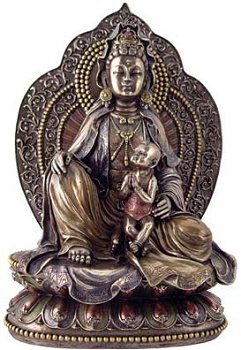
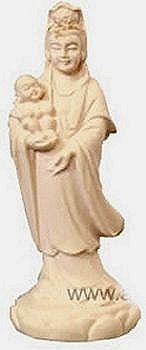
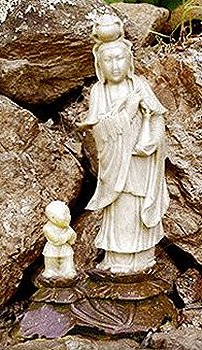
Kuan Yin as the child giver came to be depicted
with a baby boy either in her arms or beside her.
child giving
Kuan Yin with baby boy |
|
|
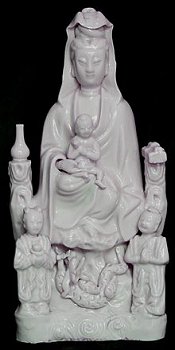 Maria Kannon
 |
In the photos above we can trace the development
from Kuan Yin to Maria Kannon and from a relatively
detached female bodhisattva who delivers babies
to others to a “loving Mother” (Jibo
Kannon) as the Japanese call Kuan Yin when she
holds a baby close in her arms. Other forms of
Kannon reminiscent of Mary are called Koyasu Kannon
(child giving and rearing) and Juntei Kannon (pure
one). For great photos and more information click
on Mark Schumacher’s article "Virgin
Mary & Kannon, Two Merciful Mothers"
He says that one can sometimes tell a Maria Kannon
from a loving mother Kuan Yin statue when a Christian
cross was hidden somewhere on the work. But often
it is up to the observer whether s/he sees a statue
as a representation of Mary or Kannon. E.g. the
Kuan Yin in photo 3 looks like a Chinese Virgin
Mary to me.
Ever since the 14th century the two have become
almost indistinguishable. This development began
when the Catholics finally made it to China (7
centuries after the Nestorians), bringing with
them white porcelain Madonnas. Chinese artisans
immediately imitated these and mass produced white
clad Kuan Yins. This is remarkable because white
is traditionally the color of death in China.
Nonetheless, through Mary and Kuan Yin it came
to be accepted also as a symbol of purity. To
this day the White Clad Kuan Yin is the most popular
deity of China. (For more information on the cultural
exchange between Chinese and Western iconography
see: Lauren Arnold, "Princely Gifts and Papal
Treasures: The Franciscan Mission to China and
its Influence on the Art of the West", Desiderata
Press, 1999)
My Personal Experience with Being a Rather
Buddhist Devotee of Mary
Even though Buddhism hasn’t directly commented
on Mother Mary, it prepared me personally in many
ways for following Our Lady of Apparitions.
First of all, the practice of Tibetan Buddhism
familiarized me with the notion that the Absolute
appears to sincere seekers in many forms, be they
celestial visions or temporary human forms. It
is always understood that these forms the Absolute
takes on – while as real as our own forms
– are not absolute in themselves. Rather,
the Absolute manifests them temporarily for our
benefit as an image portraying and transmitting
divine qualities. Their essence transcends any
image or form and is said to be “the union
of emptiness and clarity”. Just like our
essence also transcends our forms. According to
Buddhism we too are mere apparitions. Our true
nature goes far beyond what our bodies make us
believe. So when someone asks me: "How can
an intelligent person like you believe in apparitions?!"
I always answer: "But we are all apparitions
in this dream we call life!"
It seems to me that Mary often points towards
this reality of matter forming out of "emptiness
and clarity" or energy and spirit. Again
and again people describe her apparitions as starting
with a light gathering in the sky. Gradually the
light turns into a human form. It seems that Christians
largely ignore this part. I’ve never heard
anybody comment on it. They seem to imagine that
Mary sits in heaven in the form that they saw
her clothed in. But the Queen of Heaven can clothe
herself in anything. In the Bible she is seen
“clothed in the sun” (Revelation,
12:1), in her apparition in Rome she was seen
clothed in the love of the trinity. It seems to
me that what Christians are witnessing here is
the omni-present God/dess clothing herself in
a human form so that we can learn to “clothe
ourselves in God”. (To compare what Paul
says about clothing ourselves in God read Gal.
3:27, 1 Cor. 15:53-54, Eph. 4:24)
I guess Christians don’t know what to
make of the Virgin Mary forming out of light,
because they are to believe in the resurrection
of the body and the bodily assumption of Mary
into heaven. But I think their notion of what
“body” means in heaven is too worldly.
The Buddha’s “body of truth”
(dharmakaya) for example, is the limitless expanse
of the universe, present everywhere.
Second, Buddhism helped me prepare for what
in Christianity is called “consecrating
yourself to the Immaculate Heart of Mary”.
It has significant parallels to Tibetan Buddhist
initiations or “empowerments”. Both
are about merging with a celestial person and
then with the divine essence it represents. In
1992-‘93 Mother Mary presumably appeared
in Colorado (though these apparitions are not
yet accredited by the Church). There she said:
“My dearest children, I come to offer you
my greatest gift – to give you my love in
a most special exchange, my heart for yours. In
this exchange, you shall make the Act of Consecration
to my Immaculate Heart, thus partaking in my triumph.”(*5)
– This strikes me as very Buddhist, because
she is calling us to let go of our separate selves
in order to become divine instead.
Part of the Christian consecration as well as
the Buddhist initiation is a spiritual commitment
to do a certain practice every day for the rest
of ones life. This is a hard thing to do in a
society where no one seems to commit to anything
for life anymore. My Tibetan guru Kalu Rinpoche
taught me about commitment. I took my first initiation
without a clue about what I was doing or that
it entailed a commitment. After that, I went to
him on three separate occasions with some question
completely unrelated to the initiation. Each time
he apparently took one look at me and could tell
that I wasn’t keeping my commitment. So
each time he asked: “Are you keeping your
commitment?” The first time I said: “What
commitment?”, the second time: “Can
I do it in English or in my own words?”,
the third time: “Well, yes, sort of, more
or less.” Since he had asked me three times
I figured he was really serious about this and
that this was an issue of much greater importance
than my unenlightened mind could fathom. So I
started to keep the commitment strictly. (It only
entails a short prayer repeated seven times every
day.) He never asked me again, didn’t have
to, he could “see” with the eye of
enlightenment that I was keeping it.
Nothing less could have convinced me of the importance
of strictly keeping my present commitment to Mother
Mary which entails three fairly long meditation
sessions a day, including praying three rosaries,
and generally obeying Our Lady’s wishes
as much as possible.
Speaking of obedience. That’s the third
thing I wouldn’t even have considered without
a Buddhist understanding. It’s a big topic
among Mary’s devotees and a training in
ego-detachment. If you understand that a separate
self with a separate will is ultimately an illusion
that leads to nothing but suffering, it makes
sense to practice letting go of that self by being
obedient to God/dess. When you know that obeying
God/dess leads to the ultimate peace and happiness
of nirvana or divine union it is a little easier
to accomplish.
Fourth, Buddhist meditation practice also helps
with the rosary. For details see my article “Praying
the Rosary: a Different Approach"
Fifth, from a feminist perspective I’m
always suspicious when I hear people say how Mary
is not to be the goal of our path but only the
way to the male trinity. But from a Buddhist point
of view I understand that all forms of celestial
persons (not just Mary) are a doorway to the formless,
the ground of all being, which Christianity calls
God Father. So in that sense, yes, Mary leads
us to the Father, not to herself as a separate
form. Nonetheless one could express the same truth
in a less patriarchal way, by saying that Mother
Mary as well as Jesus lead us beyond forms to
the essential, ultimate truth which transcends
any words and concepts.
On the other hand, the Heart Sutra teaches us
that: “Form is emptiness; emptiness is form;
form is not different from emptiness, nor emptiness
different from form.” (Christians would
say: “God is immanent and transcendent.”)
So the form of Mother Mary leads us to the formless
Father, but then the formless Father also leads
us back to Jesus and Mary, because they are all
one.
I once heard a priest in the cathedral of Santa
Rosa, California preach about Jesus and Mary’s
oneness in a very beautiful and simple way, saying:
“Whenever we say, ‘Mary!’ she
says, ‘Jesus!’, and whenever we say,
‘Jesus!’, he says, ‘Mary!’“
Sixth, Buddhism also helps put things into a philosophical
perspective. When you start reading about Marian
apparitions, it can be a bit disconcerting. What
kind of a world is that where a lady appears in
the sky, makes the sun dance, writes messages
in the clouds, unlocks prison doors, stops battles,
lets a river of fire appear in the sky……..?
If you believe all those things, you are no longer
in a stable, material world; you’ve entered
a fluid, divine realm where anything is possible
and nothing is “cast in concrete”
anymore. You may feel like you are loosing ground.
Here’s what the Mary who appeared in Colorado
says about that: “Remember, it is when you
find no ground beneath your feet, you shall realize
you are in flight to my embrace.” (p.14)
Buddhism acknowledges that the apparent stability
of our material world is an illusion. In reality
everything is energy, constantly changing, and
impermanent. Natural laws are in effect only as
long as one is under the spell of worldly illusions.
Once one is completely freed from them, especially
from the notion of a separate self, a much more
large and beautiful universe opens up.
Let me warn you though, in order to “loose
the ground beneath your feet” safely, you
need a true master for a teacher. Mother Mary
is one such master.
______________________________________________________________
ENDNOTES:
* 1. Martin Palmer and Jay Ramsay with Man-Ho
Kwok, Kuan Yin: Myths and Prophecies of the
Chinese Goddess of Compassion, Thorsons Publishers,
London: 1995, pp.8-9 and 25.
* 2. Ibid. 25, etc.
* 3. Gill Farrer-Hall, The Feminine Face of Buddhism,
Quest Books, 2002, p.62
* 4. Martin Palmer and Jay Ramsay with Man-Ho
Kwok, Kuan Yin: Myths and Prophecies of the Chinese
Goddess of Compassion, op. cit. pp.22-25 + 38
* 5. In the End my Immaculate Heart Will Triumph:
Consecration Preparation for the Triumphant Victory
of the Immaculate Heart of Mary, Queenship
Publishing Co., (800) 647-9882, p.10. The martial
language in this booklet is sometimes hard to
take, but the rest is well worth it.
back to top
|