Mother Mary and Judaism
by Ella Rozett
With
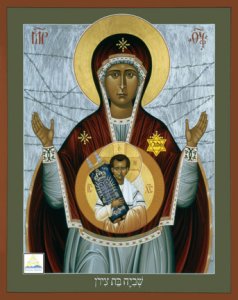
this icon the artist, Franciscan friar
Robert Lentz, wants to remind people that
Mary and Jesus were Jewish. It's so obvious
when you read the Bible and yet people
seem to want to forget. Christians, who
honor the Jewish identity of Jesus, Mary,
and the apostles, also honor their contemporary
Jewish brethren. If, on the other hand,
we ignore that Mary and Jesus were Jews,
we enable anti-Semitism to grow. Brother
Robert Lentz depicts Mary with the kind
of star of David the Nazis made Jews wear
and with barbed wire. Indeed, Mary and
Jesus would have been killed if they had
lived in reach of the Third Reich. The
Hebrew title of his icon reads, 'captive
daughter of Zion' which is taken from
Isaiah 52.2
|
|
Jews accept Mary as just another Jewish
mother of just another Jewish son, who could
have been the Messiah - but wasn't, as far
as they're concerned. Generally they have
no interest in Mary - or rather in Miriam.
(The Hebrew name Miriam became Maria in
Latin and Mary in English.)
Christians on the other hand, have always
had a great interest in linking Mary and
Jesus to the Hebrew Bible and tradition,
albeit in a way not appreciated by Jews
since Mary and Jesus were to replace the
things held most holy by Israel. Mary was
to be the new ark of the covenant, Jesus
the new temple. Both were to embody the
Wisdom of God described in the Hebrew Bible.
Christian
Mother of God and Jewish God the Mother
Mystical Judaism has much to say about the
feminine face of God, called Shekhinah.
She grew out of the Hebrew Bible (which
Christians call the Old Testament) and out
of later Jewish experience and imagination,
just like Mary, the Mother of God, grew
out of the Bible and Christian experience
and imagination. Certain parallels can be
drawn.
Shekhinah, means 'indwelling in the world',
God's immanence. A branch of Jewish mystics,
the Kabbalists, took this immanence, Lady
Wisdom, and the Holy Spirit, and crafted
from them God the Mother, the bride of the
Father. She is the totality of divine speech
- the Word, if you will. She is his bride
in heaven, but also on earth, for she tied
herself to the people, whom God chose to
wed.
As Christ is God become human, so she too
became like us in order that God might be
close to his children and lead us back home.
God the Mother loved her children so much,
that she left God the Father in heaven and
descended to be with her kids, following
them into exile. People saw her roaming
the communities of her exiled refugee children
at night, wearing black and moaning loudly
in pain. She cries over her children's suffering,
over the sin of humanity which made her
leave the embrace of her bridegroom, and
over her separation from him.
The image reminds me of the mater dolorosa,
sorrowful mother Mary, crying not only for
her son Jesus, but for all her children,
her heart pierced with seven sorrows. Shekhinah
leaving her heavenly abode to be with her
children in exile also is reminiscent of
Jesus "Who, though he was in the form of
God, did not regard equality with God something
to be grasped. Rather, he emptied himself,
taking the form of a slave, coming in human
likeness;" (Philippians 2:6-7)
According to Kabbalah, no one can come to
God except through Shekhinah. She is to
Kabbalists what Jesus is to Christians and
what Mary is to her devotees. The Zohar,
the major classic of Kabbalist literature,
says: "Shekhinah is the opening to the Divine:
'One who enters must enter through this
gate'."(*1) Sounds
a lot like Jesus in John 14:6: "I am the
way, the truth, and the life; no one comes
to the Father, except by me." But Mary too
is called the Gate of Heaven.
The kabbalistic persona of Shekhinah developed
over the centuries. Once she had taken on
human form, she gradually came to represent
all aspects of the feminine: the chaste
virgin and the promiscuous whore, the nurturing
mother and the bloodthirsty demon, the powerful
queen and the disenfranchised refugee.(*2)
This is the main difference between the
Jewish God the Mother and the Christian
Mother of God: Shekhinah has a demonic and
a sexual aspect, that are lacking almost
entirely in Mary.
Since a wife and mother was seen as an earthly
representative of Shekhinah, Kabbalists
were encouraged to have "kosher sex". By
uniting the feminine and the masculine in
a pure way, here on earth, they were also
helping God the Father and Mother reunite
in heaven.(*3) Pure
sex was to be joyful, but chaste. I.e. you
had to be married, it had to be after midnight,
in the pitch dark, you couldn't be naked,
whorish, or animal like.(*4)
As Shekhinah and pure femininity became
more and more powerful in the minds of men,
the sons of Adam got scared. A powerful
feminine principle was intriguing at first,
but when it threatened to become uncontrollable
by men, when it resisted subordination,
men hurried to "put it in its place". How?
They demonized independently powerful femininity.
They claimed that not only women, but even
God the Mother had a tendency to fall from
a divine into a demonic state when she wasn't
content to be subordinate under the male.
When Shekhinah falls, she turns into Lillith,
the demon who was meant to be the first
woman, but was exiled to the realm of demons
when she refused to lay under Adam
during intercourse.
To be fair, God the Father too could fall
into demonic states when he lost his divine
bride and attached himself to her demonic
shadow.(*5) Male and
female could be divine only when they were
together and in balance. Unfortunately,
balanced gender relations in the patriarchal
mind (whether Jewish or otherwise) does
not mean equality. Instead it means that
the feminine is content in her subordination
under the masculine.
Demonizing the divine Mother when she gets
out of the control of men, reminds me of
the Catholic Church's dealings with Marian
apparitions. They have become very adapt
at controlling the Mother of God. If she
says anything that is not in accord with
church doctrine or if she criticizes a bishop,
she is either immediately stamped as an
apparition of the devil instead of God or,
if they're feeling gracious, she is granted
a trial period to see if she learns to behave.
Surely, it
is hard to allow God to control us. We'd
all prefer it the other way around.
_______________________________________________________________________________________
*1: verse
1:7b of the Zohar, The Book of Enlightenment,
transl. by Daniel Matt, Paulist Press, Ramsey,
N.J.: 1983, p.37.
*2: Raphael Patai claims she inherited all
these traits from the ancient near Eastern
goddesses. In, The Hebrew Goddess,
Ktav Publishing House, New York: 1967, pp.
187 - 190.
*3: Rabbi Leah Novick, Encountering the
Shechinah, The Jewish Goddess, in: Shilrey
Nicholson, The Goddess Re-Awakening:
the Feminine Principle Today, Theosophical
Publishing House, Wheaton, Ill: 1989, p.
208
*4: Raphael Patai, op. cit. p. 265 and Isaiah
Tishby, The Wisdom of the Zohar: An Anthology
of Texts, Vol III, p. 1394.
*5: Raphael Patai, op. cit. p. 239
back
to top
home
|
|
|
|