|
Mother Mary and Martin Luther
by Ella Rozett
Martin Luther (like
most theologians) condemned any Christian who
regards Mary as equal to Jesus or who implies
that Jesus alone is somehow incomplete without
a feminine expression of God by his side. This
is what patriarchal training taught his mind to
think.
His heart on the other hand, seems to have known
that it did indeed need a heavenly mother along
with its heavenly father. And so he confessed:
"The veneration of Mary is inscribed in the
very depths of the human heart." (Sermon,
Sept. 1st 1522)
| If
one believed Rev. Peter Stravinskas, then
this inscription on his heart would be reflected
in the inscription on his tomb. Stravinskas
published a generally good article on "The
Place of Mary in Classical Fundamentalism",
but I'm afraid his source made one pious mistake:
It maintains that the relief of the Coronation
of the Virgin and inscription by Peter Vischer
the Younger which is to be found in the Wittenberger
Schlosskirche, where Luther is buried, goes
with Luther's tomb. I wish it were so, but
actually it is the memorial plaque for Henning
Göde, the last Catholic Prior of the
church, who died in 1521, right during the
most turbulent time of Luther’s Reformation.
|
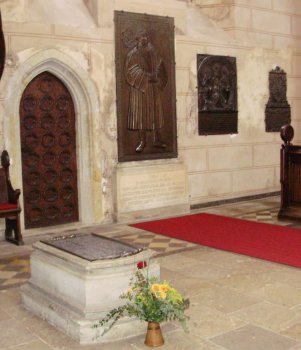
Luther's grave and memorial plaque in Wittenberg
with other plaques next to his
|
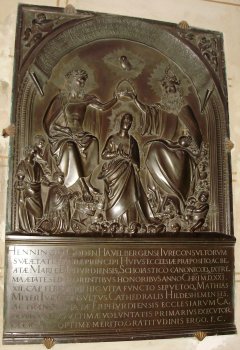
Henning Göde's memorial plaque
photos: Ella Rozett |
One might credit
all the generations of Protestants who took no
offense with this very Catholic plaque right next
to Luther’s and left it there.
Generally Luther was against any invocations
of saints and against asking for their intercession.
But Mother Mary, whom he was happy to call the
Mother of God, was a case apart, unlike any other
saint. This is probably because he recognized
the Biblical precedent for Mary’s intercession.
After all, at the wedding in Cana, she obtained
help from Jesus for the party even though her
son tried to resist her nudging. (John 2 :1-11)
So, no wonder that Catholics say, Jesus can’t
refuse the requests of his mother.
“In the resolutions of the 95 theses Luther
rejects every blasphemy against the Virgin and
thinks that one should ask for pardon for any
evil said or thought against her.” He preached
on Mary on all her feast days, more so than most
Catholic priests do today. This custom was continued
for about a century after Luther’s death.
He was also comfortable with keeping celebrated
images of Mary in his churches where they remained
until the time of “Enlightenment”
in the 18th century.
What did Luther think of the most famous Marian
prayers? He directed that the Magnificat be sung
daily in all churches. He conceded that the Hail
Mary could form part of a healthy prayer life,
though he doubted most believers’ ability
to pray it with the correct attitude. But the
Hail Holy Queen and the Queen of Heaven he condemned
as extravagant and “unevangelical”.
Luther quotes on Mary:
"(She is the) highest woman and the noblest
gem in Christianity after Christ … She is
nobility, wisdom, and holiness personified. We
can never honor her enough. Still, honor and praise
must be given to her in such a way as to hurt
neither Christ nor the scriptures." (Sermon,
Christmas, 1531)
"It is the consolation and the superabundant
goodness of God, that humanity is able to exult
in such a treasure. Mary is its true Mother …"
(Sermon, Christmas, 1529)
"Mary is the Mother of Jesus and the Mother
of all of us, even though it was Christ alone
who reposed on her knees… If he is ours,
we ought to be in his situation; there where he
is we ought also to be, and all that he has ought
also to be ours, and his mother is also our mother."
(Sermon, Christmas 1529)
"People have crowded all her glory into
a single phrase: The Mother of God. No one can
say anything greater of her, though he had as
many tongues as there are leaves on the tress."
(From the Commentary of the Magnificat)
"God did not receive his divinity from Mary,
but it does not follow that it is therefore wrong
to say that God was born of Mary, that God is
Mary’s Son, and that Mary is God’s
mother. … She is the true mother of God
and bearer of God. … Mary suckled God, rocked
God to sleep, prepared broth and soup for God,
etc. For God and man are one person, one Christ,
one Son, one Jesus, not two Christs… just
as your son is not 2 sons… even though he
has two natures, body and soul, the body from
you, the soul from God alone." (On the Councils
of the Church, 1539)
Luther believed in Mary’s perpetual virginity
and in her Immaculate Conception. Only the latter
he didn’t think should be a dogma that people
are obliged to believe.
"It is a sweet and pious belief that the
infusion of Mary’s soul was effected without
original sin; so that in the very infusion of
her soul she was also purified from original sin
and adorned with God’s gifts, receiving
a pure soul, infused by God; thus from the first
moment she began to live she was free from all
sin." (Sermon, "On the Day of the Conception
of the Mother of God", 1527)
"…she is full of grace, proclaimed
to be entirely without sin… God’s
grace fills her with everything good and makes
her devoid of all evil… God is with her,
meaning that all she did or left undone is divine
and the action of God in her." (Luther’s
Works, ed. H. Lehmann, Fortress Press, 1968, vol.
43, p.40)
"We can use the Hail Mary as a meditation
in which we recite what grace God has given her.
Second, we should add a wish that everyone may
know and respect her." (Personal Prayer Book,
1522)
Modern Protestant thinkers
on Mary:
Reinhard Kirste, founder of an interfaith
organization of the Protestant Church in Germany,
pointed out to me that since the 1970’s
Protestant theologians, especially feminist ones,
have been rediscovering a deep appreciation for
the Mother of Christ. Many are very careful not
to become too “Catholic” in their
relationship to the Virgin, but all concede that
she has a special closeness to God and would be
a good example to emulate.
Here are three examples:
* Elisabeth Moltmann-Wendel / Hans Küng /
Jürgen Moltmann, Was geht uns Maria an?
GTB 493. Gütersloher Verlagshaus, Gütersloh:
1988
*Rosemary Radford Ruether, Mary – The
Feminine Face of the Church, The Westminster
Press, Philadelphia: 1977.
*Basilea Schlink, The Mother of Jesus,
Marshall Pickering, London: 1986
back to top
|