Mother Mary in the Bible
by Ella Rozett
Many people inside and outside the Catholic
Church feel that the devotion of those who
love Mary is exaggerated, barely Christian,
and not grounded in the Bible. Yet the refusal,
especially of many Protestants, to acknowledge
Mary as anything more than a sort of incubator
of Jesus, does far less justice to the message
of the Bible.
They ignore Luke 1:48, where Mary says: “Henceforth
all generations will call me blessed.”
They don’t call her blessed.
They ignore Luke 1:52, where Mary speaks of
God and herself when she says: ”He has
thrown down the mighty from their thrones
but lifted up the lowly.” They want
to keep her a lowly handmaid, rather than
acknowledge that God lifted his humble servant
up to highest honors.
They ignore Revelation 12:1, where the mother
of the savior is seen “clothed in the
sun, with the moon under her feet, and on
her head a crown of 12 stars.” Did not
God crown her and clothe her in heavenly bodies,
hence making her the Queen of Heaven?
They ignore the part of the story of ‘the
wedding at Cana’ (John 2:1-12) where
Mary pushes Jesus to start his ministry. She
asks him to reveal some of his supernatural
powers, ‘his glory’ as the Bible
calls it. He says: ”My time has not
yet come.” But she seems to know better
and pushes him out of the nest, so to say.
Is this really just a “lowly handmaid”,
or rather an assertive, pro-active Jewish
mother?
Mary is present not only at every turn of
Jesus’ life on earth, but even before
and after. So perhaps, like the magi in Matthew
2:11, who “found the babe with Mary,
his mother” we too are to find Jesus
with his mother. There is no need to choose
one over the other. On the contrary, according
to what the Blessed Virgin Mary has said in
several apparitions, God wants us to pray
to and with both Jesus and Mary.
Let’s look at Mary’s life with Jesus.
At his conception, God didn’t force himself
on Mary. He very respectfully talked to her
until she consented to becoming the virgin-mother
of the messiah. So her consent, her "Let
it be done according to thy word" (Luke
1:38) was obviously important to God. He could
have simply impregnated her and informed her
of the fact afterwards. But it seems, part of
his plan was to leave the decision up to her.
Why? Many Catholic thinkers answer this question
by making a connection with Eve, the "Mother
of all who live" (Genesis 3:20). In his
letter to the Romans 5:18-19 Paul says: "Just
as through one transgression condemnation came
upon all, so through one righteous act acquittal
and life came to all. For just as through the
disobedience of one person the many were made
sinners, so through the obedience of one the
many will be made righteous." Catholics
apply this same thought not only to Adam and
Jesus, but also to Eve and Mary. Then it reads:
"Just like sin and death entered our world
through the disobedience of Eve and Adam, forgiveness
and eternal life entered through the obedience
of Mary and Jesus."
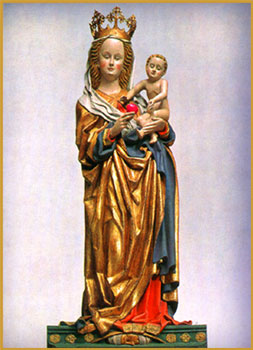 Madonna handing Jesus the no longer forbidden fruit of knowledge,
15th century statue in the church "St. Maria Koenigin"
in Cologne, Germany
The connection between Eve and Mary is also
evident in God’s prophesy in Genesis 3:15
where he says to the serpent, who represents
the Devil: "I will put enmity between you
and the woman, and between your offspring and
hers; He will strike at your head, while you
strike at his heel." Here God foretells
that although woman was the first to succumb
to the devil’s temptations, she will also
be the one who leads the fight against Satan.
And she will be the one who eventually brings
forth an offspring who will crush the Devil’s
power (his head) – though it may cost him
his bodily life (the bite in the heel).
Regrettably, even among Catholics there is
much talk about Mary being nothing without Jesus,
of her receiving all her power and grace from
him. However, that is not what the Bible says.
Here God chose Mary for her own qualities to
become his mother. Before she conceived Jesus,
God already says to her: "Hail Mary, full
of grace, the Lord is with thee. You have found
favor with God." (Luke 1:28+30) Martin
Luther of all people said: "God is with
her, meaning that all she did or left undone
is divine and the action of God in her."
(See: "Mother Mary and Luther" article)
Mary didn’t become holy because Jesus was
her son; Jesus became her son because she was
already holy. This is not to say that her experiences
with Jesus didn’t make her more holy, but
that God was already with her and "the
power of the Holy Spirit overshadowed her"
before Jesus became man. (Luke 1:35) So Mary’s
power and grace come from all three persons
of the trinity.
Let’s return to the subject of Mary’s
obedience for a minute, because it wasn’t
a small matter. By consenting to an extra-marital
pregnancy, she risked everything. If she couldn’t
convince Joseph and many others of the divine
origin of her baby, she would certainly loose
her fiancé and most likely also her life,
because the penalty for adultery was stoning
to death. So Mary really needed an incredible
faith to participate in God’s plan, and
part of that plan was a maiden whose reputation
and holiness would help people believe that
she conceived from the Almighty. What if she
had conceived Jesus only to be stoned to death
for adultery?
Obviously, her faith was well placed. God took
good care of her by linking her up with Elizabeth,
who also conceived miraculously. Then he filled
Mary’s older cousin with the Holy Spirit
and let her recognize immediately the truth
about Mary and her divine baby. In Luke 1:42-43+45
Elizabeth exclaims: "Blessed are you amongst
women, and blessed is the fruit of your womb.
Who am I that the mother of my Lord should come
to me?" Filled by the Holy Spirit, Elizabeth
calls both mother and child blessed and she
is the first to call Mary "The Mother of
my Lord", i.e. the Mother of God. Hence,
Elizabeth is the first disciple of Jesus and
Mary. Her holy enthusiasm continues: "Blessed
are you who believed that what was spoken to
you by the Lord would be fulfilled." (Lk
1:45) Overjoyed that God gave her such an ally,
Mary responds with a song of praising God, known
as the Magnificat. (Lk 1:46-55) What a beautiful
example of women supporting each other in the
work of God!
Although God took care of Mary, her faith was
also severely tested by trial after trial. After
the virginal conception she had to give birth
to Jesus in a poor and cold stable while on
the road. From there, the family proceeds to
Jerusalem to present Jesus to God in his temple.
Here again God fills a man and a woman (Simon
and Ana) with the Holy Spirit to give a message
to Mary and to the world. (Lk 2:26-38) God has
Simon proclaim that Jesus is the messiah and
that both he and his mother will suffer much
because of it. In verses 34+35 he says to Mary:
"Behold, this child is destined for the
fall and rise of many in Israel, and to be a
sign that will be contradicted, and you yourself
a sword will pierce, so that the thoughts of
many hearts may be revealed."
Patriarchal editors have inserted brackets
in the text, so as to make it look like Simon’s
words about Mary’s suffering ("and
you yourself a sword will pierce") were
an aside and that the thoughts of many will
be revealed only by Jesus’ suffering. But
there are no brackets in the Greek text. Simon
addresses the trials of Jesus and Mary without
missing a beat. So once again, scripture suggests
much more team work between man and woman, Jesus
and Mary, than people like to admit. From Jesus’
birth in the stable to his death on the cross,
Mary accompanied him and shared his pain. His
suffering and sacrifice was also her suffering
and sacrifice and his joys were also hers.
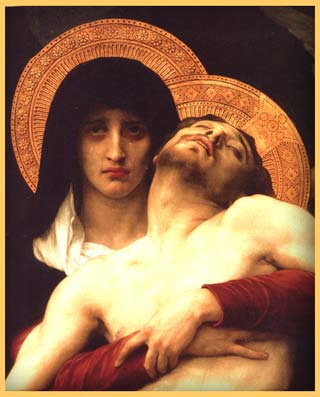
"Pieta" — Detail of painting
by William Adolphe Bouguereau
When Jesus was twelve years old he apparently
thought he was ready to leave his earthly parents
and to stay in the temple in Jerusalem. Lk 2:41-52
describes how Jesus didn’t want to go home
with his family. Living in the temple was a
valid option for the extremely devoted, but
Mary and Joseph didn’t allow it. Knowing
that Jesus was the messiah, Mary apparently
felt confident nevertheless that she could prepare
him as well for his role as any number of priests
and scholars at the temple. His parents commanded
him to come home with them "and he was
obedient to them". (Lk 2:51) Apparently
Mary was right in her confidence, for, as Luke
reports: "And Jesus advanced in wisdom
and age and favor before God and man."
(Lk 2:52)
At the wedding at Cana (John 2:1-12) Mary asks
Jesus to help out with a miracle when the party
runs out of wine. At first he rebuffs her sharply,
saying: “Woman how does your concern affect
me? My hour has not yet come.” She ignores
his reply, apparently knowing that he won’t
really refuse her, and instructs the waiters
to do whatever Jesus will ask of them. The rest
is history: he turns water into wine and his
hour of public ministry has come after all!
John Calvin’s response to this story
was to criticize Mary for her desire “to
exceed humanity and to make herself an intermediary,
which is to forget that grace is totally from
God and at His disposal.”* The arrogance
of patriarchal thinkers never ceases to amaze
me! Obviously God granted Mary’s selfless
desire because she knew how to call down that
grace that is “totally from God”
upon humanity. God must have seen only compassion
and wisdom in her request and confirmed her
role as intermediary. God wasn’t afraid
to empower Mary.
So the wedding feast at Cana is where Catholics
get this idea that Jesus can’t refuse
any requests submitted to him by his mother.
Mary was not only instrumental at this wedding,
but she was also among the first disciples to
tour the country with her son. The text says:
“After (the wedding) he went down to Capernaum,
he, his mother, his brothers, and his disciples.”
She wasn’t physically by his side the
whole time, but apparently as much as she could.
She was still among the disciples at Pentecost,
when they all received the Holy Spirit from
the risen Christ. Acts 1:13-14 lists the apostles
present on the occasion and then adds: "All
these devoted themselves with one accord to
prayer, together with some women, and Mary the
mother of Jesus, and his brothers."
Like the other disciples, Mary sometimes had
to go home to look after family, etc. In this
she is no different than for example Simon,
who in Mark 1:30 attends to his mother in law,
when she is seriously ill.
During these years of wandering, the Bible
mentions Mary a couple of times in a way that
is often interpreted as Jesus saying she wasn’t
important, or even disrespecting her. Let’s
look at Mark 3:31-35. On a more superficial
level, this passage is about a typical Jewish
mother telling her son: "Eat! Eat!"
Earlier in the same chapter (Mk 3:20-21) Mark
describes how so many people beleaguer Jesus
and his disciples that they can’t even
get around to eating. Apparently this happened
more than once, because somebody is concerned
enough to send word about it to Jesus’
family. Like any good mother would, Mary thinks
her son is going over the edge. How can he keep
up his ministry if he doesn’t take time
out to eat? She gathers her relatives to go
set him straight. Apparently she wants to use
her authority and allies to dispel the crowd
long enough for her son to eat. That’s
how they arrive at the packed house where Jesus
is and demand that he come out to them. Sounds
like they want to kidnap him and make him eat.
But he knows what’s going on and basically
tells her: ‘Ma, I’m a big boy now;
I know how best to run my life!’ He’s
emancipating himself.
However, Jesus usually acts and speaks not
only on a worldly but also on a spiritual level.
And so he uses the occasion to invite all of
his followers into his family. He says: "Who
are my mother and brothers? Here are my mother
and my brothers. Whoever does the will of God
is my brother and sister and mother." (Mk
3:33-35) He invites all of us to do what Mary
did when she said: "Let it be done to me
according to thy word." (Lk 1:38)
The same theme runs through Luke 11:27-28.
Here a woman exclaims: "Blessed is the
womb that carried you and the breasts at which
you nursed!" And Jesus answers: "Yeah,
rather, blessed are they that hear the word
of God and keep it." He doesn’t say,
‘no, my mother is not blessed’, he
literally says "indeed" (she is blessed
for being my mother) "and even more blessed"
are all who keep God’s word. Now the same
gospel of Luke makes very clear that Mary is
the foremost among those who "hear the
word of God and keep it". She hears the
angel Gabriel at the annunciation and responds
with: "Let it be done to me according to
thy word". Shortly after wards Elizabeth
confirms: "Blessed are you who believed
that what was spoken to you by the Lord would
be fulfilled." (Lk 1:45). Again in the
following chapter, Luke says: "And Mary
kept all these things, reflecting on them in
her heart." (2:19)
Of course Jesus' emphasis is not on the body
that nursed him but on the soul that joins him
in doing God's will. We are to follow the example
of Jesus and Mary rather than only admire them
as something external.
The famous 13th century mystic Master Eckhart
voiced the same idea when he said: "What
good is it to me, if the eternal birth of the
divine Son takes place unceasingly, but does
not take place within myself? What good is it
to me, for the creator to give birth to his
son if I do not also give birth to him in my
culture?"
Jesus’ emphasis was always on including
as many as he could in the family of God. In
this family the most humble are the greatest.
So he humbles not only his mother but himself
as well. Rather than calling himself Son of
God, he prefers to refer to himself as Son of
Man. He even says: "Why do you call me
good? No one is good but God alone." (Lk
18:19)
Jesus wanted to be our servant and brother
and for his mother to be our sister. Is it therefore
wrong to think of them as the Son of God and
the Mother of God? No, it is wrong to think
that God can’t be our Lord and servant,
our father and brother, our mother and sister,
divine and human. God does not fit into the
neat little packages we want to stuff him into.
He bursts them all open.
Finally, in John 19:26-27. Here we see her
under the cross. Except for the apostle John
all the male disciples have fled in fear. Those
who risk everything for Jesus are John and 3
Marys: Mother Mary, her sister Mary, and Mary
Magdalene. "When Jesus saw his mother and
the disciple there whom he loved, he said to
his mother, ‘Woman, behold, your son.’
Then he said to the disciple, ‘Behold,
your mother.’" – Catholics say
that at this moment Jesus gave his mother to
all of his disciples as our mother. Apparently
this has never occurred to Protestants. Why
not? They do know that what is said in the Bible
is not just an historical account of what happened
between people 2000 years ago. They know that
when Jesus addresses his disciples, he addresses
all of us. They know that when he says to an
individual: "Your sins are forgiven; your
faith has set you free." He means all of
us. Then why would the Spirit who inspired the
Bible not mean all of us when s/he inspired
Jesus to say: "Behold, your mother!"?
_____________________________________________________________________________________
*Thomas O’Meara, Mary in
Protestant and Catholic Theology, Sheed and
Ward, New York: 1965, p.133
back to top
|