Mother Mary and the Goddess
by Ella Rozett
Related pilgrimage sites:
1. The ruins of Ephesus and the house of Mary
(as in Paul’s letter to the Ephesians).
Outside of Ephesus, Turkey is the house where
Mother Mary lived with the Apostles John and
Mary Magdalene after they fled Jerusalem because
of persecutions. (For the entire history of
this house see Donald Carroll’s book
"Mary’s House", Christian Classics
Co., 2002) From this house Mother Mary "ascended"
into heaven.
I believe it is no coincident that for many
centuries Ephesus had been the center of goddess
worship and when it became the cradle of Mary’s
official veneration in the church. The city
boasted the mightiest temple to any goddess
in the ancient world. It was one of the Seven
Wonders of the World and the largest building
ever to have been constructed entirely of
marble. Ephesus owed its fame and spirit to
this temple. Even for modern standards the
city’s government was compassionate and
tolerant. It worshipped Artemis of Ephesus,
an earth and mother goddess more ancient and
primal than the Hellenistic Artemis.
In the shadow of this mighty goddess Mother
Mary was safe from persecution and ascended
into heaven. It was here that in the fourth
century the largest building in Ephesus (the
old Museion, not the Artemis temple) was converted
into a church and dedicated to the Virgin
Mary. (Some say this was the first church
in Christendom to be dedicated to the Madonna,
but other churches want to claim that honor
too. It seems that the chapel in Spain, erected
by St. James the Apostle after Our Lady appeared
to him in 40 C.E., might qualify as the first.)
In 431 C.E. the Third Ecumenical Council was
held in Mary’s church in Ephesus and
proclaimed her the Mother of God.
It is interesting that God/dess ordained
for both Mother Mary and Mary Magdalene, (according
to the apocryphal gospels of Philip and of
Mary Jesus favored her among the disciples
and loved her devotedly) to die at this holy
place of the Goddess.
Many scholars believe that Mary was declared
the Mother of God and allowed to be venerated
because of the need of the Hellenistic world
for a heavenly feminine principle. They say
it was a compromise with pagans in order for
Christianity to become acceptable. While this
is quite true, there may be more to it. What
if the Holy Spirit, the feminine face of God/dess
Herself was the one who made the connection
between the divine feminine in Christianity
and pre-Christian religions? What if God/dess
Him/Herself uses Mary to make us see that
there is only one God/dess who has the power
to express him/herself in many faces?
2. This is, it seems, what S/he did most clearly
in Mexico. The Virgin of Guadalupe appeared
in what is now Mexico City on the holy hill
of Tepeyac, dedicated to Tonantzin, the Mother
Earth goddess of the Aztecs. That is one reason
why the bishop didn’t believe Juan Diego.
He must have thought: "We know who appears
on that mountain and it’s not the Virgin
Mary but some pagan goddess!" Actually,
the native Mexicans thought the same thing:
"We know who appears on that hill: Tonantzin!"
And so they referred to what we call ‘Virgin
of Guadalupe’ as ‘Tonantzin’
for more than a century. To this day Mexicans
know the Virgin if Guadalupe not as just another
form of Mother Mary, but as a particularly
Mexican Queen of Heaven. Just as the majority
of Mexicans are of mixed Native Mexican and
Spanish blood, so too their divine Mother
is a mixted native and foreign heavenly person.
Human and Divine Triangles, or:
My Goddess is no wimp!
An article by Ella Rozett originally written for (but never published) a magazine called "Sage Woman: Celebrating the Goddess in Every Woman".
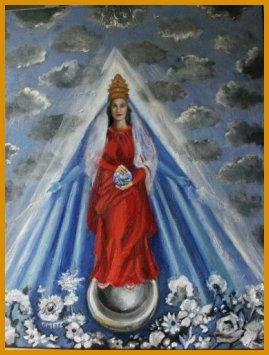
Some time around 1995 I received a Reiki
treatment from a woman healer. When she performed
some kind of sacred gestures over my female
organs, a vision flashed before me: the Queen
of Heaven with her crown and mantle forming
a perfect equilateral triangle. It lasted
only a few seconds, but long enough to let
me know three things were important here:
the perfect triangle, her divine power, and
the name: a voice not coming from the triangle
pronounced it as Santa Maria. – For me
it was love at first sight.
|
|
|
|
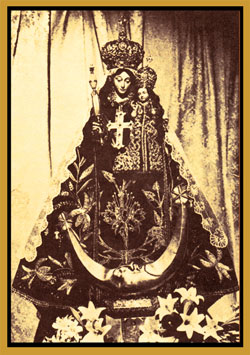
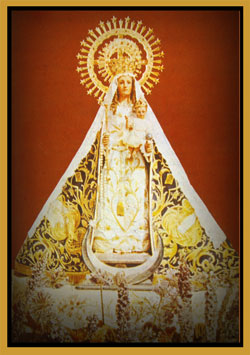
Traditional Triangle
Madonnas, left: Our Lady of Quinche,
in Ecuador
right:Our Lady of the Rosary, Guatemala
|
I wasn’t raised Catholic and had never
had any feelings for Mother Mary. But since
1982 I’d been meditating in Buddhist
and Christian ways. There were days when I
happily invoked God’s presence with the
very patriarchal: Lord! Other times I felt
a need for the feminine and called out for:
Amma! I’ve used that word ever since
I heard a Tibetan woman talk about how she
got arrested by the Chinese. She said she
could never forget the sound of her daughter
screaming after her in utter desperation.
She imitated that scream for us, filling a
big conference room with a desperate yet powerfully
loud and soulful Ahhhmahhh! That Amma stuck
with me. And so I sometimes called, I did
not know what Mother, with the exact same
word that Tibetans, Hindus, Semites, and who
knows who else, all use to call their divine
mother. – Maybe that’s why Santa
Maria came to me, because I unwittingly had
called her.
|
|
|
|
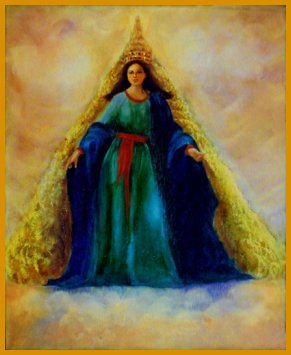
Contemporary Triangle
Madonnas, left by Dolores Delgado, right
by Caroline Ometz
|
After the vision disappeared, my intuition
suggested two things:
First, the triangle somehow seemed to be an
ancient symbol of pure femininity.
Second, Santa Maria did not need any male
God beside her. She seemed almighty to me,
just like a Goddess. As far as I could tell
with my admittedly very limited vision, there
was no male God or Baby Jesus anywhere in
sight. Just she was enough. (Some say that
was the meaning of ‘virgin’ in antiquity:
a woman who belonged to no man and was sufficient
and perfect in and by herself.)
Now I had two problems. First, though my
intuition told me that the triangle had to
be an ancient symbol for the feminine, I had
a hard time making sense of it and finding
satisfying confirmation for it. A woman’s
body certainly forms a lot more circles and
curves than triangles. Of course there is
the "pubic triangle", but it seemed
to me to be present on men as well as women.
Someone suggested that not only the pubic
hair, but also the ovaries and uterus form
a sort of triangle. But, perhaps because I
am German and a virgo, (i.e. a perfectionist)
that didn’t seem quite good enough. The
ovaries and uterus don’t form a perfect
equilateral triangle like the one in my vision.
I wanted a real and perfect triangle that
appears only on women. Yet I contented myself
temporarily with what I had. After all Santa
Maria appearing as a triangle at the moment
when someone is doing a healing over my pubic
triangle seemed like a pretty good hint. So
I would sometimes place my hands on my ovaries,
forming a triangle with my thumbs and index
fingers. Then I would meditate on how if one
flips that triangle up, one has the Goddess
triangle. Hence I came to the conclusion that
she is like the sun and each woman like a
ray of her light.
|
|
|
|
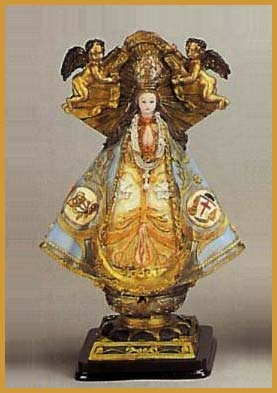
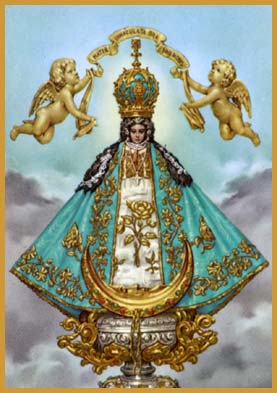
Our Lady of San Juan De Los Lagos, Mexico, the actual statue
and a common rendition
|
Later it occurred to me that when you put
the two triangles together, you end up with
the "star of David", symbol of Judaism.
A rabbi explained to me that it symbolizes
God’s movement towards us and humanity’s
movement towards God. He was adamant about
the triangle not symbolizing God himself.
I suspect because he would want the Jewish
God to point neither towards something like
the Christian trinity, nor to the Free Masonic
triangle, symbol for God on our dollar bills,
nor to a Goddess triangle, for that matter.
But what I want to know is: where did King
David get this star? From the Jewish goddess
Asherah? I found the only hint of that in
Anita Diamant’s novel "The Red Tent",
where Jewish women eat triangle shaped cakes
in honor of their Goddess.
Only since I started writing this article,
has God/dess finally led me to definitive
answers. Ah, the value of putting things in
writing! First I came across Shahrukh Husain’s
book "The Goddess", which says that
the triangle as a symbol for woman, earth,
and/or goddess goes all the way back to the
Paleolithic era, as early as 27,000 B.C.E.!
The book cites various religions that share
this "genital triangle of the Goddess,
widely known today by its Sanskrit name of
yoni".1 Then it shows a picture
of a stylized yoni that looks nothing like
a triangle but like a drop. Somewhere it mentions
an eye as the approximate shape of the vulva.
Now that seemed like a more realistic shape
for portraying it…. until my quest for
a perfect and exclusive feminine triangle
led me to a priestess of the Goddess tradition.
She gave me some hints, but here I can only
recommend: "Women, know thyselves!"
Take a mirror, investigate, and you might
be surprised at the perfection and number
of your triangles!
Still, I did not find these discoveries a
completely satisfying explanation for the
symbol of a cosmic, feminine triangle. It
seemed to me, there had to be more to it than
body parts. I guess I too am a child of our
era. Millennia of patriarchy have pretty much
rooted out a spiritual appreciation of the
gate through which women bring all of human
life into this world, under unimaginable labor
and pain. My apologies to all you mothers!
However, even Goddess worshippers interpret
the three sides of the Goddess triangle as
more than body parts. They see them as symbolic
of the three phases of a woman’s life:
the ‘maiden, mother, and crone’.
They also speak of three phases of the moon.
Yet, I find both divisions a bit random.
I rather like what I was taught at the university
of Bonn, Germany: that divinity is threefold
because it includes all things with their
opposites and that, which transcends a thing
and its opposite. This would mean that the
female Goddess includes the male God and that
which transcends male and female. It would
also mean that the triangle would work just
as well for the male God who includes the
female Goddess and transcends male and female.
Now that feels like proper spirituality, metaphysics,
and gender politics in religion!
|
|
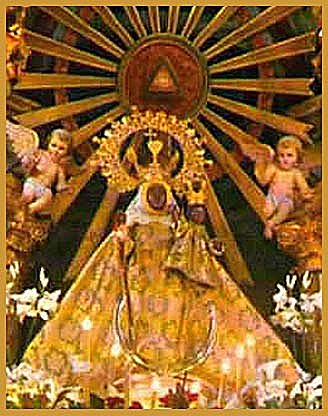
Our Lady of the Light, Cuenca, Spain, with the triangle of the trinity above her Photo courtesy of José Hernández Matías
|
Of course the Santa Maria triangle may stem
from the Christian trinity. This occurred
to me only after years of deliberating the
riddle, whereas other women get it right away.
When I shared my vision with the interfaith
meditation class I teach at a jail, a Baptist
woman immediately commented: "She’s
the trinity!" (Which was all the more
amazing to me since the Baptists don’t
see Mary as anything near divine.) When I
confided the image to my Protestant mother,
she said: "She’s the center of the
trinity." In a 1947 apparition in Rome
Our Lady affirmed herself: "I am the
one that is of the Divine Trinity: daughter
of the Father, the Mother of the Son, and
Spouse and Temple of the Holy Spirit."
2 Yet in contrast to these explanations,
I did not perceive even a trace of anything
masculine in the Santa Maria of my flash of
a vision. I suppose it may still have been
there though. If someone looked at me for
two seconds, they would not notice the male
hormones either, without which I could not
function.An artist told me that the triangle
is a symbol of dynamic power. That fits with
the message of power I got from Santa Maria.
The second problem I had after my vision
(besides trying to understand the symbolism
of the triangle) was that from what I had
heard and seen of the Virgin Mary in the Catholic
church, she always seemed overly meek and
submissive. No wonder my husband told me one
day: "My friend Maddy says your goddess
is a wimp!" Our friend insists that what
she really said was: "The Virgin Mary
is a disempowered, watered down face of the
Great Goddess." Still sounds like a wimp
to me, but no matter. I felt similarly about
the Catholic church’s rendition of Mother
Mary. It seemed to me that my mighty Santa
Maria had very little to do with theirs. Yet
I heard nobody but Catholics even talk about
her. It seemed that only they might appreciate
what it was like to see her. So I tried to
be content with attending a church that at
least calls her by the name with which she
was introduced to me. But it wasn’t very
fulfilling as far as my quest to get to know
her more intimately. So how else was I to
respond to her introduction to me?
The answer only came years later. One day
I went to a fundraiser concert for the Catholic
Aids ministry. Someone performed a song about
Lourdes, the famous shrine in France where
the Queen of Heaven, with the help of a peasant
girl, manifested a miraculous healing well.
In order to find the sacred well, Mother Mary
instructed Bernadette to dig in the earth
with her hands. The singer explained that
this was symbolic for us having to dig through
the layers of our subconscious in order to
find the sacred well within. That was the
first time I heard anything sensible said
about Marian apparitions and I knew I had
to find out more. So I started reading about
Lourdes, Medjugorje, Fatima, Paris, Mexico
City, and many other places where Santa Maria
has appeared. What I found was that the Mary
of the apparitions, the Mother of God, Queen
of Heaven, Spouse of the Holy Spirit, Divine
Mother, Queen of Peace, Morning Star, and
all the other great names she is known by,
is the same powerful heavenly Mother I saw.
This Maria isn’t submissive at all. She
forms out of light and demands to be venerated
with small and huge churches, with candle
light processions, equally with Jesus. In
1920 she told the 10 year old Jacinta of Fatima:
"Tell everybody that God gives graces
through the Immaculate Heart of Mary. Tell
them to ask graces from her, and that the
Heart of Jesus wishes to be venerated together
with the Immaculate Heart of Mary. Ask them
to plead for peace from the Immaculate Heart
of Mary, for the Lord has confided the peace
of the world to her." 3 Right
after World War I she warned that a second
and worse war would come if the church did
not consecrate the whole world to her Immaculate
Heart. They did nothing, the war came and
only in 1942 Pope Pius XII finally obeyed
her. By then it was too late for countless
millions.
Mary’s apparitions are said to have
started in 40 A.D., when she was still alive.4
More recently, in Medjugorje, Bosnia, she
makes the sun dance, writes messages into
the sky, unlocks prison doors, stops wars
and warns of others. She acts as a spiritual
director, exhorting us to constant prayer
and to divine union. She likes to choose as
her prophetesses simple girls, such as she
was when she became the mother of Jesus. She
hardly ever chooses to convey important messages
through male clergy. (That may be one reason
why the Church authorities have a love-hate
relationship with her apparitions and scrutinize
them with great suspicion.) She has millions
of Catholic and Orthodox Christians madly
in love with her, although most still want
nothing to do with apparitions.
So I want to assure you, this Heavenly Mother
is no wimp! I will admit however, that I sometimes
get the feeling that she ‘bites her tongue’
so to speak. She knows that if she said something
that was against Catholic dogmas she would
immediately be condemned as an apparition
of the devil and then she couldn’t serve
the millions of faithful Catholics who stream
to her. She does push the envelope, but she
knows she can only go so far. At one point
in the Middle Ages she had become so powerful
that she was venerated more than the male
trinity. To reestablish male dominance on
earth and in heaven, Pope Pius V in the 16th
century "prohibited all existing offices
(rituals) and prayers to the Blessed Mother"5.
The next Pope gave her back all her power
and then some, the next one after him restricted
her veneration again, and so it goes back
and forth through history.
Now her divinity is a more or less open secret.
It’s o.k. to call her Divine Mother and
for centuries artists have depicted her in
the same red and blue garments that symbolize
Jesus’ human and divine natures. Yet
a Catholic may not speak of Mary’s divinity
as being a theological truth, only a poetic
one. Only a rare theologian will acknowledge
Mary’s divinity and only with the adage
that hers is a gift from God whereas Jesus’s
is by his own nature. She was a creature that
was divinized; she wasn’t God to begin
with. In that she is an example of what, according
to mystical Christianity, we are all called
to: becoming inseparably one with God –
divinized, "inheriting the kingdom of
God" as Paul calls it. Until the inquisition
and the reformation (both anti-mystical movements),
Christians used to summarize the whole Christian
story by saying: "God became human so
that humans could become God." It still
says that in the "Catechism of the Catholic
Church".6
Do the faithful care whether Mary’s
divinity has always been her own true nature
or was a later gift from a God who is portrayed
as male? Some do, some don’t.
Here is my view on the issue.
Let’s consider what the Bible says in Genesis
1:26-27: "Then the Gods (The Hebrew word
is Elohim, which means gods, plural.) said:
‘Let us make the earthling (Hebrew: "adam"
comes from "adama" = earth) in our
image, after our likeness.’ (…) And
God created the earthling in his image, in the
divine image he created them; male and female
he created them." So it seems obvious enough
that God/dess has a male and a female face,
which together are one, and that’s how
God/dess created us too, male and female together
as one.
This is not a revolutionary thought. For millennia
the Judeo-Christian tradition has acknowledged
a feminine aspect of God. The Spirit of God
was often seen as feminine. In the Old Testament
"Lady Wisdom" is a feminine aspect
of God. The Jewish tradition has much to say
about another feminine aspect of God, which
they call Shekhinah. She represents God’s
indwelling presence in the world, his compassion,
his solidarity with the people of Israel, and
more.
So God has a female face, the Holy Spirit, which
"came upon Mary" (Luke 1:35) and made
her conceive Jesus. That same Mary was "created
in the image of God", like all of us. She
achieved perfect divine union and was enthroned
as the Queen of Heaven and Earth. Thus she has
become the most prominent manifestation of the
feminine face of God known to Christians. The
feminine Holy Spirit together with Mary of Nazareth
turned Queen of Heaven give expression to the
motherly face of Elohim – God/dess. Is
this really so different from God Father, who,
together with Jesus of Nazareth, Lord of the
universe, gives expression to the male face
of God/dess? In any case the female face manifests
itself in Mary and the male face in Jesus.
Christians debated for centuries at what precise
point in time Jesus became God’s son. If
we want, we can have that same debate about
Mary. Personally, for me it is enough to know
that God/dess always had and always will have
a feminine aspect and that Mother Mary is an
expression of it at this point.
From what she told me in 2 or 3 seconds through
symbol and word, she is both God/dess and saint,
i.e. a human in union with God.
When the Jewish journalist Yossi Klein Halevi
asked a nun in Israel: "Could you say something
about the nature of devotion to Mary here in
the convent?"7 she placed her
finger against her lips and smiled. "It’s
a secret. Not everyone would understand. Even
Christians would think it’s excessive."
I’d love to hear what millions of Christians
are thinking about Mary behind their sealed
lips!
As far as liberal politics are concerned,
I must admit, my Heavenly Mother is sometimes
politically "incorrect". She’s
against abortion. I agree with her on that one.
But she’s also against divorce, even when
there is abuse and domestic violence. She likes
celibacy, although she allows her modern prophet/esses
to marry. She loves the Catholic Church although
she cries about its state of affairs and reprimands
its priests. She doesn’t believe in reincarnation,
which I do. There have been days when I felt
like denying the veracity of her apparitions
because I disagreed with her. But then I realized,
that would make me no better than those patriarchs
who would call her the devil as soon as she
said something they find politically disturbing.
So I figure we don’t have to agree on everything
right away. I give her respect and the benefit
of the doubt and just leave some questions open
for later. Maybe one day it’ll turn out
that I was wrong, or that she was forced to
compromise, or that her prophet/esses weren’t
completely pure channels. Whatever the case
may be, I’m sure glad she came to me.
ENDNOTES:
1. Sharukh Husain, "The Goddess"
Duncan Baird Publishers, London: 1997, p. 96
2. Brother Francis Mary Kalvelage, "Marian
Shrines of Italy" Academy of the Immaculate,
New Bedford: 2000, p. 35
3. "Our Lady of Fatima’s Peace Plan
from Heaven" Tan Books and Publishers,
INC. Rockford: 1983, p.10
4. See Roy Abraham Varghese "God-Sent:
A History of Accredited Apparitions of Mary",
Crossroad Publishing Co, New York: 2000, p.
70. (I recommend skipping over the patriarchal
introductions to these kinds of books.)
5. "Marian Shrines of Italy", p. 55
A good article about Mary’s power before
that time can be found in Barbara G. Walker’s
"The Women’s Encyclopedia of Myths
and Secrets" under "Mary".
6. "Catechism of the Catholic Church",
Bantam Doubleday Dell Publishing Group, New
York: 1995, pp. 128-9
7. Yossi Klein Halevi, "At the Entrance
to the Garden of Eden: a Jew’s Search for
Hope with Christians and Muslims in the Holy
Land" , Harper Collins Publishers, New
York: 2002, p. 135
|