Colombia, Las Lajas:
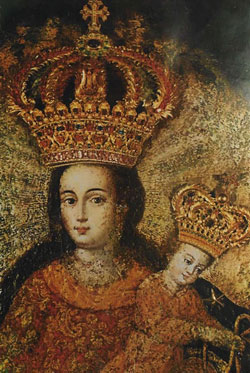
Our Lady of the Rosary of las Lajas
(Nuestra Señora del Rosario de las Lajas),
la Mestiza (the woman of mixed Spanish-Indian race)
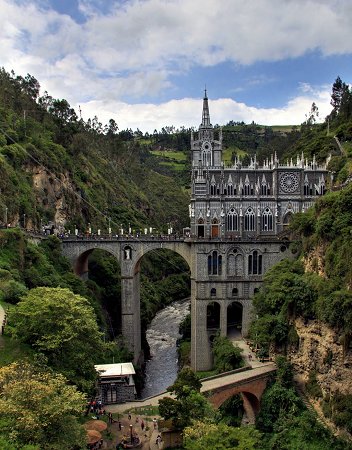
In her Santuario de Las Lajas, 7 km from Ipiales, the
nearest village, in the southern Colombian Department of Nariño,
10 km from the border to Ecuador, in the canyon of the Guáitara
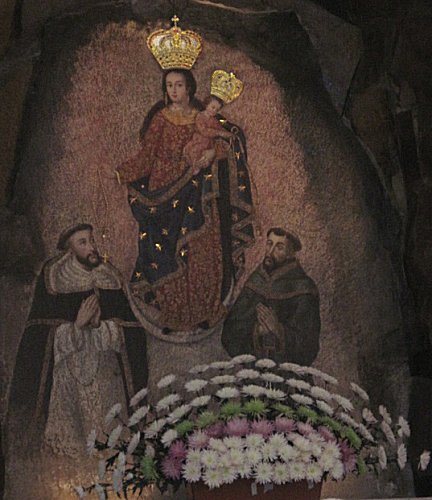
River. About 4 ft. high, applied directly into the rock in 1754.
|
Though this Madonna is not black she shares important
characteristics with Black Madonnas. The Apparitions: |
 |
Days later, Maria returned once more to Ipiales, carrying her daughter
Rosa, a deaf-mute, on her back in the Indian fashion. By the time she
had climbed to Las Lajas, she was tired and sat on a rock to rest. The
child got down from her back and started climbing around the rocks. Soon
she exclaimed: “Mommy, Mommy, there is a white woman here with a
boy in her arms!” Maria was shocked since this was the first time
she had heard her daughter speak. She was also scared because she could
not see the figures the girl was referring to. So she grabbed the child
and hastened on to Ipiales.
When she told friends and relatives what had happened, no one believed
her. So she just took care of her business and went home to Potosí.
When she came by the cave Rosa yelled: “Mommy, the white woman is
calling me!”(*3) Maria still couldn’t
see anything and so she hurried to take her daughter far away from this
apparently haunted place. Back at home she told other friends what had
happened. This time, since the path by that cave was much traveled, the
news of something supernatural happening there spread quickly.
A few days later, the child Rosa disappeared from her home. After looking
everywhere, the anguished Maria guessed that her daughter must have gone
to the cave, because the child had often said that the white lady was
calling her. Maria ran to Las Lajas and was overjoyed to find her daughter
kneeling in front of the white lady and playing affectionately with the
child who had come down from his mother’s arms to be with Rosa.
Maria fell to her knees before this beautiful spectacle; she had seen
the Blessed Virgin and the Divine Infant for the first time.
Fearful of ridicule from the people who had not believed her previous
accounts, Maria kept quiet about the episode. But she and Rosa frequently
went to the cave to place wild flowers and candles in the cracks of the
rocks.
Time passed, with Maria and Rosa keeping their secret. But one day the
girl fell gravely ill and quickly died. The distraught mother decided
to take her daughter’s body to the feet of the Lady of Guáitara.
There she reminded the Virgin of all the flowers and candles Rosa had
brought her and the poor mother asked the lady to restore Rosa to life.
The Blessed Virgin, moved by the sadness of Maria’s unrelenting supplications, granted Rosa’s miraculous resurrection. Overflowing with joy, Maria went to Ipiales. She arrived at night time and told everyone what had happened. Those who had already gone to bed, got up, the church bells were rung, and a great crowd gathered in front of the church to hear what had happened. At daybreak everyone went to the cave. There was no more doubt about the miracle when all could see supernatural lights streaming from the cave. Going in, they found for ever engraved into the rock wall, the image of the Most Holy Virgin. Maria Mueses de Quiñones could not recall noticing it until then.
The image:
It looks like Mother Mary and Baby Jesus are fishing for saints, which
I guess they always are. Here, the “fishing rods”, if you
will, are a rosary and a scapular. The Virgin is offering a rosary to
St. Dominic, who was indeed instrumental in spreading that devotion throughout
the Catholic world. Jesus is offering the scapular to St. Francis whose
order spread that devotion and has had a special connection to this sanctuary
from the start.(*4) (To this day, the sanctuary
is under the pastoral care of the Franciscan Sisters of Mary Immaculate.)
Both the rosary and the scapular are instruments of salvation and of Marian
devotion.
The crowns were added later by the faithful.
The church:
The oldest record of this holy place comes from the travel accounts of
the Franciscan friar Juan de Santa Gertrudis. He was a blind monk who,
between 1756 and 1764, traveled on foot from Ecuador to Nariño,
Colombia, begging for money to build the first chapel in Las Lajas. At
its completion, Fray Juan miraculously regained his vision, he believed,
as a result of his deep faith in the Virgin Mary of Las Lajas. Over time
bigger sanctuaries were needed. Today’s church was built from January
1, 1916 to August 20, 1949, with donations from local churchgoers.
In 1951 Church officials finally accredited Nuestra Señora de Las
Lajas as an authentic miracle and declared the sanctuary a minor basilica
in 1954.(*5)
Each September 16th, the date of the apparition of the image, thousands
of pilgrims come to the sanctuary to honor the Virgin and to pray with
her. The other great feast day for the Madonna of Las Lajas is Maundy
Thursday of Holy Week. That’s when pilgrims come from several nearby
cities, including from Ecuador, walking about twelve hours in honor of
the Mestiza. Other big organized pilgrimages take place in December and
early January.(*6)
In the course of the centuries all these pilgrims have left countless
ex-voti on the rock walls of the way down from the village into the canyon
of the sanctuary. They attest to the mercy and miracle power of the Madonna.
______________________________________________________________
*1: Prof. Plinio Corrêa de Oliveira,” Our
Lady of Las Lajas”, and Michael O'Neill, “Guáitara
Canyon, Columbia (1754) : Our Lady of Las Lajas” Thank you to
Michael O'Neill of "Miracle Hunters"
for pointing me towards this great Madonna.
*2: “Nuestra Senora
de las Lajas” I have translated and slightly edited his account.
* 3: Many websites summarize this story and claim the girl cried: “Mommy,
the Mestiza is calling me”, but it seems like the title Mestiza
was a later invention.
* 4: According to the New Advent Catholic online encyclopedia’s
article on the scapular
“the best known scapular is that of the Third Order of St. Francis”.
* 5: See English Wikipedia article on "Las
Lajas Sanctuary"
*6: See Spanish Wikipedia article of "Santuario
de Las Lajas"