Cuba, El Cobre:
Nuestra Señora de la Caridad del
Cobre (Our Lady of Charity of Cobre),
Cachita (Dear Charity),
Patron and Queen of Cuba,
La Virgen Mambisa (the Revolutionary Virgin)
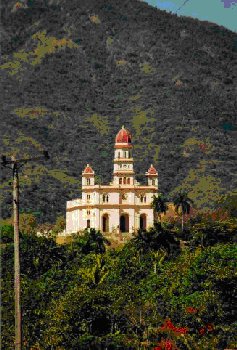
In her Sanctuary Our Lady of Charity of Cobre, 12 miles Northwest of Santiago. You can take a taxi or the no. 2 bus that runs four times daily from the main bus station in Santiago. Open daily from 6:00 am to 6:30 pm, 16/17th century?, 30 cm. Her head is made of baked clay covered with a polished coat of fine white powder, possibly rice paste, then painted.
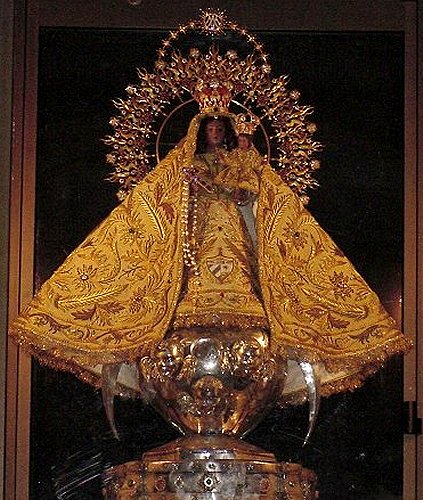
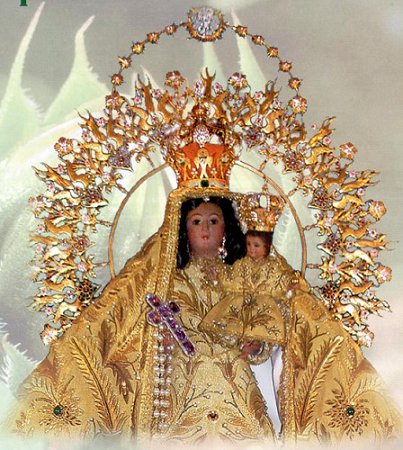
| Most representations of the Queen of Cubans portray
her as rather light skinned, but some depict her as black. The actual
statue is generally regarded as a ‘mulata’, a woman of
mixed race like the flock of her Cuban children. Her eyes and hair
are indeed pitch black. A recent thorough renovation did a good job
of revealing well shaped features that had been deformed by countless
coats of paint, but it also made her look even whiter. Her feet rest
on a silver moon whose ends surround the silver cloud where three
cherubs spread their golden wings. Baby Jesus raises one hand in blessing;
in the other hand he holds a golden globe. His Mother holds a cross
in her right hand. It used to be a golden one. Why would I count this Lady among Black Madonnas? One, because her Cuban children see her as dark. Two, because, like so many of her sisters, she has a connection with a non-Christian Dark Mother. Hers is actually particularly strong, because she is simultaneously worshipped as the Mother of Christ and as Ochún (or Oshún), the Afro-Cuban Yoruba goddess of love, dancing, femininity, sweet water, and gold. The Church seems to have made its peace with the fact that Our Lady of Charity draws not only Catholics, but also crowds of non-Christians and faithful with dual identities into her church. In any case, the Catholic caretakers of the shrine mostly keep her dressed in yellow and gold, the colors of the African goddess, as if to keep the Yorubas happy. Of course it may just be that Ochún’s color has become so much part of Cachita that no one would want to miss it. Even her Catholic devotees dress in yellow for her special holiday celebrations on September 8th and July 25th when thousands come to her on pilgrimage. Good old syncretism is alive and well in Cuba! Yorubas say the Virgin of Cobre has several characteristics in common with Ochún. Both have a connection with water. True, Our Lady was found in saltwater, which would associate her more with Yemayá, their goddess of the sea, rather than with Ochún, goddess of sweet water. But since she appeared near the mouth of a river, she qualifies. Also, the golden cross in her right hand reminds the Yorubas of the gold that Ochún possesses. Lastly, Mother Mary’s charitable love that flows from this statue through graces and miracles, reminds Yorubas of their ever happy and loving Mother goddess Ochún.(*1) |
 |
| People get confused about the fact that
the Lady of Charity of Cobre is described in paintings and words as
an apparition, similar to say, the apparitions in Fatima. They wonder
if there was an apparition of the “actual” Virgin Mary
or if it was “just” the statue that was found. The fact
is that when a statue appears in a miraculous way, it is, to her devotees,
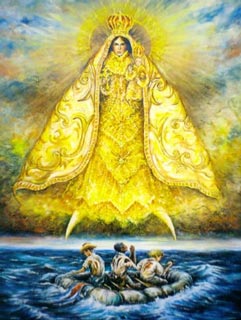
just like their Mother appeared in the flesh. So what happened? One day in 1608 (1611, 12, or 13 according to some) two native Indian brothers, Rodrigo and Juan de Hoyos, together with a 10 year old African slave boy, Juan Moreno, set out to gather salt from a salt mine. It was needed to preserve the meat of the Barajagua slaughter house, which supplied the inhabitants of Santiago del Prado, now known as El Cobre. Their journey included a canoe ride across the Bay of Nipe. But half way across they had to go ashore because a storm threatened to capsize their vessel. They camped at a place called Cayo Francés and waited for the weather to change. The next morning the seas were calm and they left the shore before daybreak. According to the testimony of the African slave “The aforementioned Juan y Rodrigo de Hoyos and myself, embarked in a canoe, headed for the salt mines, and far from Cayo Francés we saw something white above the foam of the water, but we couldn’t make out what it was. As we got closer, it seemed to us to be birds and dry branches. Then the aforementioned Indians said, “It looks like a girl.” While they were discussing this, they arrived, saw, and recognized the image of our Lady, the Most Holy Virgin with Baby Jesus in her arms, on top of a small wooden plank. On this small tablet were written large letters. Rodrigo de Hoyos read them and they said, “I am the Virgin of Charity.” Looking at her clothes, they admired that they were not wet. In seeing this, full of joy we each gathered only one third of salt and came to Hato de Baragua."(*2) |
 |
Ivelisse Rodriguez wrote an excellent
article entitled “Virgen de la Caridad del Cobre: Origins,
Nationalism”. Here is a large excerpt, slightly edited: In the Santería narrative, Ochún came to Cuba because she was despondent over her children being taken away from her by slave traders. She asked her sister Yemayá what Cuba was like, and Yemayá pointed out the similarities between Cuba and Yorubaland but noted how the people in Cuba looked different. Ochún then requested that Yemayá make her skin lighter, turning her skin a copper color, and her hair straighter so that all Cuban people could accept her. Thus she traveled to Cuba and was soon loved by all Cubans. Originally, mostly slaves were the ones who worshiped Our Lady of Charity. This shifted during the Ten Years War (1868–1878) between Cuba and Spain. The clergy, who was in favor of Cuba's independence, prayed to Our Lady of Charity, believing that she was on their side. Then in the 1895–1898 war for independence those in favor of independence prayed to Our Lady of Charity, including the revolutionary soldiers. Thus she became known as “La Virgen Mambisa” (the revolutionary virgin).(*3) After the war, in a letter dated September 24, 1915, the veterans petitioned the Roman Catholic Church to have Our Lady of Charity acknowledged as the national patroness of Cuba because of the way she had helped them reach independence. On September 8, 1916, Pope Benedict XV approved this request. |
|
Another decisive moment in the life of the Virgin of Charity came after
the Cuban revolution. Initially, it was believed that she was on the side
of Castro and his revolution, but this all changed on September 10, 1961,
when feast day celebrations were to be held in her honor. In keeping with
tradition, there was supposed to have been a procession. However, Eduardo
Boza Masvidal, the bishop in charge of the procession, was accused of
being a counter-revolutionary and was forced to call off the scheduled
procession. An impromptu procession ensued, and a clash between Cuban
Catholics and the police broke out. A young man named Arnaldo Socorro
was killed, presumably shot by the police. From then on, those who held
anti-Castro sentiments started to believe that the Virgin was really on
their side. Thus, a replica of Our Lady of Charity accompanied the ensuing
exodus of many Cuban Catholics to Miami.”(*4)
The official website of Our Lady’s sanctuary adds a beautiful article
on how the Virgin of Cobre and her clergy helped liberate the slaves of
the Cobre district during a whole century of struggle against the Spanish
crown.(*5) It also confirms that “…
there was certainty among the people that the Virgin Mary under the title
of Our Lady of Charity of Cobre accompanied and protected the Cubans in
the search for their independence.” Like other Black Madonnas (e.g.
of Czestochowa, Poland and Wilna,
Lithuania) the Queen of Cuba became a symbol of national identity and
independence.(*6) Nor is she the only
Black Madonna that has been credited with helping liberate the slaves
and standing by the oppressed. Apparecida do Norte
in Brazil and some Italian BlackMadonnas enjoy the same reputation. For
more, read in the introduction under Leftist
Views.
In 1936 Cachita was solemnly crowned. In 1977 Pope Paul VI raised her
sanctuary to the category of Basilica and in 1998, Pope John Paul II crowned
her a second time.(*7)
To this day the faithful come from across Cuba on pilgrimage to this
Brown Madonna and her image can be seen throughout the country.
Tip for the pilgrim: there is an inn behind the church, Hospedería
de la Caridad, which welcomes foreigners who abide by the strict rules;
a stay costs a mere 10 pesos a night (38¢), although they generally
charge foreigners a few dollars. There are only 15 austere but well-kept
rooms; it's necessary to reserve by phone (tel. 22/3-6246) at least 15
days in advance.(*8)
____________________________________________________________
*1: “Ochún,
Diosa del Amor”
*2: "Cachita-Ochun:
La Virgen de La Caridad del Cobre"
*3: Especially one famous copy of Cachita in Santiago is known by that
title, but it describes well who the Virgin of Cobre has been for Cuba.
*4: Virgen de la Caridad del Cobre - Origins,
Nationalism
*5: La
Virgen y La Libertad
*6: “Historia
de la Virgen de la Caridad del Cobre” and “Historia
de la imagen de la Virgen Mambisa”
*7: Our Lady
of Caridad Del Cobre (Nuestra Señora del la Caridad del Cobre)
Patroness of Cuba
*8: More info on www.cuba-junky.com