Croatia, Marija Bistrica:
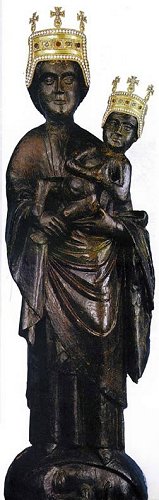
the Black Madonna with Child,
Our Lady of Bistrica,
Queen of Croatia
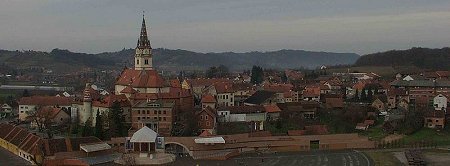
The little town Marija Bistrica (literally Mary Bistrica)
lies on the slopes of Mount Medvednica, about 15 km North-West of Zagreb.
16th century, about 5 ft., wood.
photo of the Black Madonna unveiled by "Holy
Card Lover"
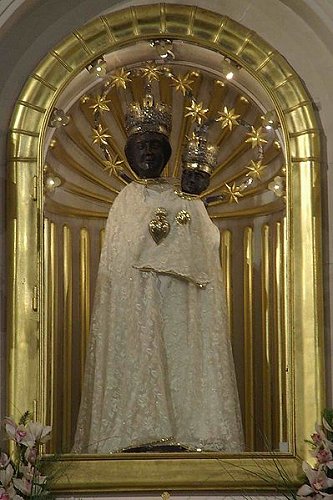
| How happy is a devotee’s heart when a Black Madonna
has a whole town named after her and her own flag! Her village of
about 1,000 and municipality of about 7,500 inhabitants is a famous
place of pilgrimage, visited by hundreds of thousands of pilgrims
every year. Her willingness to grant miracles is attested to by countless
plaques of thanksgiving that fill the walls of her basilica’s
courtyard. As the Queen of Croatia Our Lady of Bistrica has more than just a small town to herself, she has a whole, albeit small country. It was at the end of the 18th century that she became a symbol of national identity, like what the Black Madonna of Czestochowa is to the Poles or Our Lady of Guadalupe, the Dear Dark One, to the Mexicans. At that time she was given the title Most Faithful Advocate of Croatia, which later was superseded by 'Queen of Croatia'.(*1) |
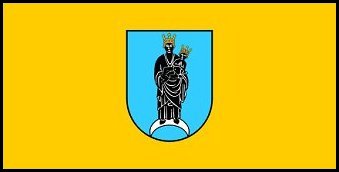 the flag of Marija Bistrica |
The legendary history of the Black Madonna of Bistrica:(*2) 1499: She is created by an anonymous artist and placed in nature in a little chapel on Vinski Hill. 1545: Turkish invasions threaten her survival and the local priest brings her into town and hides her in the church wall under a stained glass window. Soon after, he dies, taking the secret of her hiding place to his grave. 1588: Intending to come out of hiding, the Madonna
lets a bright light shine from her place in the wall, and her children
uncover her. |
 |
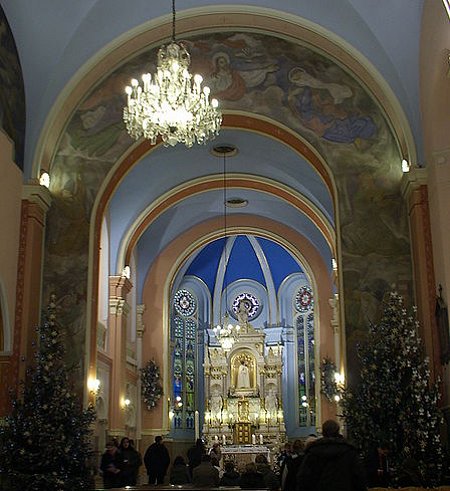
1650: Once again the Black Madonna has to hide from her enemies. This time the villagers bury her in the ground. 1684/5: As before, she is rediscovered.(*3) 1710: the Croatian parliament vows to fund a new altar in the church, which is done in 1715. 1750: Pope Benedict XIV grants plenary indulgence (remission of sins) to pilgrims who go to confession and receive the Eucharist in Marija Bistrica. 1879 to 1882: a new church is built to replace the old one, with arcades around it decorated with 22 paintings of the miracles granted by Marija Bistrica. During the construction a fire destroys all of the church except the statue and the main altar. 1923: Pope Pius XI grants the rebuilt church the status of a minor basilica. 1935: Antun Bauer, the archbishop of Zagreb, officially crowns the statue Queen of Croatia. 1938-1960: Blessed Aloysius Stepinac, a great lover of this Black Madonna, is archbishop of Zagreb and leads annual pilgrimages to her as long as he can. The last one takes place on July 8, 1945 and draws 40-50,000 faithful. Then the Soviets forbid such events. October 3, 1998: 500,000 Croatians are in attendance
as Pope John Paul II visits Marija Bistrica to beatify Cardinal
Aloysius Stepinac, who had defended the Jews during the Nazi occupation
and publicly criticized Communist crimes under Soviet occupation.(*4) |
 |
Very significant is the moon bearing a woman's face under this Madonna's
feet. For a full explanation read the section on "Psychological
Explanations" in the introduction.
____________________________________________________________
*1: Vjekoslav Perica, Balkan
Idols: Religion and Nationalism in Yugoslav States
*2: Much of this information comes from the Wikipedia article on "Marija
Bistrica".
*3: There is a slight discrepancy between Wikipedia and "holycardlover's"
blogspot on Our
Lady of Bistrica . Both seem believable and I've tried to reconcile
them as best I could.
*4: “Aloysius
Stepinac“ article on Wikipedia.