Guadalupe de Cáceres:
The Virgin of Guadalupe
Patronness of Extremadura
Queen of Hispanics
Our Lady of Silence
In her sanctuary, the monastery of Guadalupe, near Cáceres, Extremadura on the Portuguese border.
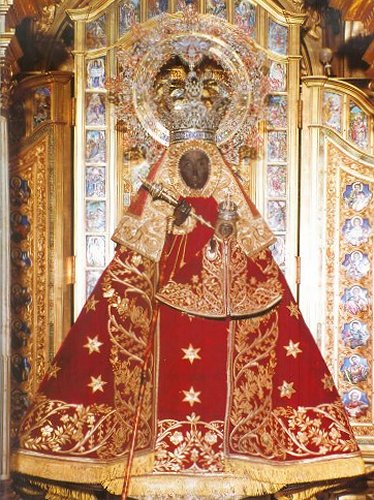
Legend has it that this image belonged to Luke and was buried with him when he died. In the fourth century Luke's remains, with his statue, were brought to Constantinople. Later Pope Gregory the Great (c. 540 - 604) brought the statue to his private chapel in Rome. Soon this Virgin performed her first great miracle. It was during an outbreak of the plague that the people carried her in a great procession through the streets of Rome and with intense religious fervor asked her to stop this punishment. That day the epidemic ceased while an angel was seen on the castle cleaning a blood stained sword.
After Gregory's death, the image was given to St. Leander, archbishop of Seville. It was venerated in his cathedral until the Moorish invasion in 711. In 714 some clergymen who were fleeing from the Muslims took the Virgin with them and buried her in an iron casket near the river Guadalupe (Hidden River).
After six hundred years, Our Lady of Silence was ready to emerge from
yet another grave. By now the area was Christianized again. One day a
poor cowherd from Cáceres by the name of Gil found one of his cows dead.
He decided to skin it for the leather. But when he had made the first
incision in the form of a cross, the cow suddenly revived and at that
very moment the Queen of Heaven appeared and addressed Gil thus:
"Don't be afraid. I am the Mother
of God, savior of the human lineage. Take your cow and bring it to the
rest of your herd. Then go home and tell the clerics what you saw and
that I sent you to them. They are to come to this place where you are
now and to dig where your dead cow was. Under those rocks they will find
an image of me. And when they take it out, tell them not to move it from
the place where it is now, but to build a little house right here and
put the image in it."(*1)
With those words the Virgin disappeared. When Gil came home he found out
that one of his sons had just died. He invoked the Mother of God he had
spoken with earlier and the child revived. This sign convinced the clerics
of the veracity of Gil's story. Immediately they complied with the Virgin's
instructions and dug up the perfectly preserved sacred image together
with documents attesting her origins.
A little hermitage was built and entrusted to the Franciscans who wrote this story down. Over the centuries they also collected nine codices, kept in the monastery archives, that list the miracles attributed to this Virgin of Guadalupe.
One of the early Franciscan monks at the monastery of Guadalupe became Zumarago, the bishop of Mexico City to whom the Mother of God sent Juan Diego with news of yet another Marian apparition. Supposedly the Lady in Mexico told Juan Diego her name was Coatlaxopeuh (pronounced Quatlasupe), which some translate to mean She who Crushes the Serpent.(*2) Sounded like Guadalupe to the man from Guadalupe.
The monastery of Guadalupe must be the richest sanctuary in the Hispanic world, because for centuries, just like a worldly queen, the Virgin of Guadalupe had the right to demand alms and part of the inheritance of well-situated people.(*3) All that wealth was not only used to adorn her church-palace and throne room but also to accommodate her pilgrims and take care of their needs. At one point four major and seven minor hospitals, a school of medicine and music, pharmacies, libraries, pilgrims' hostels, and scriptoriums formed part of her sanctuary. It is a magnificent center for Hispanic culture and religion.
______________________________________________
*1: www.centenarioguadalupe.org, Historia de la Imagen.
*2: Actually we don't know exactly with what name Our Lady introduced
herself to Juan Diego in his native Nahuatl language. Several versions
and interpretations are discussed in www.livingmiracles.net/Guadalupe.html,
scroll down to "Origin of the Word Guadalupe".
*3: www.centenarioguadalupe.org, La Devoción a Santa María de Guadalupe.