Jerez de la Frontera:
Nuestra Señora de la Merced Coronada
(Our Crowned Lady of Mercy)
Patroness of Jerez de la Frontera
In her Basílica Nuestra Señora de la Merced on the Plaza de la Merced. Jerez is in the province Cadiz in Andalusia, 13/14th century, life size.
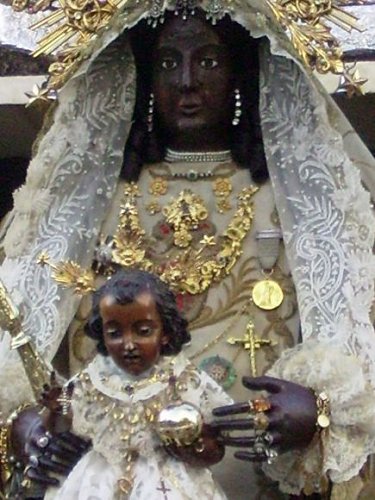
One says that St. Pedro Pascual opened a monastery of Mercy outside the city walls of Jerez la Frontera in 1268. The “heavenly, royal, and military Order of Mercy and the Redemption of Captives” had been founded in Northern Spain in 1218 by St. Peter Nolasco. He had been granted a vision of the Virgin Mary, in which she identified herself as Mercy and asked him to take up the work of redeeming prisoners that were held as slaves of Muslim invaders. Captives who came from wealthy families were often freed by ransoms, but the poor remained enslaved. This order was to level the playing field, mostly by raising money for ransoms. It also fostered devotion to Mother Mary and missionary work.
| When the group of Mercy monks under the
guidance of St. Pedro Pascual was planning to open its first house
in the area of Jerez, the city council asigned them a field outside
the city walls where they could build. It was known that there had
been a tile and brick manufactory in that place, of which some parts
of the oven still stood. When the workers were demolishing the remaining
ruins in order to build the new foundations, they found a cavity with
a small niche containing a beautiful image of the Blessed Virgin all
blackened, no doubt by the smoke of the tile burner. When the discovery was reported to St. Pedro Pascual he was very pleased. He declared it to be manifest proof that the Queen of Heaven would protect the futue monastery and the city. The Black Madonna was worshipped in a temporary location until the new monastery was built and she could be installed in her place of honor behind the main altar. Nobody doubted that she should be known as Our Lady of Mercy and be the celestial head of the order she had come to protect and lead. According to this version she was declared patroness of Jerez already in 1272 and the city swore her loyalty in 1300.(*1) |
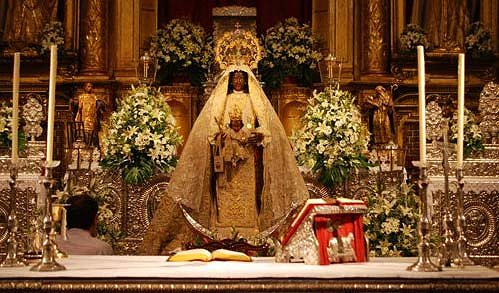 The Black Madonna placed behind the altar as if she was presiding at mass |
|
The other opinion claims that Our Lady of Mercy didn’t come
to Jerez until the 14th century.(*2) It recounts
that in 1340 Christian forces reconquered the town of Algeciras
from the Muslim occupiers, who had held it for a few hundred years.
They converted a mosque into a Christian church and installed in
it the Virgin of the Palm Tree. The Virgen de la Palma, as the locals
call her, is another Mary statue that had been discovered under
somewhat mysterious circumstances. To this day she is celebrated
as the patroness of Algeciras. |
 |
This phenomenon was repeated for several nights in a row. So the monks
held a meeting and decided that it was a clear sign of the desire of the
Blessed Virgin Mary to be venerated in their church. Their reasoning seemed
to be confirmed by the fact that they never again heard of the soldier
who had brought her to them. So she was placed center stage behind the
main altar and given the title Our Lady of Mercy, indicating that from
now on she was the head of the order.
According to I.E.S. Francisco Romero Vargas, both opinions are backed
up by old manuscripts in the Mercy order archives of the city. Yet it
seems to me that the second story actually belongs all together to the
Virgin of the Palm Tree with whom it starts, never explaining why it switches
to the Virgin of Mercy mid way. The patroness of Algeciras indeed was
taken from the city during the Muslim occupation of 1369 and didn’t
return until the 18th century.(*3) Looks to me like
she spent 400 years with the Mercy monks.
What all agree upon is that the cult of the Black Madonna of Jerez received
a great boost in 1599 to 1600. There was a harrowing drought and the monks
recommended that the statue be taken on a procession as a way of imploring
the Queen of Heaven for help. It must have helped, because shortly thereafter
the city council voted to declare her patroness of Jerez and for years
to come Lady Mercy was honored on April 30th, the day the rains came.
From then on her shrine was filled with votive offerings and jewelry.
Later her feast day was moved to August 15th, the day of Mary’s
assumption into Heaven. Now she is honored with a procession and festivities
on September 24th.
Until the 19th century Mother Mercy was always in the care of her monks,
but during that century she had to leave the monastery on three occasions
of political anti-Catholic unrest in the wake of the French Revolution.
Twice her monastery was converted into a hospital.
Finally at least the church, though not yet the monastery, could be reopened.
It was often run by priests, who had been monks of Mercy but forced to
disband their order. It wasn’t until 1940 that their community was
reestablished as the custodians of the shrine.
This Black Madonna wasn’t canonically crowned until May 31st 1960,
but the people recognized her as their queen long beore that.
Little is left of the original statue. Because the custom of dressing
images of Mary up like royalty made people cut up old statues so that
they could be treated like a puppet. The audacity to cut them into pieces
for this purpose began in the 17th century.
_______________________________________________________
*1: “La
Merced” in on-line journal “Jerez Hoy 2020"
*2: Presented in I.E.S. Francisco Romero Vargas’ article “Nuestra
Señora de la Merced. Patrona de Jerez”
*3: See the “Fiestas
de Algeciras” article on Wikipedia.