Huy:
Notre-Dame de la Sarte
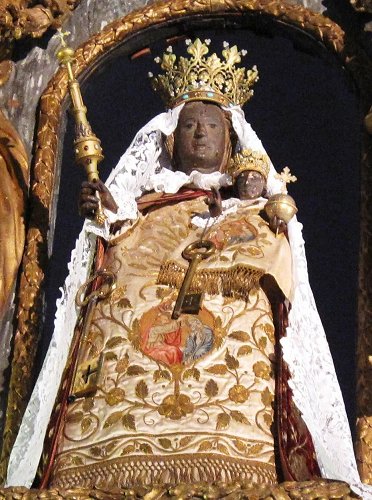
In her own church Église Notre-Dame de la Sarte on her mountain overlooking Huy, Plaine de la Sarte 84 (about 2.5 km from the center of town), end of 15th century, almost life size, oak wood. *
| According to the Belgian TV program (see
footnote), this is one of eight Black Madonnas in Belgium. Legend
says that she was brought here by a crusader, though art historians
date her to the end of the 15th century.
The original chapel of Notre-Dame-de-la-Sarte was destroyed in
the 16th century, during the Wars of Religion. So there stood the
Black Madonna, disfigured in the ruins, a plaything for children.
In the summer of 1621, with the town still occupied by Dutch Protestant
troops, a local woman by name of Anne Hardy was passing the ruined
chapel on her way home from collecting fire wood. Looking at the
statue, she decided to give her a better home (or did she mean to
burn her?!). She hid the Black Madonna among her firewood and meant
to carry her off, but to her surprise, she could not lift the bundle
at all, even when she asked two passers-by to help her. The three
realized that the Madonna was refusing to leave her sanctuary and
so they returned her to her niche. For this purpose the miraculous
statue allowed herself to be picked up with ease. The news of this
supernatural event immediately drew crowds of pilgrims. Three sworn
affidavits were obtained from witnesses. Soon the chapel was rebuilt
and Heaven granted more miracles. The church could not hold the
crowds of pilgrims and so a bigger church was built from 1624 to
1628. |
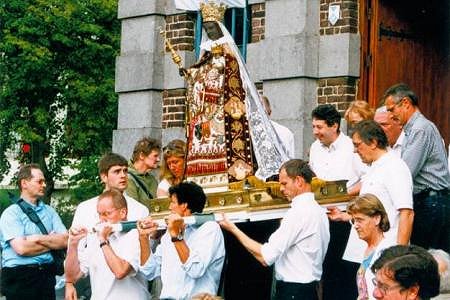 The Black Madonna is leaving her sanctuary in 2012 |
In 1656, when a drought threatened the country with famine, the local government and clergy organized the usual public supplications to the Virgin, only this time they added a procession. The Black Madonna was solemnly brought down from her mountain into the city. She had scarcely returned to her sanctuary, when the rain, that was so desperately needed, began to fall abundantly. From then on, the ritual has been repeated every seven years. It begins with special devotions the night before August 15th, the feast day of the assumption of Mary into Heaven, followed by the procession the next day. The most recent of these rituals (as of this writing in 2013) was celebrated in 2012 with a nine day festival.
On June 26th 1896, the Black Madonna was canonically crowned.
__________________________________________________
* According to a Belgian TV program “teletourism”, which aired
a piece on Black Madonnas on 10/11/2012, she is made of oak, according
to Ean Begg, walnut wood. Ean Begg also reports some people’s doubts
as to whether this is truly a Black Madonna, but in this video she is
clearly referred to as one of the 8 Black Madonnas in Belgium, including
by the parish priest. (Ean Begg, The Cult of the Black Virgin,
Penguin Books, London: 1985, pp. 157-8.) Here is the link to the French
video. It starts with a minute on gift boxes before it launches into the
mystery of Black Madonnas. Click on the photo of the artist to start the
video. http://sacrafeminae.org/
Other info taken from: http://huyhuyenphoto.skynetblogs.be/archive/2007/03/10/notre-dame-de-sarte.html