Hal/Halle:
Our Lady the Black Virgin of Hal
photo: Andreas Lechtape
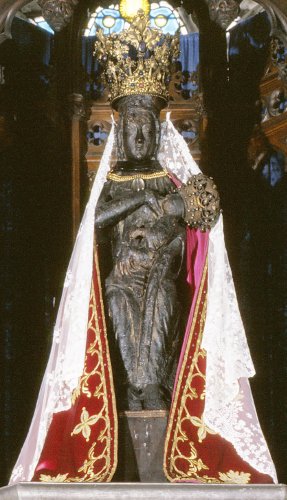
According to tradition, Ludwig IV of Thuringia sent this and three other Black Madonnas home to his wife St. Elisabeth of Hungary (d.1231) when he was on his way to the Crusades. He never made it further than Southern Italy, but Belgium profited from this treasure he secured. St. Elisabeth left the statue to her daughter Sophie of Brabant, who in turn left it to her daughter Matilda, Countess of Holland, who gave it to the church St. Martin in 1267. The church was declared a basilica in 1946.
Marian devotion in Hal, however, goes back much further. In ancient times a sacred oak tree bearing a Madonna statue, was venerated. Several ancient European religions held oak trees sacred, from the devotees of Zeus in the South to the followers of Thor in the North. This particular sacred tree remains to this day. Early on a sanctuary was built to enclose it. Now the remains of the trunk of this king of trees are still honored in the crypt of St. Martin, where you'll also find the remains of several human monarchs.
Our Lady of Hal is one of the first Madonnas of the type virgo lactans
(nursing virgin) that appeared in Western Europe towards the end of the
Middle Ages. With her right hand Mary offers her breast to baby Jesus.
A little booklet in the sanctuary has much to say about this kind of Madonna.(*1)
It acknowledges that depictions of the divine child being
nursed by his mother go back not only to earliest Christian times, but
probably have their roots in Egyptian Isis worship. In the Christian world
they are justified by this Bible passage: "While he (Jesus) was speaking,
a woman from the crowd called out and said to him, "Blessed is the
womb that carried you and the breasts at which you nursed." (Luke
11:27) Although Jesus does not respond favorably to this woman's outcry,
Christian liturgy echoes her veneration of Mary. E.g. in the octave of
Christmas it says: "Blessed are the breasts that nursed Christ, the
Lord." The Church Fathers, notably St. Augustin, often contemplated
the miracle of the human Virgin-Mother nursing God as her baby.
The author of the booklet in Hal also cites an old Latin hymn that sings
out: "Oh glorious woman, elevated above the stars, Him who created
you by his design, your sacred breast has nourished."
The nursing virgin
theme disappeared in middle and late Byzantine art, but reappeared in
late medieval Italy, then France and the rest of Europe. 17th century
Greek icons of this type are called 'the most holy nurturer of our life'
(panaghia trophos).
|
|
But let us return to Hal. After
the reformation, a fierce struggle engulfed Belgium as Catholics
and Protestants fought for control over the country. Our Lady of
Hal, as the most ancient and most important Marian shrine of Belgium,
became the symbol and rallying point for Belgium Catholics. Therefore
the Protestants, who had already demolished so many statues, made
it a priority to destroy the Black Madonna of Hal as well. In 1580
the deciding battle took place. An overwhelming Protestant army
laid siege to the town, bombarding it with canon balls. But, legend
says, the Queen of Heaven appeared on the city walls and intercepted
the fiery balls in her lap. The gunpowder turned her black. The
grateful population brought hundreds of canon balls that had landed
inside the city walls to Our Lady, piling them under her bell tower.
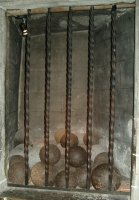
32 of those are still kept in the church. |
|
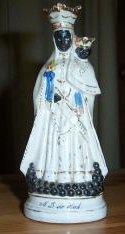
In 1667 an epidemic ravaged the city and did not stop until on the first Sunday in September the Black Madonna was carried in a fervent procession along a path that stopped at all the churches and chapels of Hal dedicated to Our Lady. This so-called Wegom (big tour) is still followed with a solemn procession every year on the first Sunday in September. Pilgrims also walk this Wegom individually. It takes about 1 1/2 hours. The traditional 'small tour' is to circumambulate the altar space containing the statue three times (but not during masses).
___________________________________________________________
(*1) A. Houssiau, Notre Dame de Hal, edited
by R. Decoster, Halle, p. 5-6+12