Santa Catarina Juquila:
The Virgin of Juquila,
La Juquilita,
La Morenita (Dear Dark One),
originally: the Most Pure Virgin of the Conception of Amialtepec.
In the state of Oaxaca, about 4 hours Southeast of Oaxaca City, 16th century, about 30 cm natural wood with burn marks from a fire.
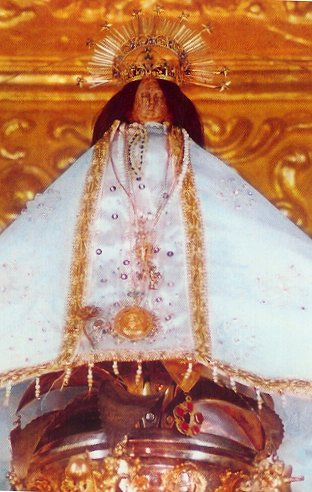
There are several versions of the legend of this Dear Dark One. The most
common one claims that her first known owner was a Dominican priest called
Frey Juan Jordán de Santa Catarina. He was the first to bring Christianity
to the state of Oaxaca. Some say he brought this statue from the Philippines,
which would explain the oriental hair do under her wig. He kept this little
figure on his personal altar until he moved on to another area in 1558.
The monk had an indigenous house servant who was from Amialtepec and who
had a great love for this Morenita. Upon his departure the priest gave
the Madonna to his faithful, young servant. The humble peasant kept her
on an altar in his hut and that's where she first began to perform miracles.
With that her fame quickly spread.
75 years later, in 1633, the Church authorities took notice of this Virgin
so well loved among the Indians. Seeing that her owner was well advanced
in years, the clergy decided it was time to build a church for her. Only
that way could they ensure that the image would be surrounded by a truly
Christian cult and that the offerings people had been leaving to her would
be used appropriately. The old Indian servant was at first opposed to
this idea, but somehow he was persuaded to let the Dark Mother move out
of his hut and into a Christian temple.
Now every winter the locals would burn their fields in preparation for
spring sowing. One year a great wind suddenly whipped the fire out of
control and it consumed the whole village, including the church. The villagers
barely got away with their lives. When they returned to see if the fire
had spared anything, they found the only surviving object in the church
and the village was the Most Pure Virgin standing on her sculpted agave
plant, on which she still abides today. The fire stained her face dark,
owning her the title Morenita.
With her miraculous survival of the flames the Black Madonna's fame spread
even more. Apparently this led the priest in the nearby town of Juquila
to covet the famous statue. His name was Jacinto Escudero and he announced
that the Virgin really should reside in a larger, more dignified, and
more accessible church - i.e. his own. Again her owners did not want to
let her go, but were somehow "persuaded". However, it seems that Our Lady
also wanted to stay with the simple folk in the mountains and so, the
night after she had been brought to Juquila, she stole back to Amialtepec.
The Indians were punished for stealing her, she was brought back to Juquila
and guarded day and night. Still, she escaped again and returned home.
Now tension between the two towns rose to dangerous levels as she was
ordered back to Juquila for a third time. Extra guards, chains, and locks
were installed. But the Mother of God was not going to be chained down.
In a flash of light she was back with the villagers. With that the priest
finally saw the error of his ways, he relented, and the people's fervor
for their Dark Mother doubled.
Because of the violent and stubborn way in which Jacinto Escudero had
handled the whole situation he was transferred to Guadalajara. Unfortunately,
after a while he forgot the powerful signs the Virgin had worked in order
to make her will known. In his conceit he pitted the Church against the
Queen of Heaven, asking the bishop of Oaxaca to move Our Lady back to
Juquila. And so in 1719 the bishop talked to the people of Amialtepec
until they finally gave into his insisting request. They expected their
Mother to miraculously return to them a fourth time and as often as was
needed, even if they allowed her to be brought to Juquila. In order to
show their good will they even participated in a great, solemn procession
escorting her with much pomp.
Unfortunately they were disappointed. The gentle Mother did not wish to
fight her Church any longer. She tries to teach her children, but she
can't force the clergy to learn. We're not sure what exactly happened
next; the historical records burnt in a fire. But somehow many people
died in the church during the Morenita's first days in Juquila. Some think
there was fighting, others say many who entered were struck by a plague
of sorts, caused either by natural or supernatural powers.
Nonetheless the image remained there and gradually people accepted the
Mother's new home. She appeased them by continuing to work miracles in
both her old and new domicile. Her children learned how to honor her in
both places.
This is what they do to this day: For the thousands of pilgrims who come
to Juquila every week their visit starts in Amialtepec, 9 kilometers before
Juquila. There they go to the chapel of 'El Pedimento' (the request),
a shrine high on a hill near the original site. The ground around El Pedimento
is dense clay, which is considered sacred and is said to have healing
properties. People use this clay in various ways. Some rub their faces
with it, some eat it, but most use it to give shape to their requests.
As God created the earthling (Adam) out of clay so the children of God
co-create their dreams. They sculpt little clay houses, cars, farm animals,
food, husbands, body parts that need healing, anything they want…. Then
they attach a message addressed to the Virgin and lay their "request"
at the feet of a large ceramic copy of the Black Madonna. On their return
the following year they bring a cross with some type of sign on which
they give thanks for the granting of last year's favor.
So popular is this shrine that each day a caretaker hauls all of the offerings,
requests, and crosses out back, forming an enormous holy dump pile.
Having finished at El Pedimento, the pilgrims continue to Juquila. Many crawl the last two kilometers, from the entry area to the actual statue, on their knees. They make their way along a dirt road that leaves their knees bloody upon arrival. Once at the feet of their Mother, many pilgrims make a promise (a promesa), something like: "If you get me safely to the USA I will come back here to give you thanks when I return to Mexico." Or: "If you grant me a child I will make this pilgrimage three more times in my life."
Many stories testify to this Dark Mother's willingness to help her children. She is credited with curing the ill, raising dead babies back to life, granting sudden wealth, etc. But there is a price. You have to keep your promise and you have to observe chastity during the pilgrimage. One story tells of "a lusty, overeager couple who stopped by the roadside to engage in some hanky-panky and presto, were changed to stone. To this day, it is said, they are stuck there, somewhere off in the mountains, belly-to-belly."(1)
The feast day of the Morenita of Juquila is December 8th. On any given day "you'll pass hundreds of pilgrims on foot and bicycle, some camping out for days, even months. You'll wend among truckloads of the faithful packed under tarp-covered pickups, forming a kind of modern-day wagon train."(2) On her special day the roads become particularly jammed. The occasion is celebrated with a fair, fireworks, sporting events, indigenous and contemporary dances.
______________________________________________________________
*1: Carlos Amantea, Our Lady of Juquila: Lovers Set in
Stone, www.ralphmag.org
*2: Most of the information in this article is based on the story told
on the back of a Mexican calendar depicting the Virgin of Juquila, but
some information, including this passage, is taken from Carol Alice and
Geri Anderson's internet article: A
Day in Santa Catarina Juquila