USA, New York City:
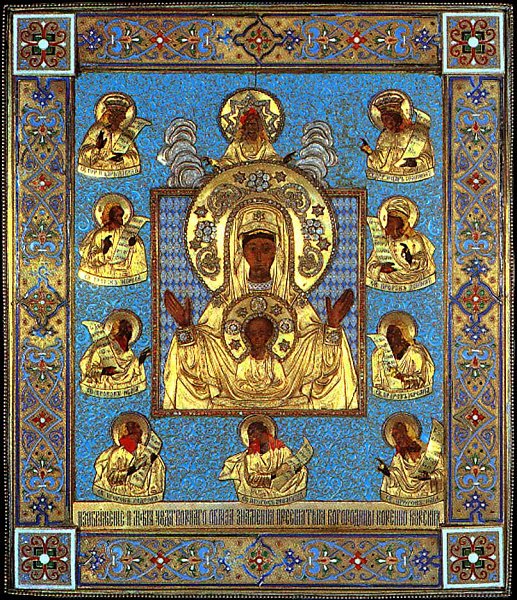
The Kursk Root (Korennaya) Icon of the Mother of God of the Sign
In her Cathedral of Our Lady of the Sign (Znamenia Cathedral), 75
East 93rd St. But she travels a lot, visiting her Russian Orthodox children
all over the world. To make sure she is home check her schedule here
or call the cathedral at (212) 534-1601. 13th century, about 18 inches
high, painted icon with precious metal, enamel cover. For more
on her original home see Kursk in this index.
It is ironic that the only “real” Black Madonna
(not just a copy) in the USA isn’t actually a Black Madonna in the
strict sense. Certainly she is dark, ancient, miraculous, strong willed,
and connected to the earth. But she is Russian Orthodox and the Orthodox
Church doesn’t give the title ‘Black Madonna’ to any
images. Its Madonnas are usually dark. If they are very special, they
carry other beautiful titles like “glorified icon”.(*1)
I include the Kursk Root icon in this index for three reasons: 1) because
she shares so many characteristics with Black Madonnas. 2) because North
American lovers of the Dark Mother should avail themselves of any opportunity
to meet her in person. 3) in gratitude to people like a certain David,
who brought this Madonna to my attention.
Her name:
Kursk is the city in Russia near which this icon was found. ‘Root’
recalls that she was found at the root of a tree, as will be explained
below. But I think there is a deeper meaning that echoes in this title
– something to do with the Mother of God being our root, our mother
who came from the earth and grew into the Divine. In the "Hail Queen
of Heaven", a famous Marian prayer, Mary is simply addressed with
"hail root and gate..." Certainly to her Russian Orthodox children
the Kursk Root icon also represents their roots in Russian soil.
Mother of God of the Sign is a very common type of Orthodox icon of Mary
where she is depicted in the ancient posture of prayer (standing and with
arms outstretched) while carrying Jesus within her. To me, this perfectly
exemplifies what we are to do in meditation: know that God is in you and
let go of everything else in perfect surrender.
Her story:(*2)
In the 13th century, during the dreadful period of the Tartar invasion
of Russia, the devastated province of Kursk was emptied of people and
its principal city, Kursk, became a wilderness. Now, the residents of
the city of Rylsk, which had been preserved from invasion, often journeyed
to the site of Kursk to hunt. One of the hunters, going along the bank
of the river Skal, noticed an icon lying face down on the ground next
to the root of a tree. No sooner had he picked up the sacred image than
there immediately gushed forth with great force an abundant spring of
pure water. This took place on September 8th, the feast day of Our Lady’s
birthday, in the year 1295.The hunter constructed a small wooden chapel
and placed the newly manifested image of the Mother of God therein. The
residents of Rylsk began to visit the place of the manifestation of this
holy object and the icon was glorified by more miracles. So many of the
miracles involved the spring and another 7 healing springs nearby that
I would call the place the Lourdes of Russia.
Soon Prince Vasily Shemyaka of Rylsk ordered that the icon be brought
into the city of Rylsk. This was done in a solemn manner, with the people
of the city going forth to meet the icon of the Mother of God; but Shemyaka
himself declined to attend the festivities and for this reason he was
punished with blindness. Realizing his mistake, he repented and straightway
received healing. Moved by this miracle, Shemyaka constructed a church
in the city of Rylsk in honor of the Nativity of the All-Holy Theotokos
(Mother of God), and there the miraculous icon was enshrined on September
8th, the day of its manifestation, appointed as the annual feast date.
However, as so many Black Madonnas, she had a will of her own and kept
miraculously returning to the place of her appearance. The residents of
Rylsk continually brought her back, but each time she returned to her
former place. Then, understanding that the Mother of God was well pleased
to dwell in the place of the manifestation of her image, they eventually
left her there in peace. Innumerable pilgrims streamed to the site and
services of supplication were celebrated there by an ascetic priest called
Bogoliub, who lived next to the wooden chapel.
In the year 1383, the province of Kursk was subjected to a new invasion
of Tartars. They decided to set fire to the chapel, but it refused to
burn, even though they piled up fuel all around it. So the Tartars accused
the priest Bogoliub of sorcery. The pious priest denounced their foolishness
and pointed instead to the will of the miraculous icon. That that, the
malicious Tartars laid hold of it and cut it in two, casting the pieces
to either side. The chapel then caught fire and the priest Bogoliub was
carried off a prisoner.
In his captivity, the God loving man placed his hope in the all-holy Mother
of God. One day, as he was guarding flocks and passing the time by singing
prayers and doxologies in honor of the Mother of God, some emissaries
of the Tsar passed by. They heard this chanting, arranged to ransom the
priest from captivity, and Bogoliub returned to the former site of the
chapel. There he found the pieces of the miraculous icon which the Tartars
had cast away. He picked them up and straightway they grew together, although
the signs of the split remained. Learning of this miracle, the residents
of Rylsk gave glory to God and to His all-pure Mother. Again they attempted
to transfer the holy icon to their city, but once more the miraculous
image returned to its former place. A new chapel was then built on the
original site of the icon's appearance and here it remained for about
200 years.
The city of Kursk was revived in the year 1597 at the command of Theodore Ivanovich of Moscow. This pious Tsar, who had heard of the miracles of the icon, expressed his desire to behold it. So it was brought to Moscow, where it was greeted with great solemnity. The Tsaritsa, Irene Theodorovna, adorned the holy icon with a riza (a precious metal cover to protect and adorn an icon). At the command of the Tsar, the icon was set in a silver-gilt frame upon which were depicted the Lord of Hosts and prophets holding scrolls in their hands. The icon was subsequently returned and, with the close cooperation of the Tsar, a monastery was founded on the site of the chapel. A church, dedicated to the Life-bearing Spring, was built above the spring that had appeared when the icon was first revealed. The monastery attached to it was called the Kursk Root Herrnitage in honor of the manifestation of the icon at the root of the tree.
During the next war, an invasion of Crimean Tartars, the icon was transferred
to the cathedral church of Kursk, and an exact copy was left at the Hermitage.
Tsar Boris Godunov bestowed many precious gifts for the adornment of the
icon and even the pretender, the false Dimitry, who desired to call attention
to himself and to win the support of those who lived in the vicinity of
Kursk, venerated this icon and placed it in the royal mansions where it
remained until the year 1615.
While the icon was absent from the city of Kursk, the grace-bearing aid
of the Mother of God did not forsake that city, for when in the year 1612
the Poles laid siege to Kursk, certain of the citizens beheld the Mother
of God and two radiant monks above the city. Captured Poles related that
they too had beheld a woman and two radiant men on the city walls, and
that this woman made threatening gestures at those who were conducting
the siege. The besiegers were quickly put to flight. In gratitude the
citizens made a vow to construct a monastery in honor of the all-holy
Theotokos and to place the miraculous icon therein.
In March of 1898 a group of anarchists, desiring to undermine the faith of the people in the wonderworking power of the icon, decided to destroy it. They placed a time bomb in the Cathedral of the Sign, and at two o'clock in the morning a horrendous explosion rent the air and all the walls of the monastery were shaken. The frightened monks rushed immediately to the cathedral, where they beheld a scene of horrible devastation. The force of the blast had shattered the gilded canopy above the icon. The heavy marble base, constructed of several massive steps, had been jolted out of position and split into several pieces. A huge metal candlestick which stood before the icon had been blown to the opposite side of the cathedral. A door of cast iron located near the icon had been torn from its hinges and cast outside, where it smashed against a wall and caused a deep crack. All the windows in the cathedral and even those in the dome above were shattered. Amid the general devastation, the holy icon remained intact and even the glass within the frame remained whole. Thinking to destroy the icon, the anarchists had, on the contrary, become the cause of its greater glorification.
During the Bolshevik revolution, the icon disappeared from the Cathedral
of the Sign on April 12, 1918 and was nowhere to be found. Thankfully
it was rediscovered under the following circumstances: Not far from the
monastery there lived a poor girl and her mother who for three days had
not had anything to eat. At that time Kursk was controlled by the Bolshevik
regime. On May 3, the girl, a seamstress, went off to the marketplace
in search of bread. Returning home at about one o'clock in the morning,
she passed by a well which, according to tradition, had been dug by St.
Theodosius of the Caves. There, on the edge of the well, she beheld a
package wrapped in a sack, and when she opened it, in the package she
found the sacred icon. (I imagine someone fed her that night.)
At the end of October 1919, when the White Russian Army was evacuating
the city of Kursk, twelve monks of the monastery took the icon from city
to city until she ended up aboard a ship to Greece. From there she went
to Serbia, back to Russia, back to Serbia and from there all around the
Russian Diaspora: from Yugoslavia to Austria, Czechoslovakia and finally
to Germany in the spring of 1945. The holy icon proved to be an unending
consolation to many thousands of people who were experiencing all the
trials and tribulations of the latter years of World War II. From Munich
the icon was borne to Switzerland, France, Belgium, England, Austria,
and many cities and camps in Germany itself. In 1951, the icon was transferred
to the New World where it had its permanent residence first in the New
Kursk Hermitage in Mahopac, N.Y., and then in the Synod's Cathedral Church
of the Mother of God of the Sign in New York City.
At present, a festival is held in honor of the icon at the New Kursk Hermitage
in Mahopac, N.Y., on the Sunday nearest the feast of the Nativity of the
Most Holy Theotokos, and in the Synod's Cathedral of the Mother of God
of the Sign in New York City on November 27/ December 10.
Meanwhile in Russia, since 1618 to this day, every year (political circumstances permitting) on Friday of the ninth week after Russian Orthodox Easter, the icon of the Sign (or a copy of it when it is in the Diaspora) is solemnly borne in procession from the Kursk Cathedral of the Sign to the place of its original manifestation at the Korennaya (i.e. Kursk Root) Hermitage in Soboda Village (about 30 km from Kursk) where it remains until September 13th. Then it again is solemnly returned to the Kursk Znamensky Monastery for the winter. In the year 2005, 30,000 Russians attended the ceremonies.
Recent Miracles of the Kursk Icon of the Most Holy Mother of God
Since its miraculous appearance in the forest of
Kursk in the 13th century, the wonderworking icon of the Mother
of God of the Sign, has been a constant source of healing, comfort
and deliverance from calamity to countless numbers of Orthodox Christians.
With its departure from the Russian land following the defeat of
the White Army, the icon continues its miraculous aid in all the
countries it is carried to. A couple of themes in the long stories told on the website strike
me: the aspect of the Mother of God which is present through this
holy icon often doesn’t heal people directly or instantaneously.
Instead it works in conjunction with humans. She seems to demand
their cooperation in the effort to heal. |
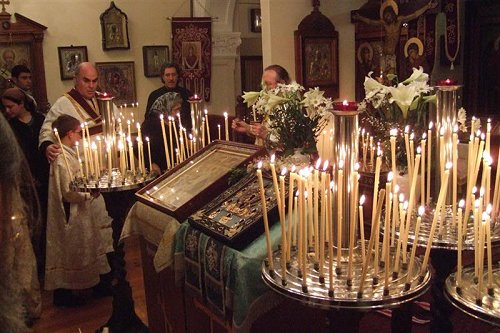 The Mother comforts her children in Australia. |
The most famous example is Saint Seraphim (born Prokhorus Moshnin) who
was born in the city of Kursk in 1759. At the age of 9 Prokhorus became
so ill that he wasn’t expected to recover. Just at that critical
time, in his sleep he had a vision of the Most Holy Mother of God promising
to visit and heal him. Next time the wonderworking Kursk-Root Icon was
carried in procession through Kursk, it went through his family’s
property. His pious mother Agathia took her sick child in her arms and
carried him out to the Mother of God. The boy kissed the Icon and, soon
after, he completely recovered.(*3) Of course the
Queen of Heaven could have healed him in the initial vision in the dream,
but she wanted someone to bring her icon near him and his mother to carry
him to her. Only then did she grant healing.
Similarly Galina Alexandrovna, was healed in 1949 only after her fiancée
Sergei Shenuk found a way to bring the Kursk Root icon to her hospital
room, ceremonies were performed, and with that the patient improved to
where a necessary operation could be performed. She lived, married Sergei,
and became pregnant only with divine intervention after 4 years of not
being able to conceive.
In 1963 her husband became seriously ill and was in and out of hospitals
for 1 ½ years. The doctors couldn’t find a way to heal him.
Finally the miracle-icon made it to his bedside and he knew all would
be well. But it still took a friend visiting and coming up with a new
treatment idea that the doctor in charge wanted to reject but found himself
accepting instead (all by divine influence).
The next story involves Maria Smimova and her fiancée. In 1953,
she was deadly sick with tuberculosis. The doctors had given up on her.
Finally her fiancée at least was able to pray for her in the presence
of the holy icon of the Dark Mother. He was in the USA at the time and
Maria in Europe. Here is his account of his meeting with the Madonna:
“On the analogion in the middle of the church, all in the glow of
many candles, lay the miracle-working image. I also put up a candle and
for the first time in my life drew near and venerated this great and holy
icon. I was caught up by an unusual feeling of joy and reverence. For
the first time in several years I saw tears of compunction on many faces.
The holy wonder-working icon lay some two or three paces from me! The
unusual spiritual fervor engulfed me. Some kind of link of the present
and past passed before me. I did not feel time — I was outside of
time. I relived my childhood and youth. Everything was here in this image,
and somehow, involuntarily, a fervent mental prayer began to pour forth
of its own accord. "Dear Mother and Protectress, heal my ailing Maria,
and unto the end of my days I will not eat meat on Wednesdays and Fridays!"
(At that time I did not know that by church regulations, Orthodox Christians
are not permitted to eat meat on Wednesdays and Fridays.)”
Again the patient only recovered to where an operation was finally possible.
Only after that did she become completely well again. – Fascinating
how Holy Mary made the fiancée take a vow for life. She needs us
to do our part. It is not minor and sometimes making deals with God really
works!
_____________________________________________________________________________
*1: For a great website about other miracle working icons of black and
white Madonnas in the Russian Othodox church click here.
*2: As told on the Russian Orthodox websites orthodoxwiki.org
and fatheralexander.org.
I edited the text some.
*3: http://en.nycathedralofsign.org/history1.html