Mende:
1. Notre-Dame de Mende
Queen of the city and county
In the cathedral, Mende is in the department Lozère, region Languedoc-Roussillon. 70 cm, 11th century or 1219 are
given as possible dates of creation, olive wood.
Photos: crowned and robed as seen in church, Ella Rozett
without robes, Jean-Francois Salles
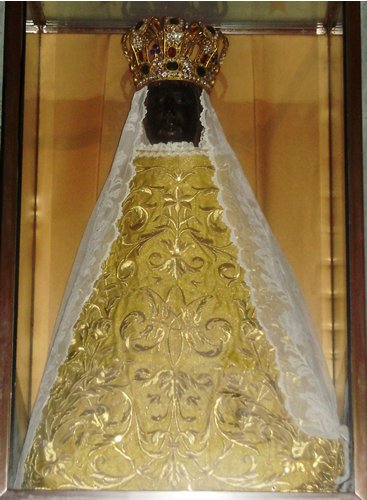
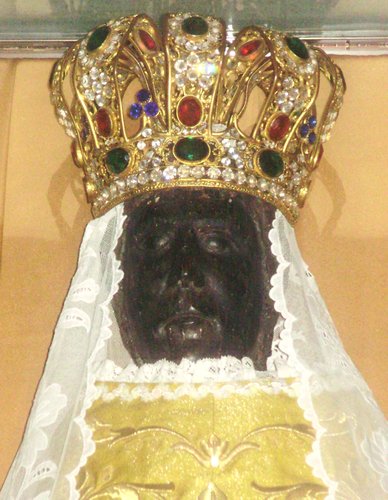
While this Black Madonna is robed in the traditional garb
that hides most of the statue, her picture on the votive candles sold
in the church shows her round belly and nipples quite clearly. It gives
her that aura of fertility goddess.
The beautiful cathedral is dedicated to her and to the 3rd century Saint
Privat, whose remains used to be kept in the crypt of the cathedral. They
were mostly destroyed during the Wars of Religion and the Revolution.
What is left of them is kept in the hermitage chapel on the sacred mountain
at whose foot Mende lies.
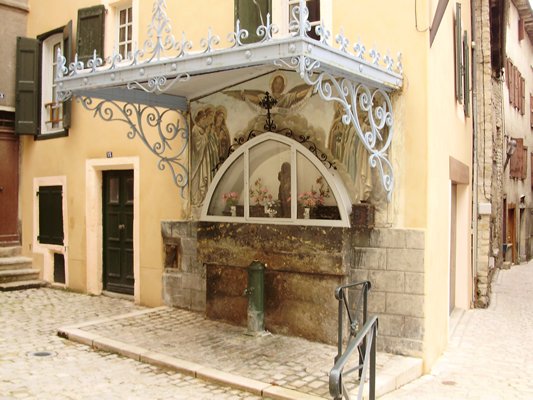
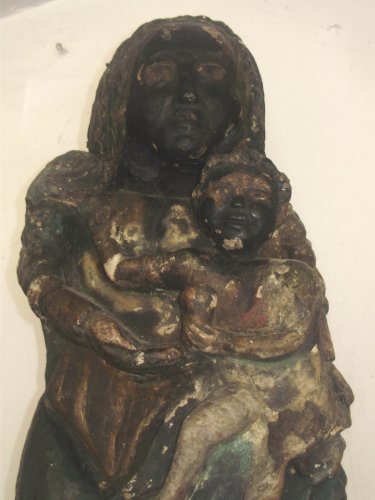
This city really has all the marks of an ancient holy site: a Black Madonna
in a cathedral built on top of a pre-Christian temple, a second Black
Madonna at a well, a sacred mountain with a cave (la Grotte du Mont Mimat)
to which annual pilgrimages are still held. No wonder the Queen of Mende’s
altar, like that of many Black Madonnas, bears the inscription “privileged
altar”. Special graces are given here.
Tradition says that she was brought to Mende from the Middle East between
1212 and 1222 by the bishop and crusader Guillaume de Peyre. Her first
mention in historic documents is from 1249. Another church document from
1857 lists the relics imbedded in her back: “some hairs of the Virgin
Mary, pieces of her clothing and her tomb, fragments of the true cross,
as well as of saints Peter, Paul, Andrew, Martial, Dennis, and James.”
(*1)
She was saved from Protestants and Revolutionaries by courageous church
ladies who risked their lives for her. It was during the Wars of Religion
that she lost baby Jesus and her hands. Her survival was celebrated with
a solemn coronation in 1894 on August 15th, the feast of the Assumption
of Mary into Heaven, a national holiday in France.
Fifty years later World War II was raging. A notice on the wall of the
cathedral tells this story: On the eve of the 50th anniversary of Our
Lady’s coronation, in 1944, Mende was occupied by two thousand Germans.
During the traditional August 15th procession in honor of the Queen of
Heaven, something of a political nature happened around Mende that normally
would have had tragic consequences. In desperation the guardian of Notre-Dame
put the city under her protection and promised to celebrate the 50th anniversary
of her coronation with all the pomp and circumstance it deserved as soon
as it would be safe to do so. Two days later the city was intact and not
a single German left in it. After the war, on 8/18/1946, this miracle
and her coronation were commemorated with a triumphant celebration.
Ean Begg mentions a perpetual lamp in her shrine offered to her in 1314,
but I didn’t see it in 2009.(*2) Perhaps it
stayed in the main altar space where she resided for a while before she
was moved to a side chapel. I’m always happy when a perpetual lamp
burns before Our Lady because it indicates the presence of the divine.
Begg also mentions the crypt of Saint Privat from Gallo-Roman times, built
on top of a Pagan temple, but the crypt is sealed now and only opened
for the occasional burial of a bishop.
|
In the Rue Notre-Dame behind the cathedral down to the left, 50 cm. Photos: Ella Rozett Note the angel in the mural above theMadonna holding a scroll. It says “Nigra sum sed formosa”, i.e. “I am black but beautiful”. It is a phrase from the Song of Songs often quoted in Black Madonna shrines and drawing positive attention to her blackness. (For more see introduction under “The Church’s Explanation for Black Madonnas”, point 7.) |
|
|
1: Félix Buffière, Ce tant rude Gévaudan, volume I, p.937
2: Ean Begg, The Cult of the Black Virgin, Penguin Books, London: 1985, p. 200