Mauriac:
Our Lady of Miracles
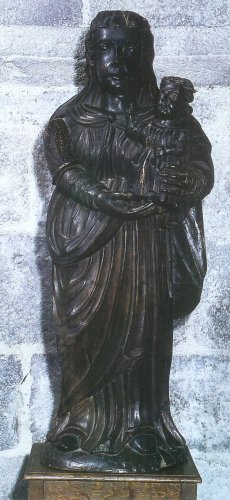
One evening around the year 507 A.D., Théodechilde, daughter of the Merovingian King Clovis saw a great light in a nearby forest. She headed for that place and drew near in time to witness a gathering around a sacred stone.(*1) By the time she arrived on the scene the only ones left were a statue of the Virgin Mary guarded by two stone lions. This was clearly a sign that Mary was to take the place of the goddess Cybele, whose presence on earth was a sacred stone and who was usually accompanied by two lions. The torch of the Great Mother, Queen of Heaven, had been passed on to the Virgin Mary.
|
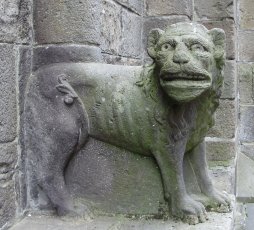
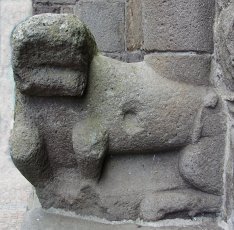
Princess Théodechilde let a chapel be built on the place with stones taken from a pagan temple, and founded a Benedictine monastery to guard it. (The remains of which can still be visited.) She ordered the nuns to always keep an 'eternal lamp' burning before the miraculously appeared image. To this day two stone lions guard the entrance of the church, one is the original the other was stolen and replaced by a copy.(*2) Photos: Ella Rozett |
 |
 |
Though the log of Our Lady's many miracles was burnt during the Revolution, people still remember some of them. They say she stopped a devastating period of rains in 1816 and the cholera in 1832. During the Crusades two French men were captured in the Orient and chained in a dungeon. When they implored Our Lady of Miracles for help, she transported them, during the night, in an instant to Mauriac. Their irons can still be admired as ex-voti in the church.
| By the 11th century, so many pilgrims flocked to Our
Lady of Miracles that a bigger church was needed. (Even St. Dominic
spent two days at her feet.) Yet the local priest was more concerned
about enlarging his own house than the house of God. When he tried
to do so by infringing upon the garden of the Queen of Heaven, she
struck him and two of his workmen dead. In order to appease her wrath,
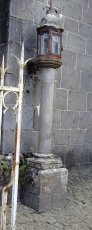
the present day basilica was quickly erected. Throughout the Middle Ages, people wanted to be buried as close to an altar or holy place as possible, in order to ensure their soul's salvation. Hence a great cemetery grew up around the church of Mauriac. Religious plays reenacting Biblical stories were held in it and a rare lantern of the dead still stands there to this day.(*3) People used to light a candle in it each night to guide the newly deceased on their journey and to announce to the community that someone had died. Similar, though much bigger 'lanterns of the dead' remain in the Dordogne region, e.g. in Atur, Coussac Bonneval, and Sarlat. |
 |
Jacque Huynen and Ean Begg draw attention to the 10th century baptismal font in the basilica sporting a Templar cross and other symbols. To them these "esoteric" signs point to a connection between Black Madonnas and the initiation rites of Christian orders which used to practice alchemy. The three children who are portrayed during their baptism represent alchemists (who called themselves 'children') receiving initiation.(*4)
Yet much of what certain authors call "secret, esoteric knowledge" is perfectly mainstream. E.g. baptism is routinely referred to as a 'Christian rite of initiation' in which the old self dies with Christ and the new self resurrects with him. The teachings aren't hidden, though the words are "self-secret" in the Tibetan sense, i.e. meaningless for those who haven't prepared spiritually to hear their transformative message.
|
What is much more interesting in this church is the local saint
who is honored there. It is Blessed Catinon Menette, a poor French
peasant woman who lived an exemplary Christian life. During the
Revolution this nun accompanied the parish priest to the guillotine,
not heeding the insults and threats to her own life. That's why
she is portrayed with a cloth stained with the blood of the priest.
But why is she portrayed as brown skinned when she was a white woman?
"Just the style that imitates Byzantine icons. It means nothing,"
says the present parish priest. |
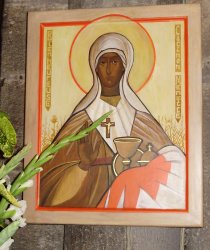 Photo: Ella Rozett |
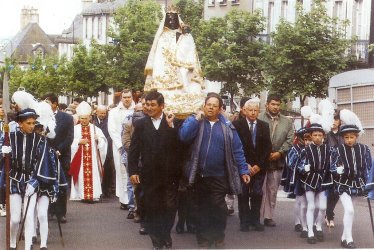
| An annual procession on the Sunday following May 9th
still draws many pilgrims. Since 824 A.D. that date is considered
to be the anniversary of the Virgin's apparition to Théodechilde.
The children of the town play an active role in the festivities. The
boys dress up as knights and St. John the Baptists, the girls as angels
and Virgin Marys. Beautiful songs are sung that day to Our Lady of
Miracles. Here is one of them: You, Our Lady, to you we sing! You, Our Lady, to you we pray! 1. You who carries life You who carries joy You who touches the spirit You who touches the cross. |
 |
| 2. You who gives hope You who keeps faith You who passes by death You who stands in joy. |
3. You, your heart on your sleeve You, honey and wine You, joy to the eyes Oh smile of God. (*5) |
____________________________________________
*1:" Notre Dame des Miracles: Mauriac, cite de la Vierge" a booklet
published by the parish of Mauriac and available in the sacristy translates
"Saint Peter" instead of sacred stone. Since Peter means stone
or rock, I guess the true meaning has to be determined by the context
and is subject to interpretation.
*2: Jean-Robert Maréchal, Les Saints Qui Guérissent en Auvergne, Éditions
Ouest-France: 2004, p. 115-6
*3: Ean Begg, p.198
*4: Ibid. and Huynen, p. 159-160
*5: The parish booklet, p.9