Marsat:
Our Lady of Marsat
Photo: Francis Debaisieux
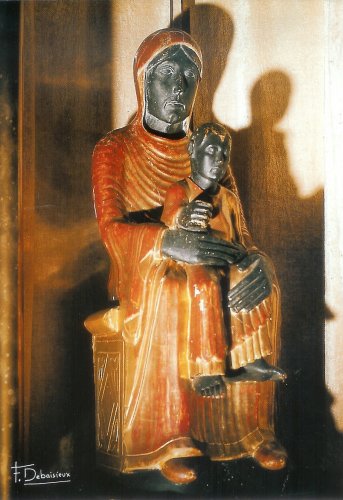
Although this Black Madonna was light skinned for most of her existence, she was no less powerful or miraculous. Since her whole style matched the classical Black Virgins of France, she was an easy pick for the Romanticists, who painted quite a few Madonnas black.(*1)
Romanticism was a cultural protest movement against the one-sided glorification of reason. It wanted to restore balance between the 'light of reason' and the primordial darkness of nature, between scientific progress and the spiritual depth of medieval traditions, between instinctual faith and knowledge.
In choosing Our Lady of Marsat for their message of fertile darkness,
Romanticists drew renewed attention to one of the oldest Marian shrines
in France. Tradition has it that the cult of Mary in Marsat was established
by one of the seventy two apostles whom Jesus sent out into the world.
His name was Martial and he brought with him a holy souvenir, a belt of
Mother Mary. The first written record of this belt and miracles happening
at its shrine stem from Gregory of Tours, the 6th century 'father of French
history'. From the 7th century to the Revolution first nuns then monks
were charged with guarding Mary's shrine and belt. The remains of their
monastery can still be visited, but the belt somehow ended up in Prato,
Italy.
| In 916 A.D. the Normans were about to attack Riom, a small town three km from Marsat. In terror the inhabitants begged the Queen of Heaven for protection. They vowed to offer her every year at her sanctuary in Marsat a candle as long as the circumference of their town, if only she would save them. She granted their request and since then until 1792, every year on the Sunday after the Ascension, a procession of faithful brought an enormously long wick dipped in wax and rolled up on a wheel, from Riom to Marsat. This is how the wheels of fire, offered to Our Lady in several churches, are explained. Other great miracles performed by the Madonna of Marsat include delivering her children from the plague in 1631. The statue was solemnly crowned in 1939, but only wears her crown on special occasions, such as her feast day on the first Sunday in May. |
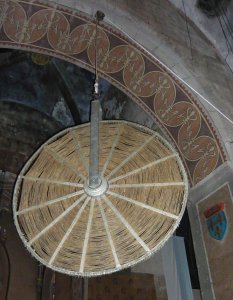 photo: Ella Rozett |
| As many Christian sanctuaries in the Auvergne, so this one too is near a sacred well. A little road side shrine covers the spring of clear water and houses another 12th century Black Madonna that was mutilated and is called Our Lady of Pity. Pitiful Lady would be a more accurate name for the beheaded, barely recognizable remains of a mother and child behind the metal grid.(*2) |
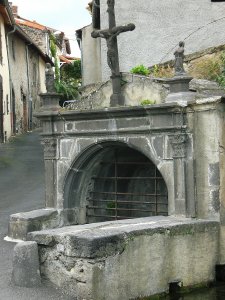
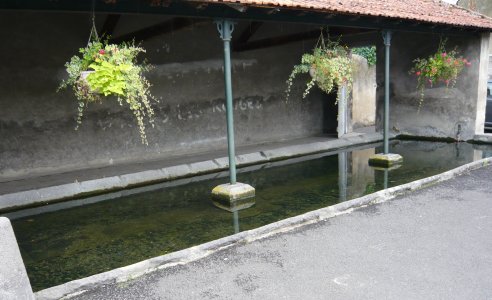 You'll find this fountain and the old public laundry basin its waters flow into, within 200 feet of the entrance to the church, through an ally. It says that the water is non-potable. Maybe the nearby Volvic bottling facility does not want competition. Photos: Kaaren Patterson (l), Ella Rozett (r) |
Our Lady of Marsat has been associated with the theme of light and darkness ever since the above mentioned St. Gregory of Tours recounted the following experience: He came to Marsat by night and saw the whole building full of light. The door opened for him by itself, but as he entered, the church was plunged into darkness.(*3) The story calls to mind John 1:5 "The light shines in the darkness…" but also psalm 139:12 "Darkness is not dark for you, and night shines as the day. Darkness and light are but one."
Several authors have guessed at the color symbolism of this Black Madonna, dressed in red and gold. I suggest red and gold represent her two natures, human and divine, which in later centuries will be denoted by red and blue. (See introduction) Mary shares these two natures with her son, as we all potentially do. This would explain why Jesus' undergarment is pure gold, while his outer garment is as red as Mary's: He was divine first, then became human. Mary's dress in contrast, was first painted red, then overlaid with a golden hue: she was human first, then became divinized.
__________________________________________________________________
*1: Brigitte Romankiewicz, Die schwarze Madonna:Hintergründe einer
Symbolgestalt, Patmos Verlag, 2004, pp. 124-128
*2: Jean-Robert Maréchal, Les Saints Qui Guérissent en Auvergne, Éditions
Ouest-France: 2004, p.101
*3: in his De Gloria Martyrum, quoted in: Ean Begg,The Cult of the
Black Virgin, London, New York: Routledge & Kegan Paul Ltd, 1985,
p.197.