Les-Saintes-Maries-de-la-Mer:
Sara la Kali (Sarah the
Black One)
Sarah the Egyptian
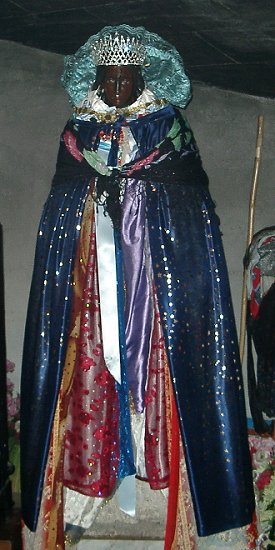
In the church in the center of this little seaside town in the Camargue, Provence. Life size.
photo: Ella Rozett
|
Although Sara la Kali is not Mary, the mother of Christ, she is often discussed in the context of Black Madonnas because she is a Dark Mother. The Gypsies(*1) venerate her as their queen, but she is also a mother to all the local Catholics who feel a connection to her. Her devotees fall on their knees before her, part her many robes and dive in head first under her skirts, resting their devout heads on her feet. Thus they pray and when they are done, they carefully and lovingly put each veil back in its place. Then the next person comes, parts the curtain, and plunges in.
So who is this Saint Sarah? |
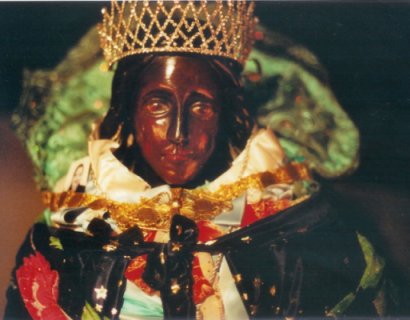 photo: Petra Buda |
1. Saint Sarah's first appearance stems from Vincent Philippon's book
The Legend of the Saintes-Maries, written in 1521.(*2)
In this record of an older oral tradition she is the Egyptian servant
of three Maries, Mary Magdalene and two other women who came to Jesus'
tomb the morning of his resurrection, carrying spices for anointing the
dead. The people of Provence call them Marie Jacobé and Marie Salomé,
though Mark the evangelist calls them Salome and Mary the mother of James.
Vincent Philippon portrays Sarah as a charitable woman, who helped people
by collecting alms. This activity led to the popular belief that she was
a Gypsy.
A much earlier medieval legend recounts the story of the "three Maries"
without mentioning Sarah. It speaks of the first Jewish persecution of
Christians. At that time our three ladies along with Martha and Lazarus
of Bethanie were condemned to what seemed like certain death: They were
set adrift in the Mediterranean Sea in a leaky little skiff without sails
or oars. Yet, by the will of God they arrived unharmed in France as the
first missionaries of Christ. The town where they came ashore is now called
Les-Saintes-Maries-de-la-Mer. While Mary Magdalene went on from there
to evangelize Marseille, the other two Maries (and Sarah) stayed.
2. The Gypsies picked up the belief that Sarah was one of them and turned her into a French Gypsy princess, schooled in the esoteric wisdom of her people. One day Sarah had visions which informed her that the saints who had been present at the death of Jesus would come, and that she must help them. Soon she saw them arrive in a boat struggling against a rough sea. She threw her cloak on the waves and by the power of her prayer it became a raft with which she helped the saints reach the shore safely. Soon she became their first convert in France.(*3)
3. Yet another legend claims that the 3 Marys coming to France after Jesus' ascension into Heaven carried with them the "Holy Grail" and that this holy blood was actually Sarah, the daughter of Jesus and Mary Magdalene. (Other similar legends call their child St. Michael.)
4. Some say Sara la Kali is a form of Kali, the Hindu goddess of death.
This seems plausible since the Gypsies themselves are descendents of India.
Kali means black both in Sanskrit and in Romani, the language still spoken
by many European Gypsies. Perhaps for the purpose of appeasing the Catholic
Church, Kali was hidden inside another story of the sacred feminine, that
of Sarah. The Gypsies couldn't very well tell the clergy: "By the way,
we're keeping our goddess of death and destruction in your basement!"
Since the gypsies themselves deny this interpretation adamantly(*4)
one could only posit an unconscious continuity between their ancestors
worshipping Mother Kali in India and their contemporaries celebrating
Sara la Kali as their mother.(*5) I would say the
same subconscious continuity of the Dark Mother archetype plays a role
in all Black Madonna worship. Whether earlier Dark Mothers were called
Kali, Cybele, Artemis, or any other name, doesn't make much difference
in this context. What matters is that the archetype holds something we
still need. For more on links between the Indian Kali, the Near Eastern
Great Mother, and Black Madonnas see the introduction to this index, under
the headings "Pre-Christian Black Mothers" and "Celtic Goddesses".
5. In 2006 I prayed and meditated at the feet of Sara la Kali, asking her: "Who are you?" The response was a somewhat angry insistence: "I will not answer that question!" Then I realized that the black feminine at the heart of the white Church is meant to hold the place of unlabeled mystery, a space that is to remain free of any concepts, free of arrogant claims like: "I know the absolute truth about her and you'd better listen to me!"
The Gypsies say, at the time of Sarah, they worshipped the Goddess Ishtari
or Astarte. Once a year they carried a statue of her on their shoulders
into the sea to receive its blessings. Now it is Sarah herself who is
carried to the sea. Each year on May 24-25, a great crowd of European
Gypsies, tourists, and local Catholics gathers to process the statues
of Saints Sarah, Mary Salome and Mary Jacob into the waters and then back
to their church. Only in 1935 did the Gypsies obtain permission to dip
their queen into the sea.(*6)
Bathing sacred images is an ancient custom to be found in many cultures.
Once a year the Romans bathed their goddess Cybele in a river. To this
day, many peoples bathe their holy images, from non-Christians in the
Philippines, who bathe statues in blood(*7) to Buddhists
bathing baby Buddha on his birthday in tea, to Hindus submerging their
Goddess Durga in water. Until modern times, some Christian communities
used to bathe statues of Mary on Good Friday with wine signifying the
blood of Christ.(*8) Likely, all these practices
go back to the dawn of civilizations when the blood of sacrificial animals
was poured over a sacred stone representing a god.
In 1448 the King of Provence had a part of the crypt excavated and found some remains of Marie Jacobé and Marie Salomé, plus a sacred healing stone that is referred to as 'the pillow of the saints'. Now the relics accompany Sarah and the two Maries during the great procession.
_________________________________________________________________________________________
*1: Though many consider the term 'Gypsies' to be politically incorrect,
no consistent, more correct term is universally agreed upon by the 'Sinti
and Roma". Hence I stick with what people know.
*2: See: an excellent article on "Saint Sarah" in www.en.wikipedia.org
lists all these legends with sources.
*3: Franz de Ville, Tziganes, Bruxelles, 1956
*4: See article Myths and Traditions of the Roma on http://www.imninalu.net/traditionsRoma.htm
*5: Some render Sara la Kali as 'Queen Kali', though it is more correctly
translated as 'Sarah the Black One'. cf. Jacques Huynen, "L'Enigme des
Vierges Noires", Chartres: editions Jean-Michael Garnier, 1994, p.
*6: 182 Ean Begg, The Cult of the Black Virgin, p. 221
*7: See: Mary Beth Moser, p.116
*8: See: Francois Graveline, "Vierges Romanes", editions Debaisieux, p.
26 and a 2008 pamphlet in the chapel of the Black Madonna of Aurillac.