Montserrat, Barcelona:
Our Lady of Montserrat
La Moreneta (Catalan: the Dear Dark One)
La Jerosolimitana (the Jerusalemite)
Patroness of Catalunia
In her sanctuary in the mountains near
Barcelona, 12th century (?), painted wood, 38 inches.
photos: Mark Veermans
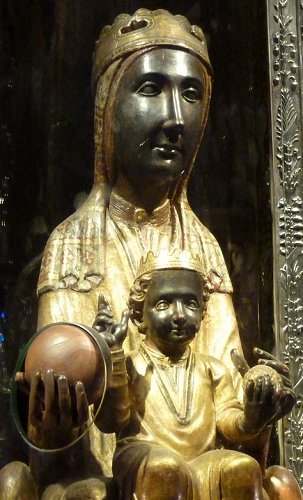
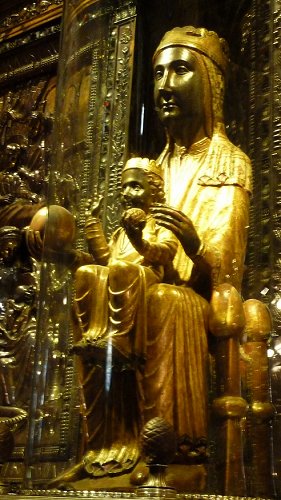
According to one legend, Luke carved this statue with Mary sitting as his model and him using the carpentry tools of Joseph. Later Peter brought it from Jerusalem to Barcelona. - Another story says that some other disciple in Jerusalem carved her and that she had some connection with St. James, the brother of Jesus who led the church in Jerusalem and later went to Spain. This version credits Bishop St. Eteres with bringing the image to Barcelona. Asides from these discrepancies, the story continues uniformly.
In the 8th century Spain was invaded by Muslims and Barcelona besieged
for three years. In 718, when defeat was imminent, Our Lady was
taken to the nearby mountains, hidden in a cave, and apparently
forgotten. A monastery grew up around the Jerusalemite, which became instrumental in spreading the cult of Black Madonnas throughout the world. Many churches, settlements, even islands in the New World (in Mexico, Chile and Peru) were named after Our Lady of Montserrat. So she may be seen as the Mother of the dark Madonnas of the Americas. |
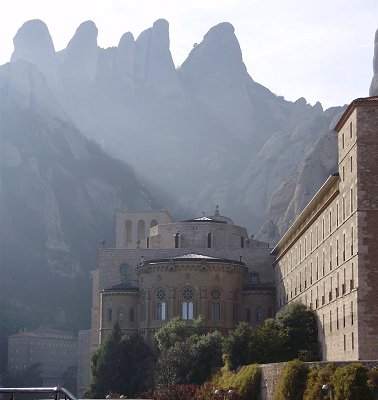 Her church with surrounding monastery and hotels. Photo: Ella Rozett |
|
In the course of the centuries many miracles have been attributed to Our Lady of Montserrat and in 1881 she was the first Spanish Virgin to be crowned by the Church. Of the many saints who went on pilgrimage to the Dear Dark One the most famous is St. Ignatius of Loyola. It was at her feet that he definitively abandoned his worldly life, offering her his saber and all it represented after spending a whole night in a prayer vigil before her. One of the treasures of the monastery of Montserrat is the Libre Vermell, the "Red Book" of 14th century music. Its introduction explains: "As it happens that the pilgrims, while holding night vigil in the church of the Blessed Virgin of Montserrat, sometimes desire to sing and to dance and even so during the day, in the church square, where only virtuous and pious songs may be sung, some suitable songs have been written down here for this need. These should be used in a respectful and moderate manner, so as not to disturb those who wish to continue their prayers and religious contemplations."(*1) - Is that what St. Ignatius did all night with the Virgin: sing and dance?! Let's go spend a night dancing and singing to Mary! |
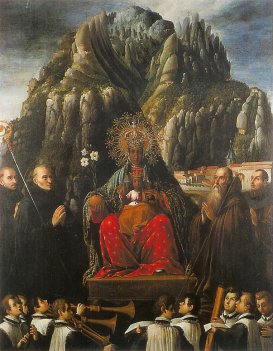 I love this painting of the Black Madonna's holy mountain, where she is held as in the palms of God, surrounded by praying hands of flesh and rock. By J.A. Ricci, "Mare de Déu de Montserrat", c. 1640, in Museu de Montserrat |
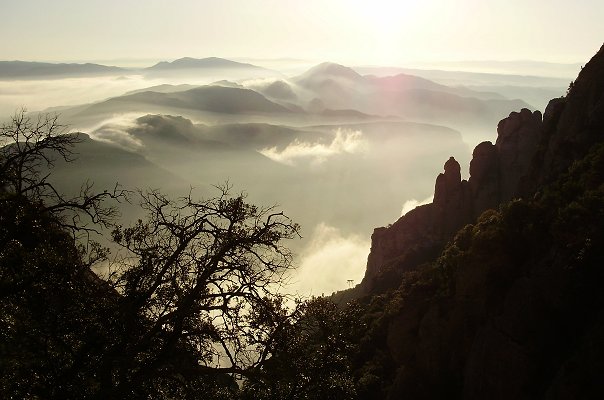
Morning view from the sanctuary on the way to the Santa Cova. Photo: Ella Rozett
___________________________________