Nuria:
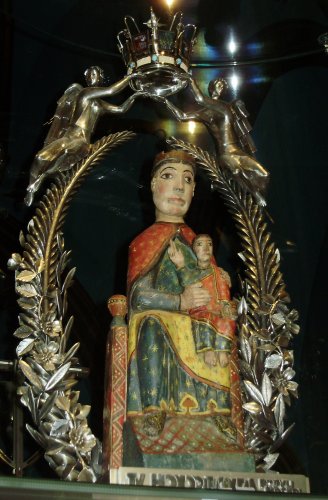
Our Lady of Nuria
The Dear Dark One (La Morenita)
Queen of the Pyrenees
Patroness of Shepherds and of the Diocese of Urgel
In her own sanctuary high in the Pyrenees,
about one hour from Barcelona, 7th - 12th century, 56 cm, painted wood,
recently whitened during restoration.
Photos: Ella Rozett
|
But some time in the 11th century, a lover of the Virgin came from the Orient. He was a pilgrim from Damascus by the name of Amadeus. An angel had appeared to him in a dream, telling him to go to the Pyrenees and to build a temple to the Madonna in a place where a white stone stood between two rivers. If he dug there he would find a great treasure. When he arrived at the site, local shepherds watched him and miraculously understood when he addressed them in Syrian. He found the place he saw in his dream, built the chapel and a hermitage, but couldn't find the treasure. Seven years passed until a bull was seen beating his horns into a stone wall and roaring. (For more on the relationship between bulls and Black Madonnas see Olot.) The shepherds took this as a sign that something important was behind that wall. Busting through it, they found a cave of white stone that shone so brightly when it was lit up that it almost looked like crystal. That day too it was filled with an otherworldly light that revealed St. Gil's cherished objects. |
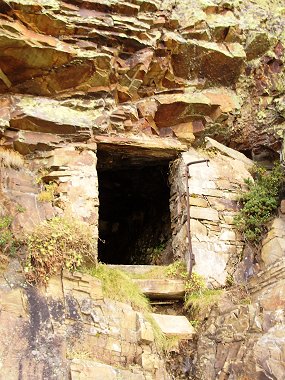 One of three caves near the sanctuary that were inhabited by Gil and Amadeus. |
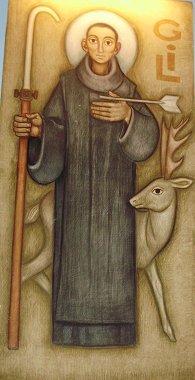 St. Gil and his only companion later in life: a deer whom he saved from hunters by intersepting their arrow with his body, which earned him the post of patron saint of cripples. A painting in the chapel of the Black Madonna. |
Soon the hermitage was restored and its reputation for being a powerful holy place spread. Everything about it was considered sacred: The stone had curative properties and people pulverized it and took it as medicine. (It's all gone now.) The water from the spring next to the cave is also said to heal. The cross is said to cure eye diseases. The bell and cauldron are used in a unique fertility ritual performed by barren couples.(*1) While the woman prays and sticks her head into the cauldron, her husband carefully rings St. Gil's bell. He must be very attentive because each ring will result in a birth! When a girl is born in answer to this ceremony one is to name her Nuria, if it's a boy, Gil. There are lots of Nurias in Catalonia!
In 1075 high ranking clergymen decided to move the Dear Dark One out of the wild mountains and bring her down to the more civilized environs of Caralps. But as so often, Our Lady refused. She gradually became more and more heavy until no one could move her and the people realized that she insisted on remaining in her sanctuary. On the return journey she seemed to weigh nothing.(*2)
During the 13th century a hermit brother of the Knights Templar was guardian of the sanctuary. Centuries later, during the Spanish Civil War, it was destroyed, but Our Lady was kept safe in a Suisse Bank! After the war this holy site with its guest houses for pilgrims was restored. A Knights Templar cross still adorns the modern church.
La Morenita's feast day is September 8th. On that day a reunion of many girls and women named Nuria is celebrated. The Virgin is carried in procession from her 'temple' to the hermitage of St. Gil where her devotees sing her praises.(*3)
Tips for the pilgrim:
A cog train takes you the last bit of the way and drops you off right
next to the sanctuary at the 'Vall de Nuria' station. The line begins
in Ribes-Enllaç, but if you want you can drive as far up as Ribes
de Freser. Nuria is not only a sanctuary but also a small ski and hiking
resort. So there are hotel rooms and cafeterias available. The modern
architecture is not all beautiful, but it's a magical place anyway. The
Queen of Heaven rains supreme here and, as in Montserrat, you can sit
and meditate right behind her throne in a room up behind the main altar.
_______________________________________________
*1: Sophie Cassagnes-Brouquet, p.201 and www.Mercaba.org
*2: Ean Begg, The Cult of the Black Virgin, London, New York: Routledge
& Kegan Paul Ltd, 1985, p.257.
*3: http://pirineos.com/article/articleview/1063/4/ 4. El Santuario de
Nuria, entre la Leyenda y los Milagros.