Olot:
Mother of God of the Bull (Mare de Déu
del Tura),
Patron of Olot
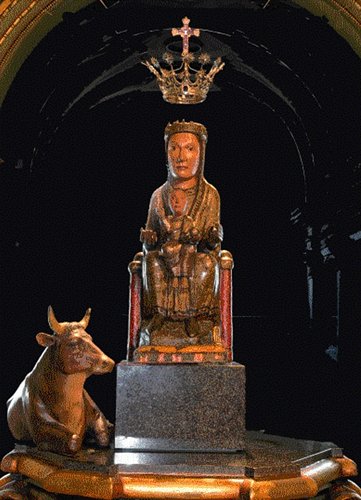
In the church by the same name, Carrer de l’Aigua, 12, state: Catalonia, open daily 8 a.m. – 9 p.m., original image from 872(?), present one from 11th/12th century and heavily restored in more recent years, 60 cm, painted wood. Olot lies between three dormant volcanoes. Walking a few minutes up the road from the front door of the church will take you to a crater.
|
Legend recounts that the Black Madonna del Tura was discovered in the Cueva de Mas Caritat outside the city, in 872. A bull kept strangely bellowing in a certain place until people dug and uncovered this treasure. She ows her name to this animal with spiritual sensitivity, for ‘tura’ is an old Catalan word for ‘toro’ i.e. bull. Almost all copies, holy cards, and paintings of this Madonna show her with her bull.
|
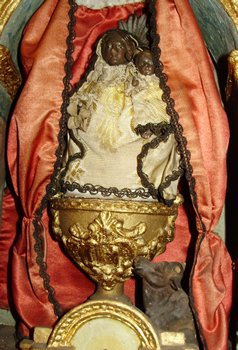
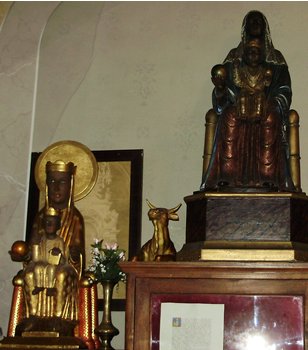
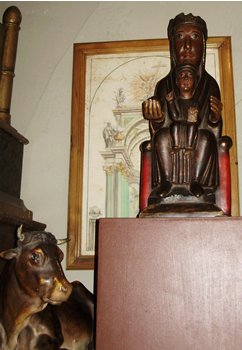
While the original statue has been whitened during recent renovations, all the copies around the church and in the sacristy show the Mother of God of the Bull to be a Black Madonna. |
Sacred Bulls, Oxen, and Cows in Christianity?
It is very striking how many Black Madonnas are said to have been buried
in the earth and later found with the help of an ox, bull, or cow with
a spiritual sense. Heaven used these animals as guides for humans and
as conveyors of the will of God. Examples in my index are: Foggia,
Guadalupe de Cáseres, Lord,
Milicia, Nuria, Prats-de-Mollo,
and Telgte but there are many more. So many in
fact that Ean Begg in his trend setting index tires of telling the story
over and over. He abbreviates it with one word ‘cattle’.(*1)
The question here is not whether animals have souls or consciousness and
are able to pick up on spiritual energies. Neither do we need to wonder
how many of these cattle stories might have been real. What’s important,
I think, is to ask why this legend of the bull, ox, or cow finding a Black
Madonna in the earth was so popular that it was told all over Europe with
minor variations? What is its message and intent? The answer is manifold.
In the article “Nuestra Señora del Tura” Gozo argues
that such stories are invented to augment the veneration of a certain
image by giving it an air of ancient origins and mystical blessings.
Furthermore, since the bull was the preferred animal sacrificed in sin
offerings by Jews and Roman followers of Mithraism and other cults, the
bull resembles Christ who was also sacrificed for others’ sins.(*2)
I agree with that author, but there is more to it. So let’s take a closer look at the role of bovines in Christianity and the religions that had an influence on it.
Foremost of course there is Judaism out of which Christianity grew. The
prophet Ezekiel describes a vision of God on his throne accompanied by
four beings with four faces each: a human, a lion, an ox, and an eagle.
(chapter1:1-14) They are expressions of the power of God that Christians
later adopted as symbols for their four evangelists.
I Kings 7:23-26 describe a basin in the temple of Salomon that is supported
by 12 oxen, presumably representing the 12 tribes of Israel. Again, Christians
copied this idea and built baptismal founts supported by 12 oxen, representing
the12 apostles of Jesus.(*3)
The Canaanites, in whose land the Israelites settled, worshipped a God
called El (the same name Jesus uses for God when he cries out on the cross
“Eli, Eli…!” which means “my God, my God”).
El was figured as the infamous Golden Calf Aaron sculpted for the people
while Moses spent time with God on Mount Sinai. El was often addressed
as Bull.
|
In the Roman Empire the devotees of Attis would
literally be showered, washed in the blood of a consecrated dying
bull and thereby felt themselves freed of all sin and “born
again”. (Compare Leviticus 17:11 and Revelation 7:14) In Egypt the god Osiris was believed to be embodied by ritually
perfect bulls, who lived in his temples their whole lives and were
embalmed at the time of their deaths. Meanwhile his wife Isis was
associated with cows. She often wears cow’s horns on her head.
|
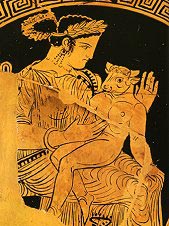 Pasiphae with her Minotaur son |
|
The matriarchal Minoan civilization
of Crete consistently linked their goddesses and holy sites to sacred
bulls. Bulls’ horns marked a place as having sacred authority.
As the consort and son of the goddess heavenly bulls were sacrificed
and resurrected each year.(*5) Since at least
2600 BCE bull leaping festivals were held throughout the year, marking
the passing of the seasons. But bulls were also killed and sacrificed
by priestesses as a way of passing life force from the gods and
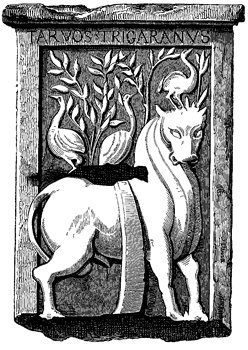
ancestors to living individuals.(*6) In Greece Hera was the Queen of Heaven who presided over all things feminine. Homer complimented her by calling her “cow-eyed” or “cow-faced” and cows were sacred to her. The earth-goddess of agriculture, Demeter or Ceres, was also sometimes portrayed as a peasant woman riding a bull.(*7) Dionysus was not just the Greek god of wine but also another god of death and resurrection with strong links to the bull. He was frequently portrayed with bull horns.(*8) The Celtic religion also knew a divine bull and sacrifices of consecrated bulls. On the right you see "The Holy Bull", a Celtic monument found in Paris in 1711, under the choir of Notre-Dame-de-Paris. (It is preserved in the Musée de Cluny ot des Thermes.) Pagan deities in general were often close to the earth, worshipped in sacred groves and accompanied by sacred animals. |
 |
In Christianity, besides being the symbol for Luke the Evangelist, the
ox, bull, or cow doesn’t really get mentioned until Saint Francis
of Assisi (1182-1226) popularizes the image of baby Jesus in the manger
accompanied by ox and ass. Saint Francis is the Christian champion of
nature and animals. He preached to them and appreciated how well they
lived out his ideal of poverty in flesh and spirit (that poverty which
was his way to divine union).
Other than next to the manger, cattle only plays a significant role in
the Christian world in the context of the Black Madonna. Why? Because,
as I explain in the introduction, she has strong ties to the earth and
to pre-Christian goddesses. I would argue that if the Queen of Heaven
insists on being dug up from the earth, or at last sensed in the earth,
by animals that were held sacred in pre-Christian religions, she is making
a strong statement. Or, if not she, then her devotees want to say something
about the divine being present not just in heaven, but also in the earth,
not just in humans, but also in animals, not just since the birth of Jesus,
but since time immemorial.
I wouldn’t doubt that with so many sacred bovines tredding through
the Roman Empire and the Bible the sacred cow, bull, or ox had sunk deep
into the subconscious of the people. They surely didn’t remember
why, but somehow those animals still had a connection to the divine in
the collective unconscious.
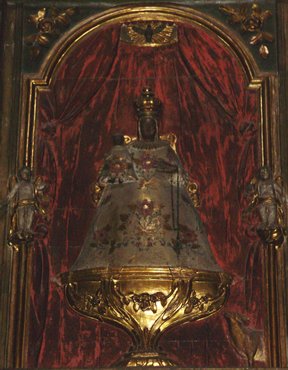
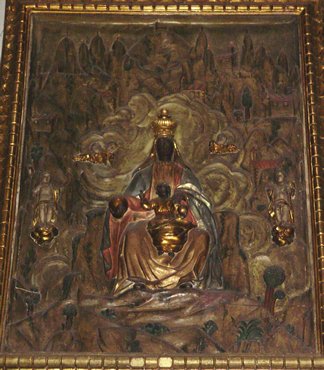
The biggest church in Olot is Sant Esteve, where you’ll find these two copies of Black Madonnas. One is Santa Maria del Tura (notice the bull on the bottom right) the other Our Lady of Montserrat held in her mountains as in the hands of the earth. Many Spanish images of the Dark Mother of Montserrat show her with her mountain. Here you see again how the people appreciate her closeness to Mother Nature. |
 |
 |
First Steps before the Black Madonna: a Unique Olot Tradition It is a local ritual: when your baby is about ready to walk, you bring it before Santa Maria del Tura, put brand new shoes on its feet and let it take its first steps in the presence of the Virgin while the mother recites this prayer: “Here I bring you this child of mine, because in jumping from my arms I want it to take its first steps before you and before God.” As Mary presented Jesus in the temple, the parents present their child to God through Mary. |
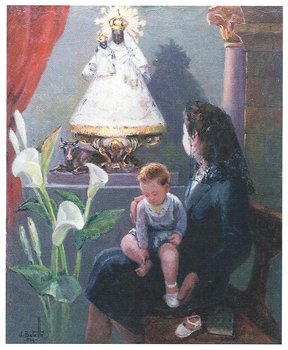 oil painting by Juli Batallé, 1954 |
___________________________________________________________________________________________________________
*1: Ean Begg, The Cult of the Black Virgin, Arkana: 1985. By
coincidence my index doesn’t yet include any cattle stories from
France, but Begg’s infinitely more complete index certainly does.
E.g. Manosque, Limoux, Font-Romeu/Odeillo
*2: In the internet magazine of the Spanish ministry of culture “Animalario:
Visiones humanos sobre mundos animals”
*3: Two such fonts survive from Romanesque times in Liège, Belgium
and Trier, Germany.
*4: Jack Dempsey, Calendar
House, chapter 7. A great book on Minoan culture.
*5: L. Caruana, the
Rape of Europa
*6: Jack Dempsey, op. cit.
*7: Miquel Ballbè i Boada, Las Vírgenes Negras y Morenas
en España, Vol. 1, Gafiques ISTER, Moia/Terrassa: 1991, p.31.
*8: Wikipedia article on “Dionysus”