Prats-de-Mollo:
Notre-Dame d'El Coral
(Our Lady from the Heart of the Oak?) (*1)
In her church of the same name, region Languedoc-Roussillon,
department Pyrénées-Orientales, 13 km from Spanish border
crossing. Church closes at 7 p.m., 9th - 13th century
photo: Madame
Dulac
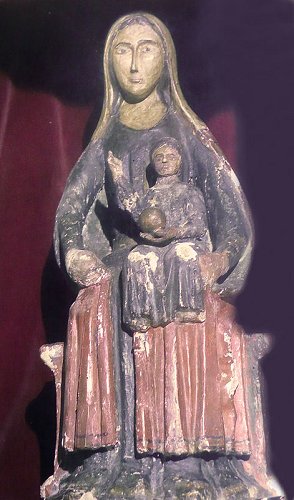
As so many Black Madonnas this one too was restored to her original fair skin color and discovered miraculously in the 13th century. But her history begins at the end of the Muslim occupation of Southern France in 811 C.E. In that era many Christian hermitages sprung up in remote areas, in part as a way of reclaiming those lands for Christendom. One such hermitage was established in Miralles, the original home of this Black Madonna, about 10 km from Prats-de-Mollo. The monks erected a little chapel and placed in it a Madonna. A village grew around the sanctuary, but after some time the hermitage and chapel were abandoned and fell into ruin. Someone placed the Madonna into her oak tree and then she was forgotten. (Maybe the locals had preferred being Muslim?)
Centuries later a herdsman was attracted to her by his bull, who wouldn’t stop mooing in front of her tree.(*2) Other miracles must have followed because all of a sudden great devotion to Our Lady from the Heart of the Oak spread in the area. A church was built for her on the very spot where the old chapel had been and the hermitage was reopened. It kept having to expand to accommodate all the pilgrims. The first written record of a church called Sancta Maria de Coral is from the year 1267. Her cult continued uninterrupted until the French Revolution when all church property was confiscated by the state. In 1790 the statue was auctioned off to the highest bidder. Luckily she was not burnt like so many other Black Madonnas. A group of Catholics from Prats-de-Mollo bought her with the intent to keep her cult alive. The village Miralle didn’t survive without its heavenly mother. All that is left of it is the hermitage that is still called after her even though since 1931 it is no longer a sanctuary but just a hostel and country inn.
| Many Black Madonnas are venerated in the vicinity of healing waters and this one is no exception. Only a few kilometers away lies the spa town La Preste. In the 14th century, people with leprosy used to bathe in the ’Leper’s pool’ to help relieve their symptoms. Now they come for urinary tract illnesses. | 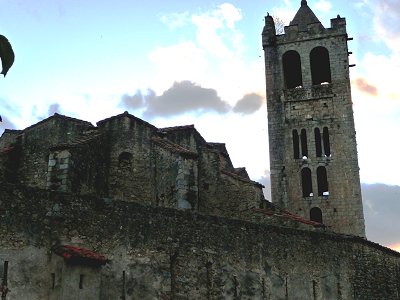 photos: Marylou Hillberg: her church against the evening sky |
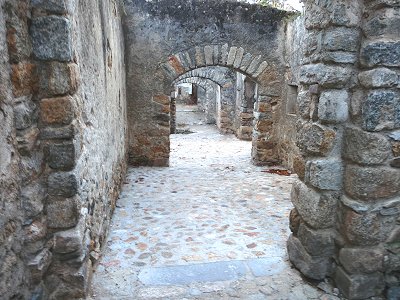 the 14th century church ramparts. |
The Virgin and the Bear Ean Begg mentions an annual Bear Festival, which he describes as the continuation of a Pagan Bear cult.(*3) He seems to have a point. Bears are somehow imprinted in the psyche of the people of this region. Not far from Prats-de-Mollo, across one or two mountains, lies Finstret with its own Black Madonna and a statue of St. Columba with her bear. Saint Columba of Sens was born around 257 in Spain and beheaded in France in 273 for being a Christian. It is reported that, at the age of 16, she fled Spain for Gaul (modern France) to escape the persecutions of Emperor Aurelian, but to no avail. While she was in prison, one of the guards tried to rape her. He was stopped by a bear, a fellow prisoner who was held to serve as one of the wild beasts that were to devour Christians and other prisoners in the arena. She still was martyred, but with her virginity in tact and thankful to a bear. Hence we see her blessing the bear at her feet. Likely that whole story was invented to give a Christian justification for images of a sacred woman with a bear. |
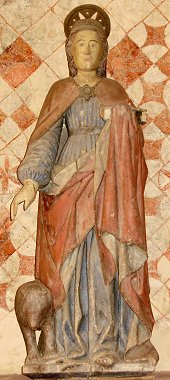 St. Columba blessing her bear |
|
The virgin and bear theme comes up again in local
bear festivals that have been celebrated for centuries, and in
some form probably for millennia. They are still held in three
villages of Vallespir, the name of this area: Prats-de-Mollo,
d'Arles-sur-Tech and Saint Laurent de Cerdans. The festivities
were traditionally linked to the Virgin Mary by celebrating them
on one of her high holidays: Candlemas, also known as the Purification
of the Virgin, on Februar 2nd. In modern times they are held more
towards the end of February, followed by three days of Carneval
(Mardi Gras) festivities. |
|
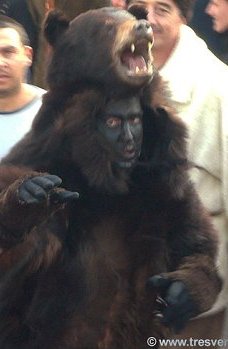
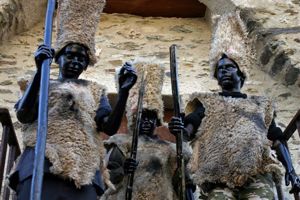 and
his cubs.
and
his cubs.
_______________________________________________________________________
*1: A French
website on the history of Roussillon proposes 4 very different explanations
and translations for her name. I find Our Lady from the heart of the Oak
the most likely because it goes with the legend, which means that’s
the meaning the local populace has been seeing in her name for centuries.
The author explains that in Old French the word for Couer de chêne
(heart of an oak tree) was coral.
*2: For more on the relationship of bulls and Black Madonnas see Olot.
*3: Ean Begg, The Cult of the Black Virgin, Penguin Books, London: 1985, p.212
English sources: http://www.anglophone-direct.com/Fete-de-l-Ours-Prats-de-Mollo
French sources: http://www.tresvents.fr/tradition/fete-ours.php and http://histoireduroussillon.free.fr/Thematiques/Batiments/Histoire/ErmitageNotreDameDuCoral.php