Pézenas:
Our Lady the Black One
(Notre-Dame la Noire)
the Virgin of Bethlehem
(la Vierge de Bethléem)
Pézenas is in the Hérault department
of the Languedoc-Rousillion region. The original is in the treasury/museum
behind Collegiale Saint Jean's church at the Place du Marché,
usually open daily 3-6 p.m. The copy that is venerated as the presence
of Notre-Dame la Noire is in Sainte Ursule's church in the Rue Henri
Reboul, open only during mass on Fridays at 9 a.m., 12th century or
older, darkened cedar wood/painted wood, 60 cm.
photo: Marylou Hillberg
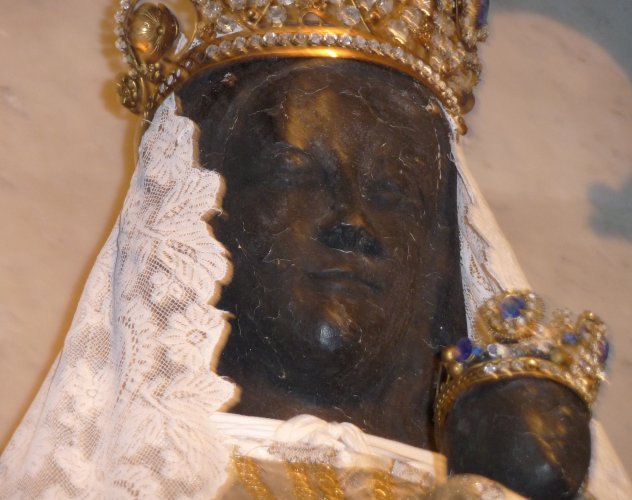
| Tradition says that Our Black Lady washed
ashore somewhere in France where a sailor from Pézenas found
her and brought her to his home town. However, an 18th century manuscript
written by a certain Officer Poncet claims that a Commander of the
Pézenas chapter of the Knights of St. John brought two Black
Madonnas back from a Crusade. Presumably he “found” them
together on the island of Rhodes. The Knights of St John are also
known as the Hospitallers or the Knights of Malta. When the Knights
Templar were eradicated in 1312, much of their property went to the
Hospitallers who had many parallel characteristics. Since their first
military action on Rhodes ended in 1310, one can conjecture that the
statue is at least from the 12th century. Since the knight who brought
her to Frnace was originally from Toulouse, he gave one of the statues
to the church of La Daurade in Toulouse
and the other to his order’s church in Pézenas (Saint
Jean de Jérusalem’s)
Ean Begg states that Napoleon III “dedicated a (perpetual) lamp in her shrine to gain her support for his army (…) against the Turks in 1860.”(*1) However long before him, the people of Pézenas already set up a perpetual lamp for their black Mother and had this important act of recognizing her divinity notarized on May 18th 1340. So we know her cult to be at least that old. (For more on perpetual lamps dedicated to Mary read in the introduction under the sub-heading “Christian and non-Christian Feminist views”.)
|
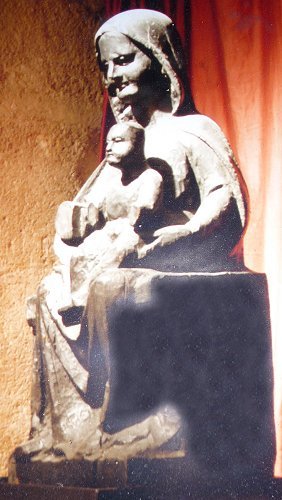 the original in the museum |
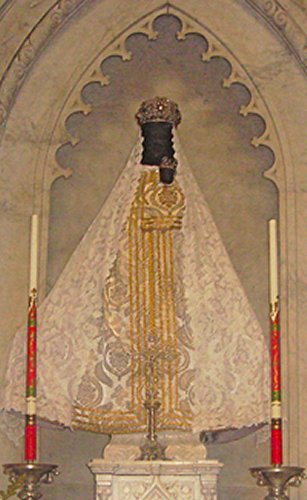 the one in Sainte Ursule, photo: Lena Robinson |
During the Revolution the statue escaped destruction, but not
without a scratch. Mary lost her right hand and both feet; Jesus was scalped
and also lost his right hand. The church of the Maltese order, which she
had inhabited, was destroyed and Our Lady left among the ruins. Taking
her life into her hands, Madame Vidal, a pious woman, asked a revolutionary
if she could take “that worm eaten piece of wood as a toy for my
grandkids”. When he agreed, she hid the statue under her smock and
brought her to the priest who was at the head of the women’s confraternity
headquartered at the Ursuline convent. After the Revolution, when the
convent church doubled as a parish church, it was decided to keep it as
the permanent home of Our Black Lady.
Notice her smile. Not many Black Madonnas smile. Supposedly she wears
an Egyptian hairdo under her veil.
__________________________________________________________________________________
1. Ean Begg, The Cult of the Black Virgin, Penguin Books,
London: 1985 p. 211
2. When I visited the Black Madonna of Pézenas in 2009 a little,
old church lady took me to her front door and let me wait outside while
she went up to her apartment and copied two chapters of a book on her
home town for me. I didn’t dare send her back upstairs to get me
the name of the author and the book. All I can tell you is that the chapters
are called “La Vierge Noire” and “Une Ville d’États”.
Unless otherwise marked, all information in this entry comes from the
chapter “La Vierge Noire”. This quote is on p.85