Sanctuary of Lord (in Catalan)
or “del Hort” (in Spanish) i.e. of the garden
Mother of God of Lord (Mare de Déu del Lord)
The sanctuary of the Mother of God of Lord lies about10 minutes outside the town of Sant Llorenç de Morunys.(*1) 1,10m, present image probably from the 16th century, though tradition dates the original statue to 970 A.D.
Photo: Marylou Hillberg
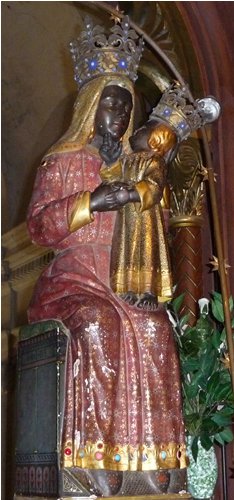
| According to legend, the Black Madonna
of Lord appeared on her mountain in the 10th century. Here is a
summary of the story as it was recorded in 1868.(*2)
|
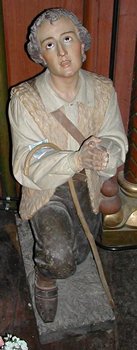
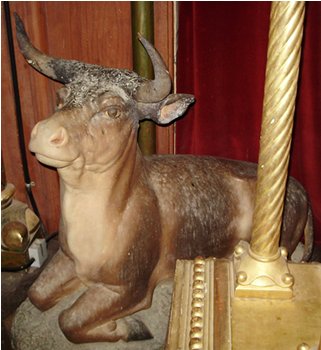
People surmised that their ancestors must have buried this image of their Divine Mother about three centuries earlier during a time of strife and crisis. When the time came for everyone to return to their homes a dispute arose as to where the Madonna should be taken. The people of Morunys wanted her in their village church and the peasants who lived around La Mola wanted her to stay there. The argument was settled when the Virgin cast her vote by making herself too heavy to be moved. The priest let it be known that she would stay where God obviously wanted her as the Mother and Refuge of the area. He ordered a perpetual lamp or candle to be kept lit before her and someone to keep guard at all times. So the faithful took turns and somebody was always praying in her presence until a little “temple” could be built for her.
They gave her the title Mother of God of the Garden for two reasons: One, because she was discovered next to a garden. And two because the bride in the Song of Songs, the archetypical bride of God, of whom Mary is the foremost manifestation, is told by her lover “you are an enclosed garden and a sealed fountain.” (chapter 4:12)
|
A small community of hermits takes care of this Black Madonna and her sanctuary. Here’s a summary of what their website says about the history of the place and its Queen from the time of her discovery until today:(*3) 987 and 992 The first documents written in Latin on sheep skin parchments mention a chapel dedicated to the Virgin of Lord, high up on her mesa. The document is still preserved in the archives of the local bishop. (As Christians began to re-conquer territories from the Muslims, who had occupied Spain in the 8th century, they liked to build chapels in highly visible places to “mark their turf” so to say.) 1202 Armengol Gomes and his wife Adelaycis present Mount del Hort to the Most Holy Virgin and the first real church is built. 1450 The second church is built. 1587 -1634 The sanctuary is a Dominican convent. 1636 The holy image cries tears for quite a while in the presence of many witnesses. 1637 The “miracle of El Verger” takes place, where a goatherd falls down a very steep cliff on Mount Lord without suffering a scratch, because on his way down he invokes the Virgin and she turns his deadly fall into a gentle flight with a soft landing. 1695 The church is renovated to such an extent that it is called “the new house.” |
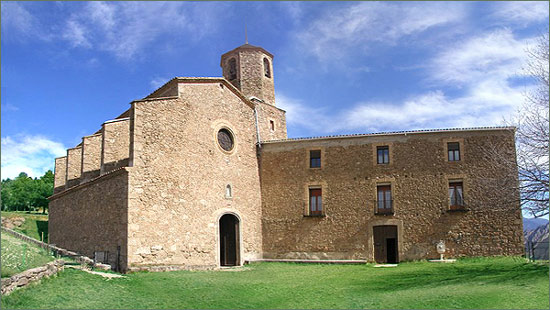
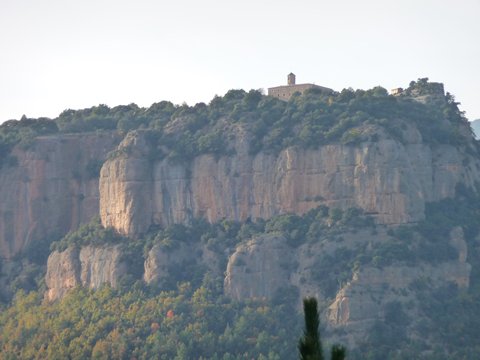 The sanctuary on its mesa. (photo: Marylou Hillberg) |
|
1785 The foundation for the modern church is laid. 1811 The government takes control of the sanctuary. 1812 The Spanish army uses the sanctuary as a prison camp for French prisoners. 1823 A militia burns down part of the sanctuary, but the Black Madonna is not harmed. 1824 During a frightening drought the Virgin of Lord, in response to her devotees’ pleas, causes a sudden and amazing rain. 1835 Carlist troops turn the sanctuary into a military hospital and little later General Mina occupies it. 1836 Coronal Niubó burns the sanctuary down completely. 1837 A very reduced chapel is improvised and part of the ruined house rebuilt. 1840 Another general orders everything destroyed again so that not one wall remains standing. The Madonna is moved to the parish church in Morunys, a nearby village where her cult revives. 1854 She protects that village and its surroundings from the cholera. 1863 A devotee offers the Virgin a precious crown and forms an association to try to rebuild her sanctuary. 1866 The grounds of the sanctuary are bought back from the government. 1870 The new church is solemnly inaugurated with a huge and very emotional crowd of believers. 1881-83 French Trappists live in the sanctuary because they are persecuted in their homeland. 1896 Another fire gravely damages the sanctuary, this time by accident. The Black Madonna is rescued by three neighbors who run for miles up the steep mountain to save her. |
 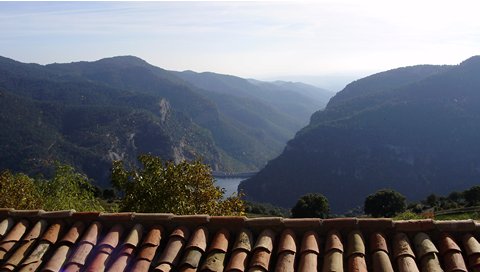
view from one of the rooms in the retreat center (photo: Ella Rozett) |
1923 The image is thoroughly restored and is given a “make over”, i.e. she receives a new crown and her previously white dress is painted in the present colors. A tear is painted onto her cheek in commemoration of the tears she cried in 1636.
1936 – 39 Nine days after the outbreak of the Spanish Civil War,
neighbors hear of plans to destroy the Sacred Image, run up and hide it
in the woods while they think of a safer place. The next day they stuff
her in a pit that is used for storing potatoes. Meanwhile the Communists
destroy what they can in the sanctuary. Later that year the Madonna has
to be brought out of hiding when her location is revealed through imprisonment,
interrogation, and torture of her devotees.
Luckily the communists don’t destroy her, but put her into a museum
and later sell her, along with many other statues, to art dealers in France.
Our Lady’s sanctuary is dismantled and abandoned.
After the end of the war she is found in France and brought back to her
parish, though not her sanctuary, which is still in ruins.
1971 The sanctuary finally is used for religious purposes again as a few Cistercian monks move in and the locals help them clean the place up and make it usable for living and celebrating mass.
1972 - 2010 For decades the place is gradually made more habitable and
more accessible. Now it is the most beautiful and welcoming retreat center
that welcomes any spiritual seekers to stay without asking for money.
(Though donations are appreciated.)
A few wonderful priests are left of the old community. They were hermits
until the Spirit called them to open wider to the world and welcome pilgrims
with a place to stay.
| I went to the sanctuary of Lord in 2009 with a friend who had had severe knee problems for many years. The fact that she made it up and down that mountain at all and without any pain at that was a miracle to us, only explicable by who was drawing her up there. She says, while her knee is still not 100% it is much improved since her visit to the Black Madonna of Lord. In gratitude she asked me to post this photo of some of the ex voti others have offered to our divine Mother. They tell the same story: The Queen of Heaven can help! | 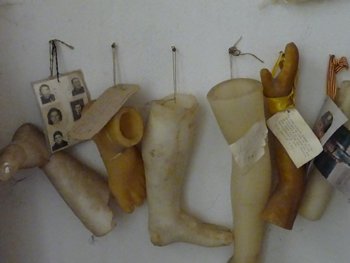 |
________________________________________________________________________________________________________________________________________________
*1: From Sant Llorenç de Morunys head up hill towards Port del
Compte, then keep left towards Coll de Jou and Sant Serni del Grau (a
sweet little Romanesque church) follow the signs to the ‘santuari
del Lord’, drive through a tunnel and up a tiny, winding mountain
road, then park at the foot of a set of steps near a freight lift for
hauling goods up to the hermitage. It’s about a 15 minutes walk
up a steep path from there.
*2: An 1868 copy of Mr. Corominas’ book "Breve Reseña
Histórica del Santuario de Ntra. Sra. del Hort" is kept at
the sanctuary. Her discovery is told on pp 22-27.
*3: www.comunitatdelord.org