Solsona:
The Mother of God of the Cloister
(La Mare de Deu del Claustre)
Patron of Solsona
In the cathedral, Province Lérida, state Catalonia, considered end of 12th century though the garter suggests end of 14th, 105 cm, stone.
photo: Cleo Morris
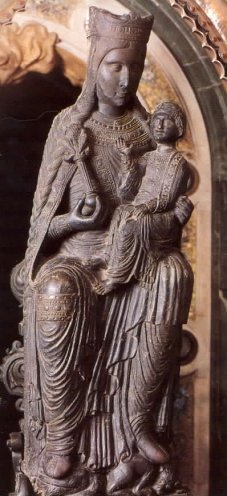
This Madonna is considered the masterpiece of early Gothic sculpture. Gilabert, a great artist born in1163 in Toulouse, France, fashioned her for the monastery Santa Maria de Solsona. It is believed that he modeled her after the famous Black Madonna of Toulouse, which was destroyed during the Revolution. Hence the Mother of God of the Cloister gives us a good idea of what the original French 'Daurade' looked like. The Lady of Toulouse was one of those Pagan goddesses that were Christianized, and her ancient roots still show here. While typical Seat of Wisdom Madonnas hold Jesus squarely on their lap with the baby facing forward, this statue is even closer related to Isis than they. Like the baby of Solsona, the Egyptian son Horus usually sits sideways on his mother's left knee
|
Our Lady of the Garter?! |
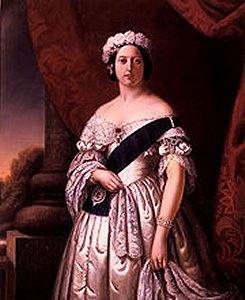 Queen Victoria wearing the garder on her left wrist |
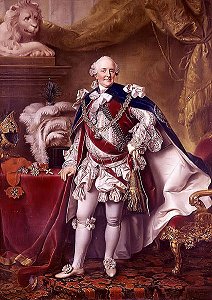 Duke Ferdinand of Brunswick Wolfenbuettel wearing the garder under his right knee |
King Edward clearly wanted to tie his Order of the Garter to a tradition
of King Richard I, who used to give his knights white and red garters
to wear for good luck during the Crusades. Red and white were the colors
of Saint George the dragon killer, patron of knights. Reminiscent of this
tradition, King Edward III placed his Knights of the Garter under the
patronage of Saint George.
So the order has a slight religious overtone in its patron saint and in
an annual church service during which new members may be admitted. However
it also has a decidedly sexual undercurrant in its creation story, in
the close association of men and women of the order, in its main insignia,
the garter, and in its motto. What is: “Shamed be those who think
badly of this” supposed to mean? Did King Edward III want to say:
“shame on you if you think of my lover’s garter on the floor
beneath us as pointing to sexual activity”? Considering how reasonable
such a conclusion would have been, he might have meant: “shame on
you if you think lowly of sexual love, which is a great and sacred thing.”
Now one must wonder if the garter on the Black Madonna was meant to have
sexual connotations or if it was simply to adorn her with a symbol of
royal honor. I think the following evidence suggests that yes, this Black
Madonna is portrayed as a figure who affirms worldly and celestial femininity,
divine and human, even sexual, love.
1) There is the unique scepter she holds. According to a high ranking
cleric at the bishop’s seat of Solsona it is sprouting a pineapple
palm as a symbol of abundance and life, the good fruit of life (as oppposed
to the forbidden fruit).
2) Unlike most Virgin Marys, she doesn’t wear a veil, but shows
beautiful long brades that underline her unabashed femininity. (Also,
she is not deferring to her son by poining at him as the Way, as do so
many Madonnas of the ‘Hodegetria’ type. Instead Baby Jesus
is pointing to her as the Way.)
3) Other Madonnas affirm sexual love. Among Black Madonnas the one of
Montevergine stands out. But, as I
explain in my article on Mother Mary and Mary Magdalene: “In medieval
thinking Mother Mary had to fulfill all the old roles of the goddesses.
That meant she was responsible for everything to do with a woman's life:
love, passion, fertility, child bearing, praying, and dying.” For
more see the sub-heading: “Goddess
of Love: Aphrodite, Mary Magdalene or the Virgin Mary?”
Another interesting detail of the black Queen of Solsona is that under
her feet she crushes an eagle (symbolizing pride) and an ape (symbolizing
idolatry). Why? It seems that she is warning the Companions and Ladies
of the Garter as well as those who may hold them in very high esteem,
to let go of pride and to worship the Divine instead of worldly royalty.
The History of the Image
Around the year 1200, Our Lady of Solsona was hidden from iconoclasts.
'Destroyers of images' have periodically reared their heads in the Christian
world ever since the 8th century. This time they weren't Byzantine Christians,
nor Muslims, Protestants, or Revolutionaries, but the Cathars and one
of their defenders, the French Raymond Roger, Count of Foix. They felt
that fleeting matter was not worthy of embodying or reflecting heavenly
energies.(*2)
To save the Black Madonna, she was hidden in a well of the monastery of Santa Maria de Solsona, which was attached to the cathedral. Eventually she was apparently forgotten. Years later, while children were playing ball around the well, a boy fell into it. To everyone's amazement the child was unharmed and the statue was found. You just had to put one and one together to figure out that the Mother of God had saved the child.
Other miracles followed and by the end of the 13th century, devotion to the Black Virgin of the Cloister was firmly established. It was passed on from generation to generation through various confraternities. One of them was called Minerva, after the Roman goddess. Our Lady earned her official title as patron of Solsona when she saved her children from the plague in 1652.
In 1810, during Napoleon's military campaigns, the French burnt the cathedral, but the Black Madonna was unharmed. The next war that threatened her, was the Spanish Civil War of 1936. This time the Mother of God of the Cloister was hidden first in a box in the bell tower and later evacuated to France. During this time the face of Baby Jesus was badly damaged, but it was restored after the war.
It wasn't until 1956 that Our Lady was solemnly and canonically crowned,(*3)
but she had long since been honored with a very unique grand festival.
Since 1653 Solsona has been celebrating the birthday of the Mother of
Christ with its Fiesta Mayor, which lasts from the evening of September
7th to the 9th and hasn't changed much over the centuries. There are parades,
music, folk dances, giant puppets each performing their own special dance,
and finally the procession of the Mother of God, the Black Madonna of
Solsona.
__________________________________________________
*2: A great article on 'Iconoclasts' in the on line Encyclopedia Britannica explains that when crusaders from all over Europe descended on the Cathars, one of the unintended consequences was that the old iconoclastic spirit was rekindled in many countries. And so, centuries after Catholics had massacred the Cathars, Protestant troops were still destroying sacred Catholic images. Goes to show that karma is a funny thing and that wars always lead to an exchange of ideas among enemies.
*3: This is according to the confraternity de la Mare de Déu del Claustre's website: www.claustre.bisbatsolsona.cat. (Ean Begg quotes 1916 as the year.)