Home
page
Mother Mary and Mary Magdalene
by Ella Rozett
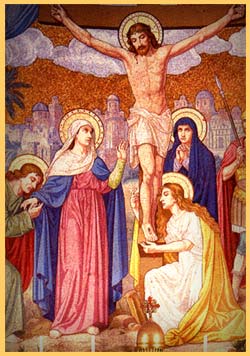
Mosaic in the church in Lourdes, from
left to right:
the apostle John, Mother Mary, Mary Magdalene
embracing Jesus' feet, Mary the sister of
Mother Mary.
Mary Magdalene in the Bible
In the last few years there
has been much talk about Mary Magdalene. Even
before Dan Brown wrote "The Da Vinci Code" some
referred to her as a manifestation of the divine
feminine. That's why some people confuse her
with Mary, the mother of Jesus. But Mary Magdalene
was one of Jesus' main disciples. Catholics
call her "the apostle to the apostles", because
Jesus honored her in a very special way. According
to the Bible, he allowed her to be the first
person to whom he revealed himself after his
resurrection and then he sent her to tell the
good news to the other disciples.
A couple of times the Bible
lists women who followed Jesus with his disciples
and "provided for them out of their resources".
Both times Mary Magdalene is mentioned first,
as if to stress her foremost importance. (see
Matthew 27:56, Mark 15:40)
All four gospels agree (which
is rare) that Mary Magdalene was the first person
Jesus appeared and talked to after his resurrection.
In Matthew 27:55-28:18 Mary Magdalene and Mary
the mother of James and Joseph are the only
ones keeping watch at Jesus' tomb all night.
Then they go home for one night, only to return
early the next morning, before dawn. An angel
greets them at the empty tomb, tells them that
Jesus has risen and commands them to run to
the disciples and tell them where to meet Jesus.
The two Marys are "fearful yet overjoyed".
As they are running to do what they were told,
Jesus appears to them. The women "approached,
embraced his feet, and did him homage."
He repeats the same message the angel had already
given them: go and tell the others where to
meet me. The other disciples meet Jesus in the
designated place, worship him duly, but (unlike
the women) they doubt. Mark 15:40 - 16:13 (and
Luke 23:55 - 24:12) tells more or less the same
story. Only he puts more emphasis on the male
disciples' disbelief. They do not believe Mary
Magdalene that Jesus rose from the dead, nor
do they believe two other men who later report
the same thing, nor the Lord himself in his
resurrected body.
John mentions Mary Magdalene
as standing under the cross with the other two
Marys (See article: Mother Mary and the Bible)
and also has a beautiful account of her being
the first disciple the risen Jesus appears to
in Jn 20:1-18. Here she cries so hard that she
doesn't recognize Jesus when he speaks to her
until he calls her by her name: "Mary!" Then
she immediately exclaims: "Rabbouni!" which
means, my teacher, or, my master. Apparently
she flings herself at him and wants to hold
on to him, because he warns her saying: "Stop
holding on to me, for I have not yet ascended
to the Father."
(Others translate simply: "Don't touch me!")
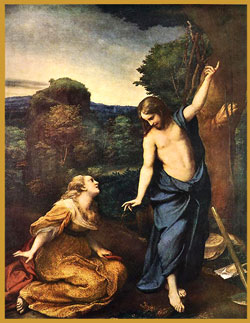
Mary Magdalene and resurrected Jesus,
"Noli me Tangere" by Correggio
Mary Magdalene in the Apocryphal Gospels
Apocryphal gospels are those
that were not admitted into the Bible. Since
they were suppressed, only fragments and damaged
copies have been found so far. Words in [square
brackets] mark holes in the manuscript that
were filled in by scholars' best guesses. Empty
brackets [ ] mean no guesses can be made; too
much is missing.(*1)
Mary Magdalene figures prominently
in "the Gospel of Philip", "the Gospel of Mary",
and in the "Dialogue of the Savior". In all
three she is presented as his favorite, most
enlightened disciple. But that does not at all
mean that she is unanimously revered by the
disciples. On the contrary, every gospel speaks
of conflict surrounding her. The apocryphal
gospels are particularly clear that this is
because of the male disciples' jealousy and
disrespect for women. Gender conflicts are talked
about explicitly. They get patched up temporarily
but not really resolved.
So much for Dan Brown and
all those people who want to believe that the
first Christians were free of such conflict
and that the urge to suppress women in general
and Mary Magdalene in particular only came later
when the Roman Catholic church established itself
as an institution of the Roman Empire. Certainly
the Emperor Constantine was no help for women's
liberation, but even while Jesus was alive,
most of his male disciples could not follow
him in his egalitarian treatment of the other
sex.
The canonical (biblical) gospels
don't delve as deeply into the gender conflict,
though they mention jealousy and competitiveness
even among the male disciples. Concerning the
apostles' feelings about Mary Magdalene, they
only mention that the male disciples didn't
believe her that Jesus had risen. But then they
don't believe men either, and not even Jesus
himself.
Here's what the supposedly
so enlightened, apocryphal gospels have to say
about Mary's gender:
The Gospel of Thomas ends
like this:
"Simon Peter said to them, 'Let Mary leave us,
for women are not worthy of Life.' Jesus said,
'I myself shall lead her in order to make her
male, so that she too may become a living spirit
resembling you males. For every woman who will
make herself male will enter the Kingdom of
Heaven.' "
Some say that this passage
contradicts earlier statements in the Gospel
of Thomas and was therefore probably added by
a later redactor. They are referring to verse
22: "Jesus said to them, 'When you make
the two one, and when you make the inside like
the outside and the outside like the inside,
and the above like the below, and when you make
the male and the female one and the same, so
that the male not be male nor the female female;
and when you fashion eyes in place of an eye,
and a hand in place of a hand, and a foot in
place of a foot, and a likeness in place of
a likeness; then will you enter [the Kingdom]."
"The Dialogue of the Savior",
while granting Mary a place of special honor,
also equates "femaleness" with inferiority,
worldliness, and obstacles to the spiritual
path. It says 144:15-21:
"When we pray, how should we pray? The Lord
said, 'Pray in the place where there is [no]
woman.' Matthew said, 'He says to us, 'Pray
in the place where there is [no] woman,' ...
'Destroy [the] works of femaleness,' not because
she is another [...], but so that they (the
works) will cease [from you]."
The Gospels of Philip and
of Mary both recount the jealousy of the male
disciples because Jesus loved Mary more than
them and revealed things to her that he didn't
reveal to them.
Even Mary herself in the Gospel
of Mary equates maleness with superiority when
she says in 9:19-20: "Let us praise his greatness,
for he has prepared us (and) made us into men."
The last part of this gospel
is Mary's account of what Jesus said to her
in a vision. Peter had asked her for this account
saying (in 10:1-5): "Sister, we know that the
Savior loved you more than the rest of women.
Tell us the words of the Savior which you remember
- which you know (but) we do not, nor have we
heard them."
But when she finishes:
"Andrew answered and said
to the brethren, 'Say what you (wish to) say
about what she has said. I at least do not believe
that the Savior said this. For certainly these
teachings are strange ideas.' Peter answered
and spoke concerning these same things. He questioned
them about the Savior: 'Did he really speak
privately with a woman (and) not openly to us?
Are we to turn about and all listen to her?
Did he prefer her to us?' Then Mary wept and
said to Peter, 'My brother Peter, what do you
think? Do you think that I thought this up myself
in my heart, or that I am lying about the Savior?'
Levi answered and said to Peter, 'Peter, you
have always been hot-tempered. Now I see you
contending against the woman like the adversaries.
But if the Savior made her worthy, who are you
indeed to reject her? Surely the Savior knows
her very well. That is why he loved her more
than us. Rather let us be ashamed and put on
the perfect man, and separate, as he commanded
us and preach the gospel, not laying down any
other rule or other law beyond what the Savior
said.' When [...] and they began to go forth
[to] proclaim and to preach." (17:10-end of
gospel)
The Gospel of Philip 63:31-10
states:
"And the companion of the S[avior is] Mary Magdalene
... her more than ... the disciples ... kiss
her ... on her ... The rest of ... they said
to him, 'Why do you love her more than all of
us?' The Savior answered them, 'Why do I not
love you like her? When a blind man and one
who sees are both together in darkness, they
are no different from one another. When the
light comes, then he who sees will see the light,
and he who is blind will remain in darkness.'
" -- Apparently Mary Magdalene was far more
enlightened than the other disciples.
People fill in the gaps in
the text according to the context, which suggests
that Jesus kissed her on the mouth. They read:
"The Savior loved her more than all the
disciples and used to kiss her often on her
mouth."
But even if Jesus often kissed
her on the mouth, one still cannot assume that
they also had sexual intercourse. Four chapters
earlier Philip speaks about kissing on the mouth
as a ritual act of being born or "begotten"
spiritually of Jesus:
"[Those who] are begotten
by him [cry out] from that place to the (perfect)
man [because they are nourished] on the promise
[concerning] the heavenly [place. ...] from
the mouth, [because if] the word has gone out
from that place it would be nourished from the
mouth and it would become perfect. For it is
by a kiss that the perfect conceive and give
birth (to their spiritual selves). For this
reason we also kiss one another. We receive
conception from the grace which is in each other."
58:30-59:5
Sounds like they all kissed
each other on the mouth. Were they all married
to each other? Were they advocating same sex
and group marriage?! Of course not. At least
during the first five hundred years of Christianity
kissing each other on the mouth was part of
celebrating the ritual of the Eucharist (or
"last supper") even within the main
stream Church. It is refered to in the biography
of Mary of Egypt (More on her below). The ancient
text describes this extremely chaste and humble
hermitess receiving the Eucharist the night
before her death: "After the prayer has
been spoken, she kisses the priest, as is the
custom, on the mouth, receives the holy mysteries
and says..." (Gertrude and Thomas Sartory:
Maria von Aegypten - Allmacht der Busse, Herder
Taschenbuch, 1982, p.55)
It is true that the Gospel
of Philip continues for 13 pages to talk about
the great mystery of marriage and the original
unity of man and woman in the first human (before
the female aspect was separated out). It says
that: "Christ came to repair the separation
which was from the beginning and again unite
the two". (70:15) But it also speaks about the
mystery of the "bridal chamber" in
a very confusing, obscure, and esoteric way,
suggesting that it far exceeds anything an ordinary
person would associate with bridal chambers.
E.g. in 74:19-20: "He who has been anointed
possesses everything. He possesses the resurrection,
the light, the cross, the Holy Spirit. The Father
gave him this in the bridal chamber;" And in
verse 67 it says: "It is from water and
fire and light that the son of the bridal chamber
(came into being). (...) The Lord [did] everything
in a mystery, a baptism and a chrism and a eucharist
and a redemption and a bridal chamber." The
Gospel of Thomas 50:15 refers to the "bridal
chamber" as the place (this earth) where the
bridegroom, Jesus, gets to be with his bride,
the disciples.
The gospel of Philip does seem to suggest that
Jesus found a deep spiritual union with Mary
Magdalene which he deemed extremely important,
but which might have been purely spiritual.
For he says in 65:30 - 66:5:
"He who comes out of the world
can no longer be detained because he was in
the world. It is evident that he is above desire
and fear. (...) Fear not the flesh, nor love
it. If you fear it, it will gain mastery over
you. If you love it, it will swallow and paralyze
you." And (76:9): "in the aeon the form of the
union is different, although we refer to them
by the same names." (78:30-79:2): "So spirit
mingles with spirit, and thought consorts with
thought. (...) If you become light, it is the
light which will share with you." (82:4-8) "If
there is a hidden quality to the marriage of
defilement, how much more is the undefiled marriage
a true mystery. It is not fleshly but pure.
It belongs not to desire but to the will."
Some people claim that 'companion',
the title given to Mary Magdalene in the Gospel
of Philip, was an equivalent to 'wife'. Yet
"The Book of Thomas the Contender",
also contained in the Nag Hammadi Library, bestows
the same title on Thomas. In 138:6-10 Jesus
says: "Now since it has been said that
you are my twin and true companion, examine
yourself that you may understand who you are,
in what way you exist, and how you will come
to be."
It seems to me that if Mary
and Jesus were married in the ordinary, "defiled"
way, the disciples wouldn't have been so baffled
why he would love her more than them and why
he would say things to her that he didn't say
to others. Wouldn't patriarchs love to explain
her special status away by saying it grew out
of her marriage to Jesus? Isn't it much more
of a challenge to patriarchal thinking to have
to acknowledge that she was that special in
and of herself and that Jesus appreciated her
fully without using her for himself in any way?
Mary Magdalene a Former Prostitute?
Another question we need to
discuss is, why did Christians decide to identify
the "sinful woman", i.e. prostitute, who washed
Jesus feet with her tears and covered them with
kisses, with Mary Magdalene? Nowadays many suspect
that this happened out of malice, in the attempt
to denigrate Mary Magdalene and to topple her
from her place of honor. It is true that for
millennia men have downplayed or defamed every
strong and virtuous woman in the Bible. However,
I think calling Mary Magdalene a former prostitute
is a case apart and served a broader need of
men as well as women.
The first problem this solution
addresses is that the Bible doesn't introduce
Mary Magdalene properly. Out of nowhere she
appears as foremost among the women followers
of Jesus and as the one he is closest to after
his resurrection. The text mentions in an aside
that he healed her from seven demons, but it
does not seem to explain why there is this special
love between them. So one is naturally left
looking for clues to fill in her story and to
link her to other stories in the Bible. One
such possible clue may be that both the "sinful
woman" and Mary kiss his feet and are very passionate
in expressing their love. Jesus rewards them
both for their free show of devotion. The second
clue is that the story of the "sinful woman"
in Luke 7: 36-50 is immediately followed by
his first mention of Mary Magdalene. In this
story Jesus stresses the exemplary love and
devotion of the woman and explains it by saying:
"many sins have been forgiven her, hence she
has shown great love. But the one to whom little
is forgiven, loves little." (Lk 7:47) According
to this reasoning it would follow that Mary
Magdalene must have sinned much before she found
Jesus, because she certainly loved him a lot.
The second problem Magdalene's
characterization as a former prostitute addresses
is women's frustration with the Virgin Mary
as the prime example of what a good woman should
be like. How many times have I heard Catholic
women complain that they had a problem with
Mother Mary because she is an impossible example
to follow! How can we be expected to be a mother,
wife, and virgin?! To be as much like her as
possible, women were traditionally admonished
to be wives and mothers, yet also "chaste".
That is to say, on the one hand they were not
to be sexy, not to want or enjoy sex. On the
other hand they were to grant sex to their husbands
whenever the men wanted it, as their "marital
duty" and their duty to God to procreate.
This made many women angry, not at the men,
with whom it wasn't safe to be angry, but with
the Virgin Mary, who seemingly put them in this
position. Men didn't appreciate this virgin-wife
example either, because it didn't allow them
to have much fun with their own wives.
Then, along comes Mary Magdalene, the former
prostitute and a passionate, heroic woman to
the end. She may be reformed but at least she
knows all about sex. She is never demure, but
defiant, free, and self-confident.
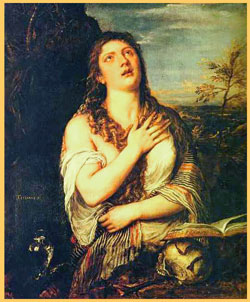
"Penitent St. Mary Magdalene" by Titian
Was it not a gift to have a variety of women
among the disciples of Christ? Do feminists
and Goddess worshippers not profess that one
needs to honor the feminine in all its archetypes:
as the virgin, the whore, the maiden, mother,
and crone? It seems to me that's what Christians
were trying to do. They acknowledge the virgin,
mother, prostitute, and crone.
The crone finds supreme expression in the gospels
as Elizabeth, Mother Mary's cousin and the mother
of John the Baptist. (To see how important Elizabeth's
spiritual and emotional support was for Mother
Mary, read in the article "Mother
Mary in the Bible")
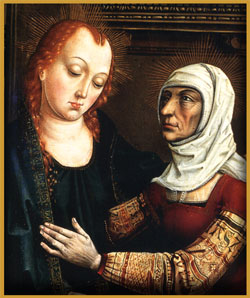
Elizabeth and the Virgin
Mary in: "Visitation"
by Master of the retablo of the Reyes Catolicos
All these women are in the
inner circle of Jesus and nothing bad is ever
said about them. Even if Mary Magdalene is identified
with the former prostitute, this is never held
against her. On the contrary, the Catholic Church
sanctified her because she left that way of
life and Jesus forgave, loved, honored, and
defended her.
It is true that celibate priests tend to focus
on the virginal Mary rather than on the passionate
Magdalene who knows everything about "down there".
Unfortunately they cannot freely indulge an
issue that is as threatening to them as sexuality.
But Christian artists were always happy to take
up the cause. Next to the demurely covered virgin,
they love to portray a dramatic and sensual
Mary Magdalene. Her big, flowing, traditionally
red hair has long been a symbol of a Christian's
ability (or at least hope) to make peace with
the force of sexuality.
There is one more reason why
Mary Magdalene was dubbed "reformed prostitute":
Some time between the 4th and 6th centuries
there lived a woman ascetic in the desert of
the Holy Land. Her name was Mary of Egypt and
she really was a reformed prostitute from Alexandria
who became famous for making a 180 degree turn
from extreme lustfulness to extreme holiness,
exchanging sexual union with men for divine
union with God. She lived 47 years in the desert,
naked and practically without food. In the Orthodox
Christian world she is still revered, but in
Catholic Christendom her story was gradually
melded into the story of Mary Magdalene, the
other famous penitent. The two kept getting
mixed up with one another, until Mary of Egypt
was forgotten, and her story tagged onto Mary
Magdalene. Hence the French tradition that Mary
Magdalene lived as a hermitess in Sainte Baume,
Provence, dressed only in her hair, and fed
only by the angels. (See: ibid.: p.12. For more
details on Mary of Egypt google her name + catholic
or + orthodox)
By the way, referring to someone
as a "penitent" does not imply that the person
is particularly sinful (as is often assumed
by non-Christians). Rather it means they chose
an ascetic lifestyle of penance - something
all Christians are called to since John the
Baptist and Jesus. When they are done purifying
their own shortcomings they continue with penances
for the sake of the rest of humanity. Like Jesus
and his apostles (and like serious practitioners
of many other religions) they voluntarily take
on what would be hardship to others and use
it to transform themselves and others.
Cynthia Bourgeault wrote probably
the most balanced book on everything to do with
Mary Magdalene. It is called “The Meaning
of Mary Magdalene: Discovering the Woman at
the Heart of Christianity”, Shambhala
Publications, Boston 2010. She too sees advantages
in Mary Magdalene’s denotation as a penitent
prostitute and says: “God sometimes writes
straight with crooked lines”. (p. 27)
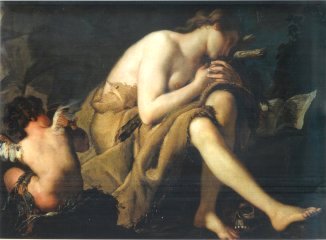
Whatever Magdalene is repentant for, in
Christian art it is not for being sensuous.
Here she is pressing Jesus on the cross
against her nacked bossom. "The Penitent
Magdalene" by Paolo Pagani (c.1661-1716)
|
Goddess of Love:
Aphrodite, Mary Magdalene or the Virgin Mary?
To me Mary Magdalene and Mother
Mary are like Isis and her sister Nephtys (Greek)
or Nebthet (Egyptian). Isis was more famous,
more important, more powerful. But she had a
sister who was her complementary opposite. Isis
was the day, life, fertility; Nephtys the night,
death, barrenness. Yet they decided to work
together for the greater good and gradually
Isis incorporated all the attributes of her
sister.
Similarly, the Virgin Mary
has this spiritual sister Magdalene. One is
purity, virginity, obedience, silent humility.
The other is passion, sexuality, loudly outrageous
and shamelessly non-conforming. Once the virgin
and the whore Mary were paired up as a suitable
couple of sisters in the Spirit, the Virgin
started to claim her sexuality and the whore
her saintliness.(*2)
In medieval art and thinking
Mother Mary had to fulfill all the old roles
of the goddesses. That meant she was responsible
for everything to do with a woman's life: love,
passion, fertility, child bearing, praying,
and dying.
Mother Mary's role as the Christian
goddess of love was expressed in three symbols:
the red rose, the unicorn, and the color red.
1. Since ancient times the red
rose was a symbol of the goddess Venus and erotic
love. The vagina was often referred to as 'the
little rose beneath the rosebush'. In the Middle
Ages, with its troubadours spreading a culture
of refined and spiritual love and with the crusaders
emphasizing self-sacrificial love, the rose
conquered the imagination of European Christians.
It became one of the favorite symbols of human
and divine, romantic and spiritual love. Mother
Mary became known as the 'mystical rose' and
her chaplet of prayers as the 'rosary', a collection
of roses. To this day it is said that each time
someone prays the rosary, Mary is crowned with
a fresh crown of roses, i.e. with the power
of love and femininity.
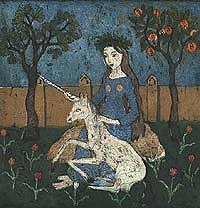
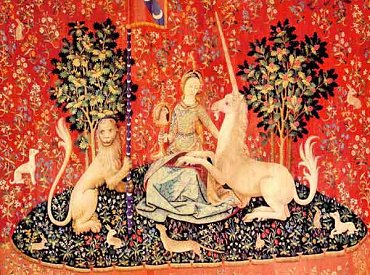
2. Mary and the unicorn were
often portrayed in an enclosed garden. According
to myth only a pure virgin (the enclosed garden
symbolized her virginal womb)(*3)
could capture a unicorn. The powerfully good,
yet fiercely wild animal could not be killed
by hunters unless it came across a pure virgin.
Then it would lay its head in her lap and fall
asleep. At that point its pursuers would strike.
In the Christian context this story came to
mean that the fierce, male God could only be
bound in this world, tamed, and made docile
by the exceedingly pure and docile Virgin Mary.
Once he entered her womb and became Jesus Christ
he could be sacrificed as the Lamb of God for
the good of all.
|
|
But the unicorn also retained
its worldly aspect. It represented wild, ferocious
manhood that could only be tamed by pure womanhood
and would gladly allow itself to be trapped
into holy matrimony and made docile. In that
context the Virgin Mary represented virtuous
womanhood taming wild manhood and channeling
erotic passion into the 'sacrament of marriage'.(*4)
3. Mother Mary's passionate
love also came to be represented by the red
robes under her blue mantel. Apparently people
felt so justified in their sexual passions by
Mary's red robes that during the Renaissance
the church decided to put an end to Mother Mary
as the goddess of love. Suddenly she was not
allowed to be portrayed in red any more, and
no more unicorns either. In 1563, the Council
of Trent condemned all associations of the Virgin
Mary with the unicorn and henceforth only virginal
white veils and heavenly blue mantels were permitted.
That's when the two Marys,
who had become one, were separated out again
and the responsibility of holding a space for
human sexuality fell solely onto the beautiful,
naked shoulders and the red open hair of Mary
Magdalene.
I like the two aspects in one
figure and I find the Virgin Mary to be quite
efficacious in blessing the sexual union of
husband and wife with a cosmic passion. Unfortunately
we don't have a goddess of human love in Christianity.
We miss the Aphrodite archetype. The closest
we can come to it is in the idea of the good
prostitute, which in a Christian context can
only mean a former, repentant prostitute, a
sensuous, passionate saint like Mary Magdalene.
I agree that 'Aphrodite' is
a much nicer name for the archetype 'goddess
of love' than 'repentant prostitute'. But since
Aphrodite is a Greek goddess, we may just have
to realize that Mary Magdalene is the Christian
form of Aphrodite, the same archetype by a different
name.
Dan Brown's "The Da Vinci Code"
Though I was not impressed
with the book, I loved the movie.
Certainly, if Jesus had married,
it would have been Mary Magdalene. In the Bible
as well as in art, she is consistently portrayed
as his closest female disciple, a very intimate
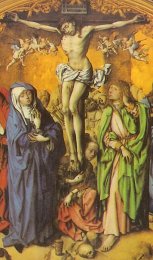
one with definite romantic overtones. Many depictions
of the crucifixion show her wrapped around the
cross of Christ in such a physically intimate
way that the message can't be overlooked: Jesus
and Mary Magdalene were somehow a couple.
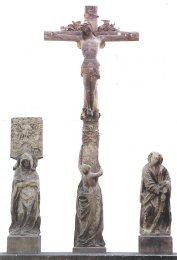
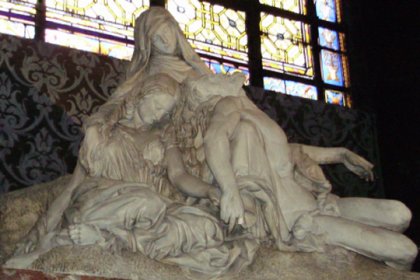
St.
Sulpice, Paris: a rare depiction of a
Pieta that includes Mary Magdalene. She
appears as the spouse of Jesus, holding
his hand in death, and as the daughter
in law of Mother Mary.
photo: Ella Rozett
|
 |
Jewish custom did indeed dictate that a Rabbi
had to be married and Jesus was called Rabbi
on several occasions. But Jewish custom also
said that once a man was married, he was not
to speak to any women besides his wife and immediate
family. Jesus, on the other hand, made a point
of talking to many women and of not worrying
too much about laws and customs. We know for
sure that the apostle Paul was not married and
even so, contrary to Jewish custom, did teach
in synagogues. We also know that both, being
married and being celibate were completely acceptable
options for leaders in the early church.
Hence we may never know for
sure if Jesus was married to Mary Magdalene
and if they had children, but I don't think
it makes nearly as much of a difference as Dan
Brown suggests. Jesus' message doesn't hinge
on that. But there certainly is a lot more evidence
that Jesus was celibate than that he was married.
To give only one example: in Matthew 19:11-12
Jesus says that forsaking marriage for the sake
of the kingdom of God is a mystery many practice,
but many others with inferior capacities cannot
grasp.
Even if Jesus had children,
they wouldn't necessarily have been important.
As he says in Mat 13:50, and in the other gospels:
those who do the will of his heavenly father
are his family. Certainly his apostles must
have had children, but they are never mentioned
anywhere. Remember, we are talking about religion
here, and about the kingdom of God, not about
worldly royal bloodlines and kingdoms who usually
ended up with imbeciles because of inbreeding.
Other religious founders had
children who played no important role in history.
Buddha's son wasn't particularly special and
died at an early age. In Islam only the Shiite
minority took Mohammed's bloodline into account
when determining its leadership. Judaism certainly
venerates its bloodline of patriarchs, yet the
prophets whom God established as the spiritual
leaders were independent of any bloodline. Lord
Krishna, the Hindu god of love, must have had
thousands of children because he is said to
have had 16,000 queens, plus consorts! Yet I've
never heard his children mentioned anywhere.
Historically, only the leadership of the Bahai
was passed from father to son. So it seems that
spiritual enlightenment does not normally transfer
with the DNA.
But if you're looking for
divinity in someone's DNA, that's an easy find,
because we're all created by God and in God's
image by receiving His breath, i.e. spirit.
Hence, it seems to me that the whole human race
is of God's bloodline.
Concerning the supposed motivation
(according to "The Da Vinci Code") for concealing
Jesus' marriage: Dan Brown says that it was
the Catholic Church's effort to portray Jesus
as purely divine and not human. Actually, the
Church insisted from the start that Jesus was
both human and divine.
It argued against the Gnostics
who would take away from Jesus' humanness by
saying that he didn't really suffer on the cross,
because God doesn't suffer. It also argued against
those who would diminish his divinity by teaching
that Jesus started out as an ordinary human
and only later became the Son of God.
Only it wasn't until the council
of Ephesus (431 C.E.) that the Church could
agree precisely how divine and how human Jesus
Christ was at any given point in time, and how
those "two natures" co-exist.
In my opinion the "two
natures of Christ" are the very core and
gem of Christianity. It is rare to find another
religion that gives us permission to be, like
Jesus, truly human and truly divine. Mystical
Christianity does.
Rather than hurting the veneration
of the "divine feminine", insisting that
Jesus was "truly human and truly divine" from
the moment of his conception, actually gave
it a great boost. For it justified the veneration
of the Virgin Mary as Mother of God.
What is certainly true is that
at a certain point the Church started suppressing
anything that supported women's full participation
in the Church. But that sharing of ministry
and power did not depend on the supposed descendants
of Mary Magdalene and Jesus. Rather it would
have been quite sufficient to faithfully emulate
Jesus and Paul (on a good day!). But instead,
Jesus' own relationship with the many women
in his life was ignored and to Paul's true letters,
fake, misogynistic ones were added. (see: my
article on "Women
of Spirit and Power in the Bible", especially
the section "the Woman who Anointed Jesus")
And the Holy Grail? In the
movie it is described as "the source of God's
power on earth". - If Jesus is God's power on
earth then Mary, his mother, could be seen as
his source. Indeed, to me much of what the movie
says about Mary Magdalene is more true about
the Virgin Mary. Loius Charpentier in his book
"Les Mysteres de la Cathedrale de Chartres"
explains that the Knights Templar went to Jerusalem,
not to seek the Holy Grail, but the Ark of the
Covenant, which they hoped to find in the ruins
of the Temple of Solomon. Charpentier says,
that they certainly did find an esoteric knowledge
and a source of power and wealth that enabled
them suddenly to create gothic cathedrals. Maybe
so, but along with that knowledge they found
black madonnas (see my article) and they venerated
their Dark Mothers in those cathedrals.
From of old Mother Mary was
given the title "Ark of the Covenant", because
she was the vessel of the New Covenant: Jesus
Christ. To her the Templars dedicated their
order, their cathedrals, and their hearts.
Mary Magdalene Pilgrimage Sites
1. Ephesus: Donald Carroll
states the following in his book "Mary's House:
The extraordinary story behind the discovery
of the house where the Virgin Mary lived and
died" on pages 78-80: "In 1952 a large sarcophagus
was unearthed near the entrance of a grotto
on the outskirts of Ephesus known as the Cave
of the Seven Sleepers, so-called because of
an ancient Christian legend attached to it.
The sarcophagus was positively identified by
Professor Louis Massignon of the College de
France as the tomb of Mary Magdalene. The bones
were removed and are now in the Church of St.
Mary Magdalene in Paris. (Read more about Mary's
house in Ephesus in the "Mother Mary and the
Goddess" article.)
2. So Paris is interesting
both because of the Church of St. Mary Magdalene
and because of the sanctuary and apparition
site of Our Lady of the Miraculous Medal in
the Rue du Bac. The shell of Magdalene's church
(L'eglise de Sainte Madeleine) is a very big
reproduction of a Greek temple that has long
housed what is claimed to be the thigh bone
of Mary Magdalene, but which did not come from
the excavations in Ephesus. When I was there
in 2006 I did not find any other remains of
Magdalene and the local custodian assured me
there are no others kept at the church. Later
I found out though that the church has a crypt
(which I didn't see). Who knows what they are
hiding down there!
3. Sainte-Baume
is a beautiful place in Southern France, where
the Magdalene is said to have spent the last
30 years of her life as a hermit. There is far
more and older evidence that she lived with
Mother Mary and John in their home in Ephesus
after the crucifixion of Christ. However, it
is conceivable that she also traveled to France.
After all Jesus had urged his apostles and disciples
to emulate his wandering as a homeless beggar.
In any case, a site where a saint has been honored
and invoked for roughly a thousand years is
sure to be filled with her blessing presence.
When I was there, my impression was that instead
of Mary Magdalene, Mary and Martha of Bethany
were in that part of France. The remains of
the latter are venerated in nearby Tarascon.
Many people think that Mary of Bethany and Mary
of Magdala were one and the same person, many
others (including myself) disagree. (For pilgrimages
including a visit to Sainte-Baume, visit our
home page.)
_________________________________________________________
*1: All the apocryphal gospels
quoted here can be found in: "The Nag Hammadi
Library". It is one book you should be able
to order through any bookstore.
*2: Cf. Charlene
Spretnak, Missing Mary, Palgrave McMillan, New
York: 2004, pp. 211-13
*3: This symbolism goes back to the Song of
Songs.
*4: A sacrament is an "efficacious sign
of grace, instituted by Christ and entrusted
to the Church, by which divine life is dispensed
to us." See:
Sacraments
of the Catholic Church
|