Montevergine:
Madonna di Montevergine
Madonna di Constantinopoli
Madonna Bruna (the brown Madonna)
Mamma Schiavona (slave mama)
In her sanctuary, a Benedictine abbey, on Mount Partenio (1,493 meters high), Province Avellino, 56 km East of Naples. In the charming medieval town of Mercogliano you catch the “funicular” or “cob train” that climbs a breath-taking slope in 7 minutes. (Or you can drive a winding road all the way up.) Open 6 a.m. to 8 p.m., painting on pine wood 460 x 230 cm, probably around 1290 A.D. though according to local legend the face was painted by St. Luke the evangelist and seems to actually stem from the 5th century.
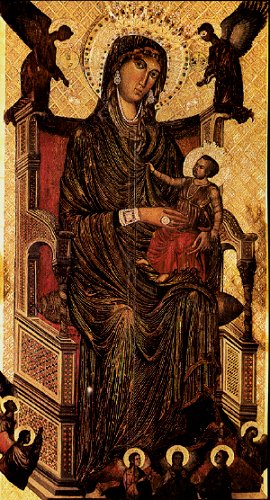
This is one of quite a few Black Madonnas that are attributed to Luke the Evangelist. Tradition says he painted only the head of Mary, which was later fitted into the larger icon. The whole is considered a “Hodegetria” type of Madonna, i.e. “she who points the way” or “the guide”, so called because her right hand points at Jesus as the way to salvation. While the Virgin of Montevergine isn’t actually in the classical Hodegetria pose, she is nonetheless known as the Hodegetria of Constantinople.
Tradition recounts that Eudocia (c. 401-460), the wife of the Byzantine Emperor Theodosius II, brought Saint Luke’s original portrait of the Virgin from Palestine to Constantinople. There it was fitted into a very large icon of Mary and Jesus and greatly revered with weekly ceremonies described thus:
"Every Tuesday twenty men come to the church of Maria Hodegetria; they wear long red linen garments, covering up their heads like stalking clothes ... there is a great procession and the men clad in red go one by one up to the icon; the one with whom the icon is pleased is able to take it up as if it weighed almost nothing. He places it on his shoulder and they go chanting out of the church to a great square, where the bearer of the icon walks with it from one side to the other, going fifty times around the square. When he sets it down others take it up in turn." Another account says, as the bearers staggered around the crowd, the icon seemed to lurch towards onlookers, who were then considered blessed by the Virgin. Clergy touched pieces of cotton-wool to the icon and handed them out to the crowd. The image was double-sided, with the crucifixion of Jesus on the other side.(*1) This makes sense if it was painted for processions. While the Polish people claim the Hodegetria of Constantinople
ended up at Czestochowa, and the Russians
believe it to be their "Hodegetria of Smolensk", destroyed
during the German occupation in 1941, the Italians maintain that
their Mama Schiavona of Montevergine is the original first Black
Madonna painted by St. Luke. |
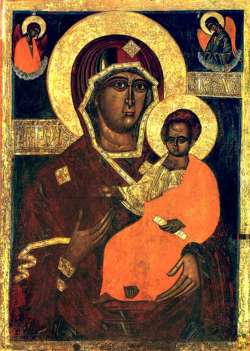 A 16th century copy of the Hodegetria of Smolensk. This is the typical Hodegetria gesture. |
The Sanctuary
As so many Black Madonna sanctuaries, so this one too started out as a
Pagan holy site dedicated to the goddess Cybele. Tradition says that in
the early 11th century, when Paganism was still practiced in remote parts
of Europe, St. William of Vercelli, the patron saint of Irpinia, decided
to turn this mountain shrine to Cybele the Great Mother of the Gods, into
a sanctuary of Mary the Most Holy Mother of God. He gathered a little
band of monks around him and occupied the place for Christianity. The
first real church was consecrated in 1124. It was destroyed and rebuilt
several times. The current monastery, guest house, and sanctuary date
from between the 18th and 20th centuries. Architecturally they are not
very interesting, but the basilica is richly decorated and the whole place
lies in breathtaking scenery.
Why “Slave Mama”?
Why is this Black Madonna, along with some of her other Italian sisters,
called Slave Mama? Because in the mind of old time Italians her dark complexion
marked her as one of the serving class, the Mother of all Slaves. An old
folk song recounts how the Madonna of Montevergine was ashamed that her
dark skin made her look like a slave. It made her the ugliest of the “six
sisters” (six famous Madonnas in the Campania region)(*3).
So she hid her face on this mountain. But lo and behold, the song concludes,
this Brown Mama turned out to be the most miraculous and hence the most
beautiful of them all.
The local peasants love their Slave Mama more than any other Madonna because
she is the mother of all those who are chained to hard work. She understands
their plight. As another folk song says: “You alone lighten our
chains, the chains to hard work, a thousand years of hard work and thousands
of sweats".(*4)
To the more politically minded (and there are many of those in Italy)
the divine Slave Mama is also the mother of all who are oppressed or outcast,
including gays. Lucia Chiavola Birnbaum elucidates the link between Italian
Communists and their love for Black Madonnas in her book "Black Madonnas:
Feminism, Religion, and Politics in Italy".(*5)
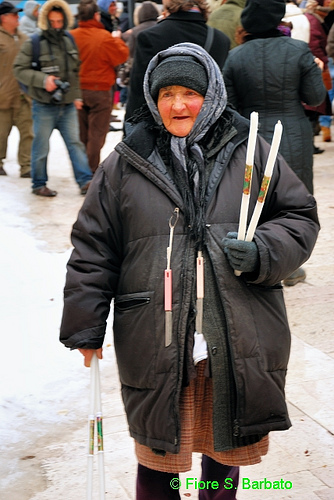
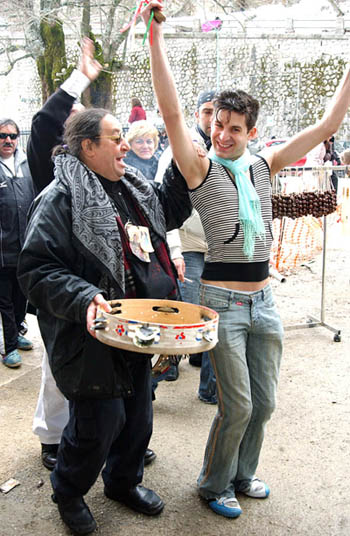
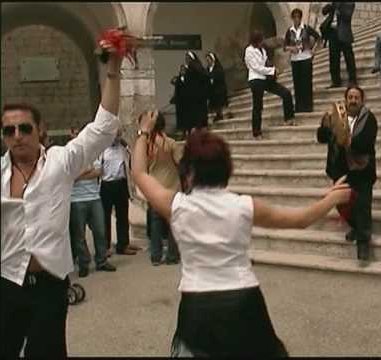
The Festival Every year the Madonna of Montevergine is honored with a grand two part festival, which opens on February 2nd, the “purification of the Virgin” during Candlemas, and closes on September 8th, the birthday of Mary (or on the closest Sunday to it). The events draw thousands of faithful and the stream never stops. All together about two million pilgrims come to Montevergine every year. They couldn’t be a more varied bunch and they don’t always get along very well. There are monks, nuns, lay people, local peasants, foreign tourists, the Pope, droves of Naples’ homosexuals, you name it. Many spend the night before the “festa” in Alpinolo, the nearest town to the abbey, so that they may be ready to attend the “sagljuta” (salute) to the Madonna the next morning. They await that hour with songs and dances in parks and other public places. The next day colorfully decorated floats make their way up the mountain to the monastery. They are drawn by oxen or horses and accompanied by singing and tambourine rhythms which give thanks to the Black Madonna, praising her as Our Lady of All Graces. The pilgrims sing and dance up and down the stairs of the sanctuary until they come face to face with the Madonna. |
 |
 |
Like so many American neo-Pagans, so too the Italian homosexuals like to think of Pagan goddesses as sexually free and egalitarian. They duly ignore that some goddesses also demanded sexual restraint, celibacy, and virginity. Not only that, Cybele and Artemis in particular displayed some real hatred of men. How outraged would we be if the Catholic Church allowed women to become priests, but only after they cut off their breasts and donned male clothes in order to look more like their Heavenly Father! And yet, nobody seems bothered that men were only admitted to the priesthood of Cybele, after castrating themselves, donning women’s clothing, and letting their hair grow long in order to appear more like their Heavenly Mother. Similarly Artemis of Sparta received as sacrifice the agony of boys who were tied to her altar and scourged until it became sprinkled with their blood.(*9)
| Yes, in Pagan goddess cults there was a time to celebrate sexuality, but also a time to honor restraint and celibacy, a time for love and a time for anger. This is reflected in the “tammurriata”, a local type of very rhythmic music and dance, accompanied by castanets and traditional drums. To the people of the Campania region it is an ancient ritual, celebrated by specially trained artists performing an almost priestly function at their great Marian sanctuaries and festivals. “The texts of the songs have both a religious and a strong pagan flavor, especially in the ambiguities with a sexual connotation. The dance represents a love game between a man and a woman or a competition and fight when two men or two women dance together”.(*10) Within one and the same verse, a singer may reflect on mystical aspects of the Virgin Mary, on the mystery of life and death, on sex and violence. | 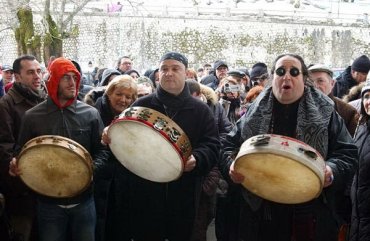 |
In between holy masses during the festival of Mama Schiavona, the (more
or less) faithful approach the holy image singing and dancing the tammurriata.
The monks aren’t always thrilled with this, but are obliged to allow
it in as much as it is ancient tradition. In 2002 however, things boiled
over. The abbot of Montevergine exploded with anger. He drove the gays
from the churchyard, accusing them of desecrating a sacred place and yelling
“Shame, shame! Your prayers aren’t welcomed here!” Now
he is accused of being reactionary. But couldn’t he too be seen
as part of the Cybele story? If the Black Madonna is the goddess, then
he is her shepherd lover or priest, repenting for his unchecked desire.
Perhaps Attis missed the difference between sacred sexual union with the
goddess and his lust for a tree nymph. He paid the price by dying to his
sexuality and turning into a non-sexual being: an evergreen tree, the
forefather of our Christmas tree. It’s as if the goddess had said:
“Oh, you like tree nymphs?! Well, be a tree then!” On the
positive side the mortal shepherd boy turned into an immortal nature spirit
inhabiting phallic shaped trees. Through them he is now in perpetual union
with the Great Mother after all and 'all's well that ends well'. Still,
I think it behooves us, gays and heterosexuals, to be conscious of the
difference between lust and sacred sexuality.
The gay sons of Mary insist that they have come to Montevergine on pilgrimage
for centuries, that the Brown Madonna is their connection with the divine,
and that they love the pilgrimage, the prayers, songs, folk dances, and
the holy mass. But they have added to the festival an aspect of gay party
and civil rights demonstration. During the day the national spokesman
for Communist youth challenges the abbot to be more tolerant and inclusive
and after 10 p.m. the “absolutely queer disco night” begins
in nearby Avellino. To many of the gays the festival is a Pagan affair
dressed up as Catholic. Of course being queer and Italian, they love the
Catholic disguise as much as what they perceive to be underneath.
*2: Previously Margherita Guarducci herself thought this honor went to the icon of Mary called Madonna of Comfort, in the church Saint Francesca Romana, in Rome, but based on this new evidence, she revised her opinion. See: "Mamma Schiavona, la prima icona di Maria", i.e. "Slave Mama, the first Icon of Mary".
*3: The Madonnas of Pompei, Mugnano, Santa Filomena, Carmine, Bagni, and Montevergine.
*4: See: "La Madonna Nera", i.e. The Black Madonna, edited by Enzo Morganti
*5: Lucia Chiavola Birnbaum, Black Madonnas: Feminism, Religion, and Politics in Italy, Boston: Northeastern University Press, 1993
*6: See article “Candelora Day”
*7: This part of the story is based on a 31/01/2009 article in the online magazine The Queer Way, “I femminielli a Montevergine”, i.e. ‘Gays at Montevergine’.
*8: A T Mann and Jane Lyle, Sacred Sexuality, Element Books, Shaftesbury, Dorset: 1995, pp. 119-121 and “Attis” article in Encyclopedia Britannica.
*9: See: article on Artemis, part: Encyclopedia 3. quouting Dictionary of Antiquity, s. v. Braurônia and Diamastigôsis.
*10: From a workshop announcement of the office of the tammorra.