Monte Viggiano:
The Black Madonna of the Sacred Mount Viggiano
(La Madonna Nera del Sacro Monte di Viggiano)
Queen and Patroness of Lucania
Viggiano is in the Potenza province of the Lucania region of Southern Italy. From May to September the Madonna resides on the Sacro Monte, the holy mountain of Viggiano at 1725 m, the rest of the year down in the village parish church of Viggiano. 6th century bust with 17th century extension and renovation, almost life sized, gold covered wood.
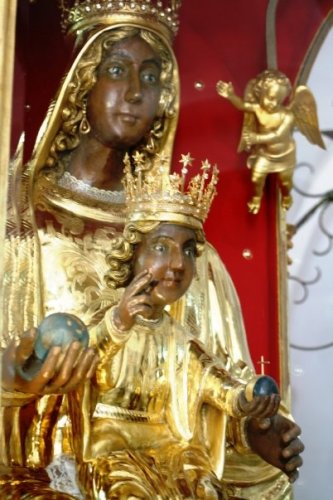
| Here we have yet another formerly Black
Madonna who has been restored to her original pigmentation. At least
she is still brown. Her story goes back to the 6th century when the city of Basilicata was still known by its Roman name: Grumentum. This town lay in a fertile valley surrounded by mountains and possessed a cathedral dedicated to St. Mary of the Assumption. It is believed that the original bust of a Dark Madonna was sculpted around 500 A.D. in order to be venerated in that cathedral and under that title. During the Muslim invasions of the 8th and 9th centuries Grumentum was completely destroyed. The few Christians who survived took refuge in the nearby mountains, taking their beloved Black Madonna with them. Realizing that she would be safest if hidden in the earth for a while, they wrapped her in a shroud and laid her in a shallow pit in a cave. Well, a while had to turn into 2-3 centuries under Muslim rule and by the end of it the image had been forgotten. It took some help from Heaven to find her again. Assistance came in the 11th century when the area was back under Christian rule. Soon after it was safe once more to venerate an image of Mary, some villagers from Viggiano saw mysterious blue flames flickering again and again up on their mountain. When they went to investigate the area where the light had appeared, they realized that it had come from a cave. Probing, they found the magnificent wooden bust, undamaged by its many years abandonment to the care of the earth. Overjoyed by such a gift from God, they brought it home to their village church and called it “Santa Maria del Deposito”. 11th century records lready attest to the great devotion of the local population to their divine Mother in her mountain abode. Interestingly enough there apparently is no legend explaining why a chapel was built in the place of her hiding and finding - the sanctuary where she spends the summers. Normally at this point Black Madonna legends would launch into an account of how the statue miraculously returned to her place in nature until people understood that she wanted a shrine there. But in this case people simply state that popular devotion demanded a commemorative church on the spot of the heavenly blue flames. As in Vassivière, France and Monte Vergine, Italy, so here too the Black Madonna spends the summers up on the mountain and the winters down in the village, following the rhythm of mountain folk who move their cattle up the mountains in the summer and come back down with them in the fall. Black Madonnas accompanying them in this, shows again how connected the Dark Mothers are to the earth. (More on that in the introduction under “Mother Earth, Pagan Goddesses, and Black Madonnas”) |
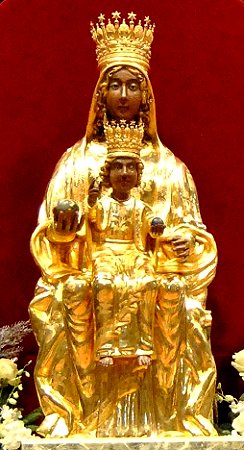 |
In the 17th century the area was ruled by Spanish nobility who turned the statue into a full bodied Madonna and Child, modeled after their Black Madonna of Montserrat. It was they who gave her that look of a Spanish Baroque Queen. Dressed all in gold, the sacred image represents the “Great Mother of God”, says Father Mario Morra SDB.(*1)
The Queen of Lucania was solemnly crowned in 1890 by authority of Pope Leon XIII. 75 years later Pope Paul VI proclaimed her Patron and Queen of Lucania, acknowledging himself that he just put the Papal stamp of recognition on what she had already long been to the people.
*1: Most of this article is based on Don Mario Morra SDB’s article: “La Madonna Nera delSacro Monte di Viggiano (Potenza): Sono Bruna, Ma Bellla" , first published in the magazine "Maria Ausiliatrice" (Mary Help of Christians), July 2005, then posted on the Marian internet site: www.mariadinazareth.it