Vassivière:
Our Lady of Vassivière
From July 2nd to the Sunday following
the fall equinox (September 21st) she resides in the church Notre-Dame
de Vassivière, the rest of the year in the church St. André in Besse-en-Chandesse,
Puy-de Dome department, Auvergne region. 1805 replacement for the ancient
statue that was destroyed during the revolution.
Photo: Francis Debaisieux
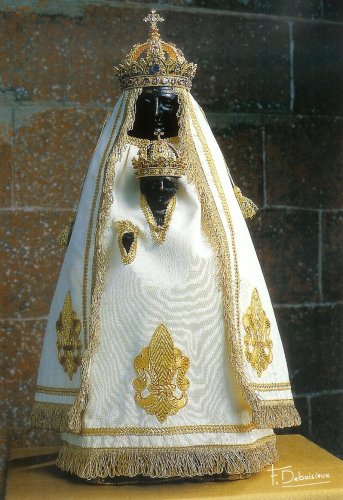
The people of Vassivière say their town was named after the ancient Celtic site that it was. In this 'vas iver', Gallic for 'temple of water', the spirits of the local rivers and lake were honored. Mary, Queen of Heaven succeeded these water gods as the source of life. To this day there is a sacred fountain a few yards from the chapel in Vassivière.
The original church in the mountain hamlet of Vassivière stood until
the 13th century and housed the predecessor of this Black Virgin. They
say strange things were practiced here. We don't know what. All we have
is a report from 1321 which informs the local authorities that the stones
from the ruined church in Vassivière were given to the cathedral in Clermont-Ferrand
a) because the church was totally ruined, b) because there were no funds
for a priest to staff it, and c) because many "profane and inappropriate"
things were committed in this place.(*1) Hmmm….
makes one wonder… Likely they were ancient, pagan practices. Or maybe
something like in Rocamadour, where around the same time, the monks put
an end to "some rather undesirable fertility rites."(*2)
In any case, Vassivière must have been a somewhat important sanctuary
to be built with stones good enough for the cathedral in Clermont-Ferrand.
Yet for more than two hundred years only the niche with its black Madonna
remained. She was considered the protector of travelers and no passerby
failed to stop and pray before her image - none, until the Protestant
reformation. In 1547 a merchant from Besse and two companions passed the
Virgin. The merchant refused to acknowledge her majesty and mocked his
fellow travelers' devotion. As punishment, he was immediately struck blind,
whereupon he repented and promised to become the Black Mother's 'King
of Devotion' if she only healed him. She did and he kept his promise.
Through his testimony her fame spread.
More miracles happened and pilgrims flocked to the Madonna's mountain.
Soon the Church decided that she would be better honored in the church
of Besse-en-Chandesse, a town 8 km down in the valley. Here the priests
could keep an eye on her, rather than leave her in the hands of the laity
in her outdoor shrine in the cow herding hamlet. But each time the statue
was brought down to more civilized environs, she escaped back to her mountain
abode. The scenario was repeated three times, until a compromise was made
that seemed acceptable to the Lady and is maintained to this day. A chapel
was built for her in Vassivière, where she spends the summers. The rest
of the year she is willing to be in Besse-en-Chandesse.
| When workers prepared the ground next to the old shrine in Vassivière for the little chapel to be built, a spring was uncovered that was immediately considered a sacred spring of Mary. It is enclosed by its own little oratory with its own little Black Madonna. And so the water spirits are still honored in Vas-iver, the temple of water. | 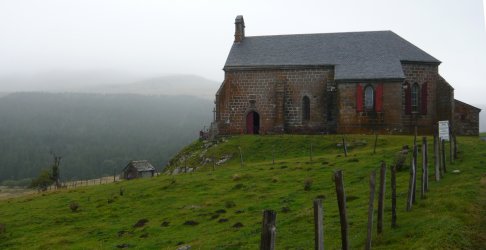 the
church with the chapel below it on the left, on
a rainy day (photo: Ella Rozett) the
church with the chapel below it on the left, on
a rainy day (photo: Ella Rozett) |
| That at least is the legend. The more 'enlightened' booklet sold in the sanctuary doesn't mention it. It recounts instead the struggle for control between the laity and the Church. The clergy didn't want that old pagan site revived without the supervision of a priest. The compromise included the stipulation that a priest must be in residence wherever the Madonna was going to be. The booklet also says that the sacred spring was probably not uncovered at the time of construction of the present day sanctuary, but was an ancient holy spring that was Christianized and incorporated into the sanctuary by setting it inside its little chapel with its own little Black Madonna.(*3) | 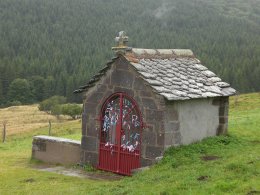 The chapel of the sacred spring (photos left and right: Kaaren Patterson) |
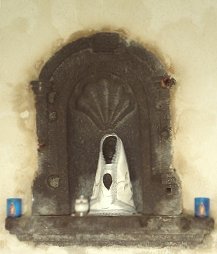 the Black Madonna in the chapel |
Each year in the early morning of July 2nd, the Madonna of Vassivière
is carried on the shoulders of men in a solemn procession up to her mountain
home at 1300 meters elevation. July 2nd is the 'feast of the visitation'
when the biblical Mary went to visit her cousin Elizabeth "in the hill
country" (Luke 1:39). God spoke to the Virgin about and through Elizabeth,
whom he had chosen as a refuge, support, and inspiration for Mary. In
commemoration of this visit, Mary of Vassivière goes into the hill country
to be with another "cousin," the Earth, to be with her natural rhythms.
She follows the cows, who are brought to their mountain pastures during
the summer and back down into town during the colder months.
As in many other wild and remote sanctuaries chosen by our Heavenly Mother,
so too in Vassivière, Mary draws her children back to their earthly mother,
Mother Nature. Mary needed Elizabeth and she knows that we need Mother
Earth in the same way, as a refuge, support, inspiration, and messenger
from God.
Her descent happens at nightfall on the first Sunday after the fall equinox
(September 21st). It is accompanied by rifle shots, fire works, and parades.
Once Our Lady is installed with all honor in her church, the worldly parties
begin. There is music, theatre, cabaret, and lot's of food.
Though the previous incarnation of this Madonna was destroyed during the Revolution, the people made reparations by solemnly crowning her in 1881. This practice goes back to the 8th century. Since the 17th century all coronations of statues of the Blessed Mother must be approved by the Pope and carried out by him or a representative he appoints for the occasion.(*4)
Between 1547 and 1609 the clergy commissioned religious as well as secular authorities to research claimed miracles. Consequently 28 were classified as authentic miracles. By 1648 another 60 had been added to the list. One of Our Lady's specialty was to revive still-born babies at least long enough so they could be baptized. In 2008 I asked the local priest if any more miracles had happened recently. His answer was: "Of course, miracles happen all the time. The greatest miracle is when the heart opens."
____________________________________________________________
*1: Philippe Auserve, "Notre-Dame de Vassivière", imprimerie Morillat
à Besse, p. 8. A booklet for sale in the sanctuary in Vassivière.
*2: They involved the sword of Roland, the nephew of Emperor Charlemagne,
who died fighting the Muslim occupation of Spain. Knowing that death was
near, he tried to destroy his magical sword so that it would not fall
into enemy hands, but it could not be done. When the archangel Michael
came to take his soul, this messenger of God thrust the sword far from
the batlle ground and it landed in the rock of Rocamadour. There it remained
near the entrance of the Black Virgin's sanctuary. The fertility rites
involved it and a lock from a chest that was situated below it. The monks
finally moved the arousing objects to a place where they can still be
seen but not touched. P. Clément Nastorg, (chaplain) "Rocamadour: admire,
contemplate, pray", Éditions du Signe, Strasbourg: 2006, p. 17.
*3: Philippe Auserve, "Notre-Dame de Vassivière", op. cit. p. 12-13
*4: ibid. p.27+29