| Home
Back to
Index
Previous
Next
Vichy:
Our Lady of the Sick
(Notre-Dame des Malades)
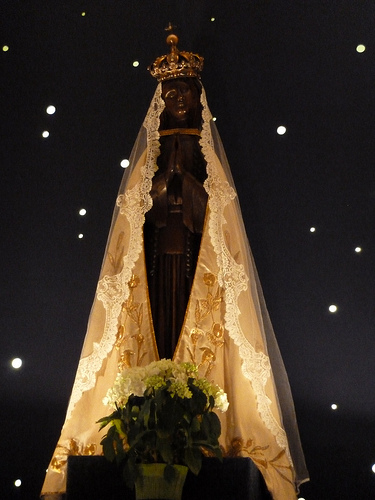
In St. Blaise, the “old
church”, to which was added on the “new church” Notre
Dame des Malades in 1931, on the Place d’Allier, Allier department
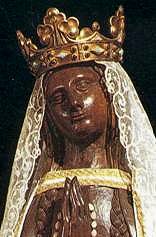
of the Auvergne region. 14th century, walnut wood.
Photo right: Mark
Veermans |
|
|
|
As so many Black Madonnas, so this one too resides in a place
that was already sacred during pre-Christian times. Excavations
have revealed cults of Isis, Cybele, Pallas Athena, Venus, Persephone,
Jupiter Sabazios, and finally Vichiaco, the personified energy of
the sacred spring that made Vichy famous.(*1)
Vichy is the “queen of spa towns” with five healing
thermal mineral springs. It was established by the Romans in 52
B.C.E. While people used to bathe in the waters, the onslaught of
health pilgrims became so great that people took to merely drinking
from the springs. A pre-Christian legend links the healing qualities
of the water to a white fairy who moved to Vichy from nearby Varennes-sur-Allier,
because her source there had been polluted by a woman.
Later Christians connected the blessed waters with their miracle
working Black Madonna of the Sick. Our Lady’s first residence
was the Celestine monastery that was established above the cavern
of the famous Célestine source.
By the end of the 16th century the springs had a “reputation
of quasi-miraculous curing powers”.(*2)
So in 1672 work was begun to enlarge the Romanesque parish church
of St. Blaise. When it was completed, on March 26, 1714, the dark
walnut statue of Our Lady of the Sick was moved there from the monastery.
Since the 18th century, Vichy has been frequented by French aristocrats.
Kings and queens, including Napoleon III, saw to it that the city
was frequently embellished. In the mid 20th century, the Pasha of
Marakesh used to come here on vacation. So the place has become
rather worldly. Great attention is placed on its opera, theaters,
and casinos. Nonetheless, faith in the Black Madonna Our Lady of
the Sick is still strong.
During the French Revolution, in November 1793, the statue was decapitated
and its dresses, jewels, and crowns dispersed. An 11-year-old boy,
Claude Baffier, saved the head. In 1801, with a new body, the Black
Virgin was reinstalled in St. Blaise. The next year, the first of
her torchlight processions through the old town was celebrated.
They continue to this day, on the Feast of the Assumption, August
15th, around 8:30 p.m.(*3)
|
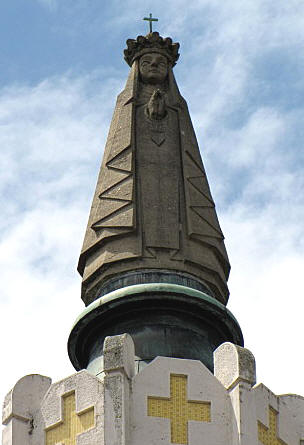
The 5,20 meter high statue of the Black Madonna
on top of the dome of her church. |
During the heyday of spa therapy between the world wars, demand
outgrew the church of St. Blaise, and a new church was built adjoining
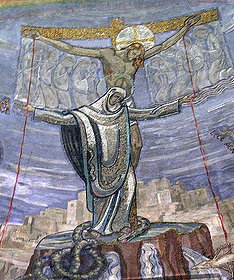
it in 1931. The art deco concrete dome is a jewel box of mosaics,
stained glass, and enamelwork. Atop it is a 16 foot tall statue
of Our Lady of the Sick. Her bell tower was added in 1956 and is
visible from everywhere in town. The Black Virgin, crowned on May
27, 1937, still receives homage in old St. Blaise.(*4)
Her chapel is decorated with a night sky. This calls to mind the
Queen of the Night, but unlike Mozart’s or other Queens of
the Night, this one is all good and holy. She rules the realms and
dark areas of our lives that might scare us, but she herself is
all comforter. She invites us to enter into darkness with courage
and the confidence that we won’t be alone.
The night sky in conjunction with the Queen of Heaven is also reminiscent
of Nuit, the Egyptian goddess of the night. (For more information
see introduction) |
Part of the amazing art deco mosaics inside the church.
Mary as the co-redemptrix practically bears the cross with her son.
|
_____________________________________________________
*1: Ean Begg, The Cult of the Black Virgin, Penguin
Books, London: 1985, p. 234
*2: Wikipedia article on “Vichy”
*3: “Patrimoine
Vichy”
*4: Info and two photos from article by Mary Ann Daly, Notre-Dame
des Malades, Vichy, Allier, Auvergne, France
|