Oropa:
The Black Madonna of Oropa
In her sanctuary near Biella and the
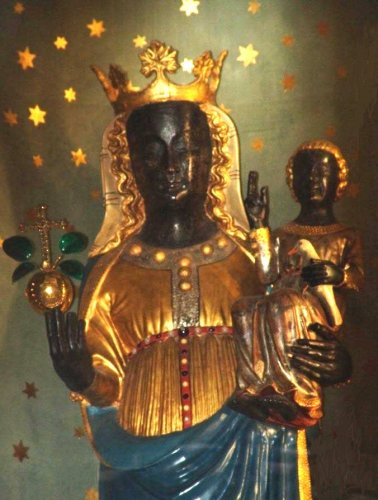
source of the river Oropa, age uncertain, 132 cm, painted wood.
photo: Maia Schiavona
|
According to tradition Luke the Evangelist carved this statue and St. Eusebius brought it to Italy. The latter was the first bishop of Vercelli martyred in 371 A.D. He spent some time in exile in the Holy Land, because he openly opposed the Emperor's theological views. During his days in Jerusalem divine inspiration led him to three statues buried under ancient ruins. Once he was allowed to return to Italy, he left one at a hermitage he had established in Crea in the Monferrato district and the second in Cagliari on Sardinia, his birthplace. The third, the Madonna of Oropa, he installed in a cave that was a pre-Christian holy site, in order to end the local, "pagan" practices. The woods around the cave were consecrated to Apollo and the large rocks and waters to various goddesses. Soon, the villagers of Fontanamora began to organize annual pilgrimages to Our Lady, making this one of the oldest mass pilgrimages continuing to this day. Apparently Our Lady became quite attached to this sacred place. When, more than a thousand years later, a group of monks tried to move her to a new location, she refused to go. She allowed herself to be moved half a mile, but then the three foot tall wooden statue became so heavy that no one could budge her until it was decided to return her to her cave. In commemoration of this event a "Chapel of the Transport" was erected on the spot where she refused to be moved any further away from her cave. |
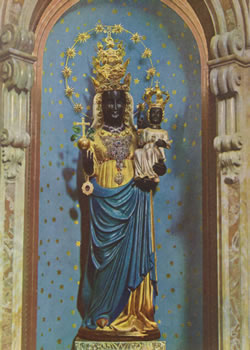 |
On the night of July 26th 1620, the feast day of St. Anne (according to tradition the mother of the Virgin Mary) Anne appeared to a nun and told her that it would be pleasing to Heaven if the statue was crowned. Since the Madonna of Oropa has worked so many miracles and has become so important to the Italians, she was crowned not only by the Pope of that year, but by three other Popes, once every hundred years, in 1620, 1720, 1820, and 1920. Hence the 3 crowns and the halo with diamond studded stars.(*1) Like many Black Madonnas, Our Lady of Oropa was invoked against the Black Death, the bubonic plague.
The statue captures a scene described in Luke 2:22-24 as the ceremony of purification (of Mary) and the presentation and dedication of Baby Jesus to God. These were performed in accordance with Mosaic law forty days after the birth of Jesus. Mary holds in her right hand the coins for the temple offering and Jesus in his left the sacrificial dove.
Until recent times the commemoration of this event was a major feast day celebrated in February with processions and the blessing of candles. Hence its name: Candlemas. When Christianity was introduced into Europe this feast day was used to supplant several pre-Christian celebrations. There was the Roman holiday called Lupercalia, which marked the end of the old year (in February) as a time of purification. February comes from Latin februare, which means to purify. It was a time to chase away any evil of the old year and to invoke the fertility of the new. Other Europeans celebrated "Imbolc" as the first stirrings of Spring in Winter.
Under Catholicism, the Virgin Mary came to represent all of creation being purified and the light of Baby Jesus' presentation to God became the spring of a new era.
*1: For more information see: Franciscan Friars of the Immaculate, "Marian Shrines of Italy", Park Press: Waite Park, MN: 2000, pp.82-6