Milicia:
Madonna della Milicia
Madonna of Loreto
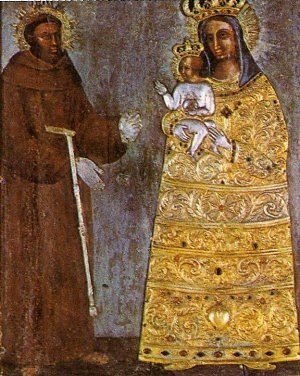
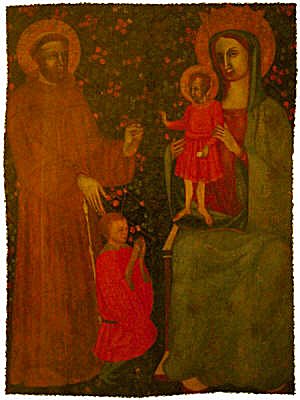
in Altavilla Milicia, about 20 km East of Palermo, in church Madonna della Milicia, second half of 14th century, 76.5 x 101.5 cm.
|
Above are two versions of the same icon: on the right the original state it was restored to in 1990, when the silver template and several layers of re-painting were removed. On the left is the way it was presented since 1853, when popular devotion wanted the Madonna and child, as well as parts of Saint Francis of Assisi covered in silver plating and studded with precious stones. The practical reason behind this may have been to protect the icon from the touches and kisses of pilgrims. However, the occasion seems to have been seen as an opportunity to augment the glory of the sacred image and to give the silversmith free artistic range. So he undressed Jesus and made him sit like a baby rather than stand like a toddler. He made Mary stand up from her throne, but gave her a more royal outfit in compensation. He tied Saint Francis’ belt further up, making it look like a cane. Then he disappeared the figure of a kneeling young man whom Saint Francis recommends to the Virgin. Most likely this is the person who commissioned the work, possibly a certain Marquis Francisco Maria Beccardelli of Bologna, who probably wanted this painting for his personal chapel in his palace and ordered it from a Tuscan artist. I agree that the Marquis distracts from the spiritul power of the
painting and it seems a bit presumptuous for the painter to dress
him in the colors of Jesus and Mary. However, it seems equally as
presumptuous to change the character of the image that dramatically
and to alter every part of it. |
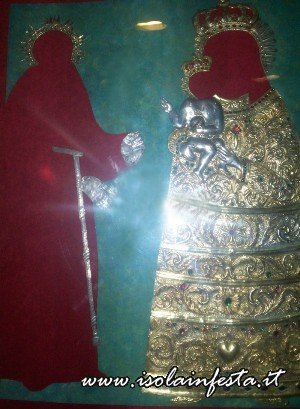 The template that covered the painting for 137 years. |
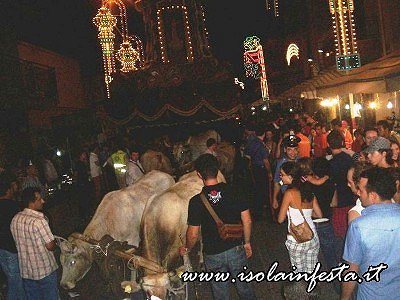
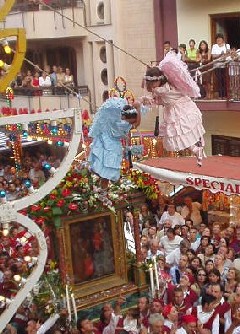
This theme of God preventing a ship from continuing its course until its Madonna is given up to the local population recurs with suspicious frequency around the Italian coastline. I wouldn’t doubt that people actually used some less than friendly means to enforce what they wanted to be God’s will. All over Europe medieval Christians stole religious treasures from eachother and enshrined them in splendid cathedrals. This Black Madonna’s yearly festival is held on September 6-8th, the birthday of the Virgin Mary. It is one of the most fervent Marian festivals of Western Sicily. It starts as the faithful begin their pilgrimage to the sanctuary of the Madonna often on foot, reciting the rosary, and illuminating their way with votive candles and torches. It culminates in a great procession when the Black Madonna is placed on a giant float, 12 meters high, that represents the ship she came in on and is drawn by two teams of oxen in commemoration of the oxen who took her to her final destination.(*1) At one point two girls dressed as angels, are lowered from above onto the float as they sing the praises of the Madonna in their Sicilian dialect.(*2) |
 |
 |
*2: All info taken from the following websites: www.isolafesta.it/smariadellamilicia and www.madonnamilicia.it