Peña de Francia:
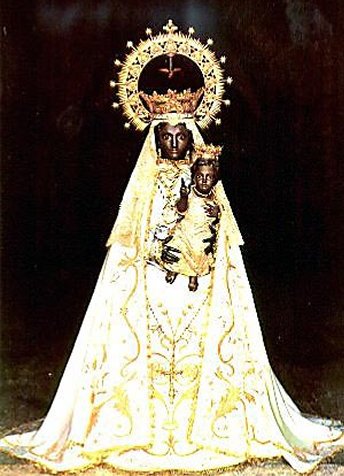
La Virgen Morena (the dark skinned Virgin),
La Morenita, Queen of Castile
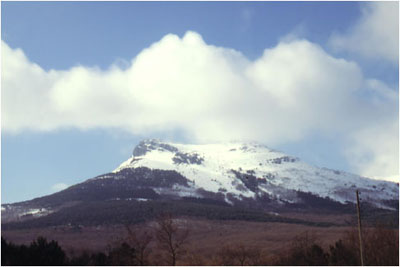
During the summer she is in her sanctuary 75 km SW of Salamanca, 15km W of La Alberca, on Mt. Peña de Francia (1723 m high),during the winter in the convent of the Poor Clares in Zarzoso, the remnants of the ancient original (possibly 8th century) are enclosed in this rendition of 1890; one can see them through a window in the chest of the new statue.
This is a story about pilgrimage - the journey of uncovering the divine. It's about the perseverance it takes to stay awake to the calling of our hearts. Staying awake is a central theme not only in this story but also in the gospels and in Eastern religious teachings. What staying awake might mean and how we might accomplish it, is for each of us to find out in meditation and prayer.
According to Ean Begg this Black Madonna was already around during the reign of Charlemagne (742-814). In those days French knights came to Spain to fight the Muslim invaders in a region that had been settled by French refugees fleeing their own Muslim occupiers. (Hence the name of the mountain, which means 'rocky hill of France) The knights found the statue on Mt. Peña de Francia, attacked and won the day. A French bishop consecrated the mountain as Monte Sacro.(1) Some time later the Christians ran out of luck and blessings, they lost that territory to the Muslims after all and buried the Madonna in order to save her from being destroyed at the hands of the "infidels".
All the Spanish, American, and Philippine websites I searched begin their
stories in the 15th century. Some of them disagree on details, but here
is a combined account of what may have happened.
It was the year 1424. In a little village called Sequeros, in the Sierra
de Francia mountain range there lived a young woman by the name of Juana
Hernández, whom everyone called la moza santa, 'the holy youngster'. On
her death bed she prophesied and admonished the people: "Turn your faces
to Mt. Peña de Francia and pray to the Virgin Mary. That's where an image
of her has been hidden for two hundred years. It will soon come to light
and Our Lord will work many miracles through it. That glorious image must
be shown to a man of good life. In that same place, out of reverence for
the Mother of God, a new monastery of the preaching brothers [the Dominicans]
must be built. That's where God and the Blessed Mother of the Christian
people will be. It will be a house of much devotion and many people will
come from foreign lands and nations with great dovotion, seeking the Mother
of God and her blessed image."(2)
Meanwhile, in Paris there lived "a man of good life" called Simon Rolan.
He was a Franciscan lay brother, not real bright, but richly endowed with
a good heart and great devotion to the Mother of God. He had come from
a wealthy family and had accumulated much merit when he sold his entire
estate and gave all proceeds to the Church and the needy.
Once, while he was absorbed in deep contemplation of the beauty of the
Holy Mother, he lost ordinary consciousness. Then he heard a clear voice:
""Simon, vela y no duermas! (That's: "Stay awake and do not sleep" in
Spanish.) Go to Peña de Francia, which lies in Western regions, and search
for an image similar to me. You will find it in a cave and once there,
I will tell you what you must do."
Simon told his confessor about this experience, but the man advised him
not to do anything. Several days later Simon was praying as usual before
the altar of the Holy Virgin, when he heard the voice again: "Simon, vela
y no duermas, stay awake and don't sleep, go to Peña de Francia and there
you will find what you have been longing to see." This time the Mother's
devotee did not ask his confessor's opinion but he did ask for his blessing,
because he was going to set out the next day, as his heavenly Mother demanded.
Simon believed that Peña de Francia was in France, West of Paris. For
five long years he searched every cave, hill and mountain, between Paris
and the sea, not imagining that "Western regions" could mean South-West,
in Spain. (Interesting how often the masters give us approximate hints
rather than easy answers. Maybe the answers don't stick, we won't stay
awake to them, unless we have struggled to find them.)
Simon became so discouraged with that struggle that one day he decided
to give up. But on his way back to Paris he heard the same voice once
more saying: "Simon, vela y no duermas, stay awake and do not sleep, do
not give up the search; do not give up what you have begun. Persevere.
A great reward awaits a great sacrifice; your labors will be recompensed."
This lifted his spirits and he resumed his quest. He also changed his
last name from Rolan to Vela, so that every time someone called him, he
might hear in his name Heaven calling him to awaken.
Giving up on the West of France, Simon decided to take the "French Road" to the most important pilgrimage site in Europe, Santiago de Compostela in Spain. He thought it might lead him to the "French Mountain", Peña de Francia. He spoke to countless pilgrims on the way, always asking if anybody had heard of his mountain, but nobody could help him. And so his pilgrimage continued long after everyone else had reached their goal.
Having found no clue whatsoever between Paris and Santiago de Compostela, Simon decided to visit the famous university of Salamanca. But instead of receiving help from pilgrims or professors, a simple vendor in the market place gave him his first clue. It was a coal vendor yelling out the superior quality of his coal from Mt. Peña de Francia. When Simón Vela heard the name of the mountain of his dreams spoken in plain day light, he cried of joy. Giving thanks to the Holy Mother of God, he approached the vendor as if he was a long lost friend and asked him to guide him to the mountain. But the man did not trust this eccentric stranger and refused any information. So Simon waited until the vendor headed back towards his home in the mountains and followed him from afar.
| When they arrived in a village called San Martin de Castañar he
lost sight of the merchant. Luckily some good women were willing and
able to show him where Mt. Peña de Francia laid off in the distance.
When he finally beheld the place his divine Mother had told him about,
he felt like he was seeing the Promised Land. It was by now May 14,
1434, five to nine years (depending on which account you believe)
after the Madonna had first sent him on his quest. After another long tiresome day of hiking, Simon came to the steep mountain. By now his provisions were depleted and he was hungry. Trusting that God would not forsake him, he continued on the deserted road. Suddenly he stumbled upon a packet containing a loaf of bread and a piece of meat. He gladly accepted this much needed gift of God. |
 Mt. Peña de Francia |
When night drew near he found a cave. Full of hope that this might be
the place the Virgin had told him about, he fell asleep. Early the next
morning, Simon began searching for the holy treasure in every corner of
the cave, but could not find anything. Distressed and discouraged he prayed
for strength and courage. Soon he heard the same voice he had heard before
sounding clearly through the cave: "Simon, stay awake: do not sleep!"
At a distance further up the mountain, he saw a dazzling light filling
the place with its brilliance. Trembling with joy, he approached it and
there he found an apparition of the Virgin Mary with the Child Jesus in
her arms sittings on a golden throne. He knelt before her and prayed with
all the fervor of his soul. Overflowing with ineffable joy he said: "Oh,
Lady, the dream of my soul, the inspiration of men and women! My labors
are now ended. Many years have I traveled far and wide to seek you and
to drink in the beauty of your eyes! Do not forsake me, be my protection."
The Lady answered: "Simon, rejoice! Your constancy will be rewarded. Your
dream will be realized. Your labors are now ended. Take heed and keep
in your heart what I wish you to do. Dig in this spot and take what you
can see and place it on the summit of this rocky hill. Build on this hill
a beautiful dwelling. You are to begin it and others will come to finish
it. This must come to pass as it has been the wish of my child." Then
the Lady suddenly disappeared and Simon was left standing alone and rooted
in the spot with wonder and awe.
The next morning Simon began the work of digging and excavating. However, he heard the same voice again saying: "Simon, vela y no duermas! Do not attempt to undertake this big task alone. Undertake it in the presence and with the help of two, three, or more people." Evidently this was to avert any doubt or suspicion from people as to the veracity of the miracle and the credibility of Simon. So Simon went back to San Martin de Castañar to look for help. He found a group of four men who remembered hearing the prophesy of La Moza Santa, the holy youngster. Elated to be asked to enter the story of the holy treasure hidden in their mountains, they agreed to help. For three days they dug until finally, on May 19,1434, after removing a huge stone, they found imbedded among the rocks the most holy image of the Black Madonna.
Right then and there, all five men received special graces from the Lady. Simon Vela, who suffered a head wound during the excavations was instantly cured; Pascual Sanchez' defect in the eye disappeared; Juan Fernandez was relieved of a stomach trouble that had been nagging him for ten years; Antonio Fernandez, who had been deaf could hear; and Benito Sanchez' crippled finger was healed. The official document of these miracles and this discovery, duly signed by those present and a Notary Public, is preserved in the archives of San Martin de Castañar.
Three years after the discovery the Dominican order opened a hermitage and guest house for pilgrims on this holy mountain of the Black Madonna. It stands to this day though only one single monk remains, who runs it. The present church dates from the 16th century.
During the first half of the 19th century various villages of the region
fought over the possession of the holy image. As a result the Virgin moved
around quite a bit. For a while she resided in Sequeros, Mogarraz, and
La Alberca. In 1859 she was brought back to her sanctuary on the summit
of Mt. Peña de Francia, but in 1872 someone stole her. For 17 years she
was abused and neglected. When she finally reappeared she was in such
a sorry state that it was beyond repair. That's why it was decided to
encase her remains in a new statue.
The devotion of her people was not at all diminshed by her modern looks.
She remained their beloved Morenita and was solemnly crowned as Queen
of Castile in 1952 on the main place of Salamanca.
You can still visit the 'gruta de la Virgen' the grotto where the statue was found. It is inside a chapel called La Blanca. Some think of it as the crypt of the sanctuary. In the hermitage 'del Robledal', near Sequeros one can visit the graves of Simon Vela and La Moza Santa.
*1: Ean Begg, The Cult of the Black Virgin, 1985, p.258.
*2: Cited in the article "Virgen de la Peña de Francia" on www.galeon.com/sierradefrancia/2_pena_fran.htm.