Puigcerdá/Hix:
Mother of God of the Sacristy
( Mare de Déu de la Sacristia)
Patroness of Puigcerda
Mother of God of the Milk
(Mare de Déu de la Llet)
Our Lady of the Cerdagne
(Notre-Dame de la Cerdagne)
In the church Sant Dominic, (Puigcerdá is pronounced
Pucherda) province Girona, in the Pyrenees, only open during masses,
daily at 9:30 a.m., Sat 8 p.m., Sun 10 a.m., noon, and 8 p.m. Original
from 13th century disapppeared during Spanish Civil War in 1936, 85
cm.
Photo, left: Dennis Aubrey
right: Mark Veermans
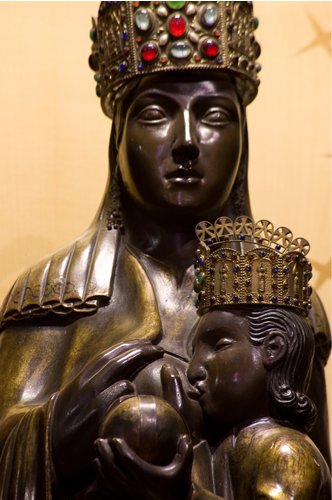
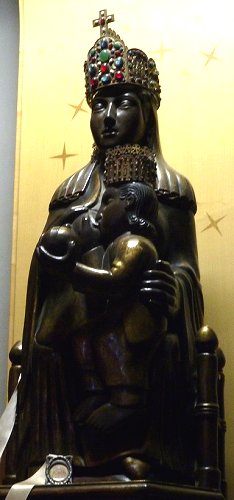
As a nursing Madonna her title used to be Virgin of the Milk, but since 1585 she is known as Mother of God of the Sacristy. Father Jean Sarrète explains why and recounts her whole history in his article “Notre-Dame de la Cerdagne” (*1):
The Patroness of Puigcerdá began her life in Hix, a hamlet 7-8
km away, across the border in France. That’s where she was given
the title Our Lady of Cerdagne (the name of the county). But the counts
of Hix were in conflict with King Alphonso II of Aragon. Most of them
were killed in 1177 and the one surviving relative was forced to move
his residence to Puigcerdá, where he founded this new city as the
new capital of the Cerdagne. Gradually more and more people were persuaded
to move there so that the town became far bigger than Hix. Eventually
the people of Puigcerdá, many of them former residence of Hix,
wanted their patroness to follow them to their new home. Since the people
of Hix weren’t going to let her go voluntarily, the bishop obtain
a decree and soldiers from the king to force her move against the violent
objections of the people of Hix. This happened around 1184.
Fearing that the people of Hix may come and steal her back, an altar was
built for the Black Madonna in the sacristy of her new church where she
could be locked in. And there she remained until 1585; hence her name
‘Mother of God of the Sacristy'.
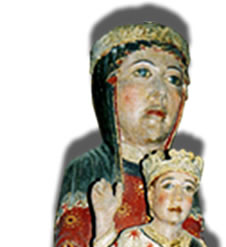
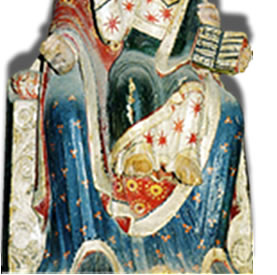
The photographer Dennis Aubrey reports that she came to Puigcerdá from Hix only recently on September 8th.(*2) But Father Jean Sarrète doesn’t mention anything about her moving back to Hix after her forced conveyance to Puigcerdá. Since September 8th is her feast day celebrated with a procession, I think she may have been solemnly carried to Hix and back on that day in acknowledgment of her first home. Hix has another 12th century Seat of Wisdom Madonna in a beautiful
Romanesque church, who holds the throne from which the Mother of
God of the Sacristy was taken. She is 68 cm high and used to be
called morena, dark, but she had been whitened.
|
  |
*1: Father Jean Sarrète, “Notre-Dame de la Cerdagne” in the on-line “Bulletin de la Société agricole, scientifique, & littéraire des Pyrenées-Orientales” Vol 43-44, pp. 299-318. This is a very detailed and well researched piece and where it is in disagreement with Ean Begg’s The Cult of the Black Virgin, Arkana: 1985, pp. 191 and 259 I trust the former source more.
*2: Visit Dennis Aubrey’s phantastic internet photo presentation at http://photo.net/photos/Aginbyte