Santisteban del Puerto:
Our Lady of Collado,
Patron of Santisteban del Puerto
In the province Jaén of Andalusia, in the church
Santisteban del Puerto on the Plaza Mayor, copy of ancient statue that
was lost. Wood.
photo: Pedro
Salido
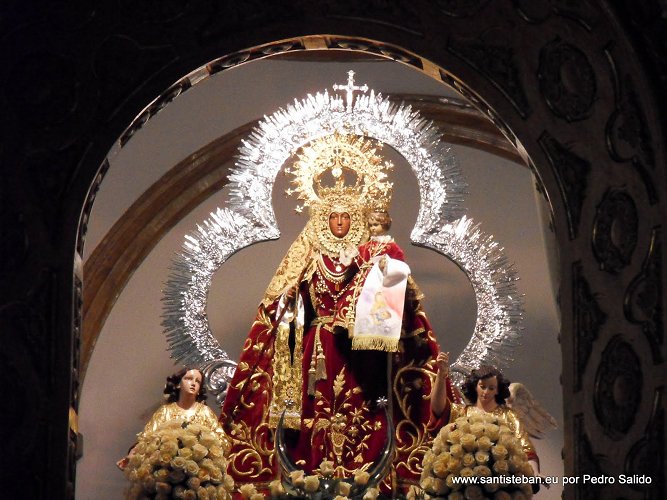
| This is one of those interesting Black
Madonnas with white Baby Jesus, the Yin and Yang of popular Catholicism,
if you will. For more details and other examples see Foggia
paintings, San Severo, and Chipiona.
Legend recounts that this statue was found by a farm worker called
Esteban Solís Palomares on April 26th 1232. It was only six
years after the Muslim occupation of the area ended and the local
farmers dared to expand their territories, tilling soil that had
long lain fallow. That day his team of mules all of a sudden had
a hard time continuing in their path. He beat them onward until,
with great effort, they unearthed a big church bell. When he cleaned
it up a bit, he found that a beautiful Madonna and Child were hidden
inside. Full of emotion, not only he but also the mules fell on
their knees and stayed there a long while absorbed in adoration.
This was the first miracle the Black Madonna worked in that town.
|
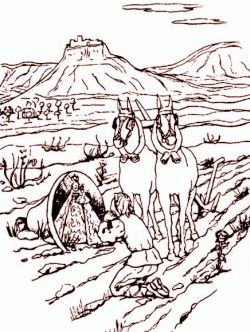 Drawing by Jacinto Higueras Cátedra |
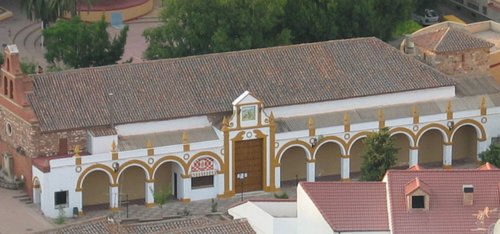
For some reason a certain Don Amador Chércoles Colomo published a booklet in 1886, in which he claimed that the Madonna was found in 1532. Yet many documents prove that the discovery took place many years before. E.g. the confraternity of Our Lady of Collado was founded in 1502. It too continues to this day and lists more historical facts on its website. The Black Madonna of Santisteban holds a stick that symbolizes her rule over her town. Baby Jesus holds the world in his left hand and blesses it with his right. Her Romanesque church was either built on top of an even older one or using construction materials from an older dwelling. In any case, visigothic elements from the 5th – 8th century are found in the church and it was declared a national historical monument in 1978. Not far from Santisteban, in the town Bailen there is another Black Madonna in her Santuario de Santa Maria de la Cabeza.(*1) |
 |
*1: Miquel Ballbè i Boada, Las Vírgenes Negras y Morenas en España Vol. 1, Gafiques ISTER, Moia/Terrassa: 1991, p. 326.