Murat:
Our Lady of the Olive Trees
(Notre-Dames des Oliviers)
In St. Martin church in the center of town, department Cantal, region Auvergne, 13th century, 83 cm, olive wood. Original (on left) stolen in 1986. A charming lady (below) replaced her until a new replica by Benoît Mercier (on right) was installed in September 2008 that more closely resembles the original.
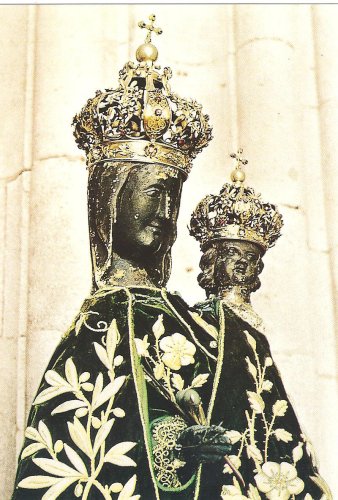
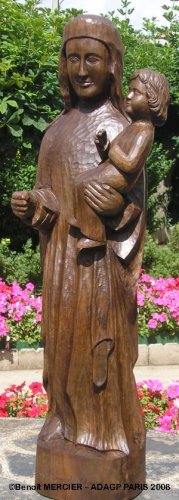
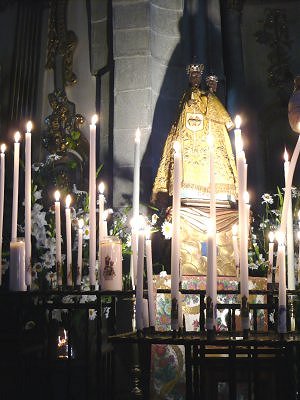 She enjoys a "living cult". photo: Marylou Hillberg |
Legend claims that this is one of several statues, which King Saint Louis brought back to France from the Crusades. While Ean Begg mentions that the king did indeed have “many connections with Murat” he also agrees with Lieux Sacrées, the greatest French website on Black Madonnas, that experts claim the original statue stems from the 14th century, i.e. a century after King Louis died.(*1) On the other hand the oldest part of the sanctuary is from the 13th century (with 14th century additions) and the postcards they sell at the church say the original Black Madonna was from the 13th century. Who knows, there could have been another Black Madonna before this one. At least no one argues with the story that a seminary was founded
in Murat in 1357 A.D. dedicated to Our Lady of the Olive Trees
and that she blackened in a fire that reduced the church to rubble
in 1493. She has been invoked since “time immemorial”
as a protector of the sick, of future mothers, and against thunderstorms.
Under her olive branch, the symbol of peace, no citizen of Murat
died during the Revolution. |
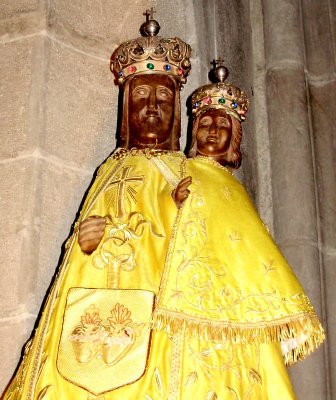 the 2nd incarnation of the Black Madonna of Murat (1986-2008) |
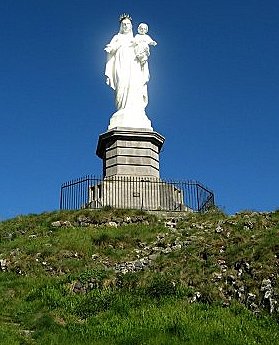 Our Lady of Good Life or of Haute Auvergne |
The Candlemas processions where everybody dressed
in green, mentioned by Ean Begg, are not held anymore. Instead,
her feast day is now held on the Sunday following August 15th, the
feast of the assumption of Mary. On the night before, the men and
youth carry their Black Madonna up the hill to a 14 m high monumental
statue of Mary called Notre-Dame de Bonne Vie, Our Lady of Good
Life, or Notre-Dame de la Haute Auvergne. She was erected in 1878
on the occasion of the coronation of Our Lady of the Olive trees
and stands on the Rock of Good Life, overlooking the town. The solemn
candle light procession is attended by so many people that on the
way down it’s like a singing river of fire flowing from the
Mother on the hill down to the church. Nowadays the very lovely Congregation St. John, an order of monks and nuns founded in 1975, takes care of the sanctuary and organizes retreats and camps. They ensure that the “cult of Out Lady of the Olive Trees” is kept alive and spread throughout the world. Every year they receive letters from as far away as Ireland, the USA, and Canada asking for photos and medals of Our Lady or for prayers to be presented to her.(*2) |
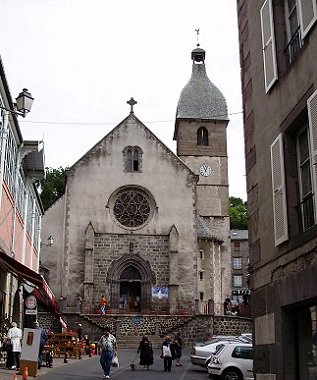 St. Martin church, photos, here and above: Ella Rozett |
*1: Ean Begg, The Cult of the Black Virgin, Penguin Books, London: 1985, p. 205
*2: You can contact them at hotellerie.murat@stjean.com