Orleans:
Our Lady of Miracles
In the Chapel Notre Dame des Miracles about one mile from the cathedral, Loiret department, Centre region, 16th century replacement of 5th century wooden statue burnt by Protestants, 130 cm including the base, painted stone.
photo: Ph. Plisson, Orleans
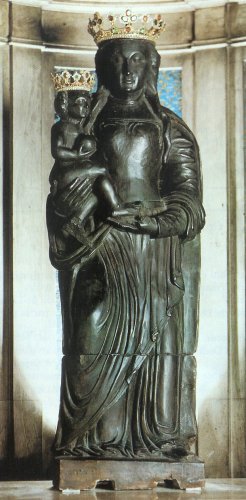
The original Black Madonna of Orleans came from Syria in the 5th century.
She accompanied a group of her countrymen who settled outside the city
gates of Orleans in a village called Avenum. They were Christian traders
who sold Middle Eastern luxury items like perfume, fabric, jewelry, and
spices. Remember, Syria sheltered one of the earliest Christian communities
and it was here (in Damascus) that Paul was baptized.
The Syrian community in Orleans prospered until the 8th century. In the
7th century its homeland had been absorbed into the expanding Muslim empire.
Gradually trade between Muslim East and Christian West ceased and the
Syrian population in France melted into the French. Their Black Madonna
became the Dark Mother of all the citizens of Orleans.
As such she rose to great fame in the 9th century, during the Norman invasions. These Viking pirates who ended up settling in Northern France, spread terror wherever they went, pillaging, destroying and massacring whole towns. The people of Avenum knew that their only hope of surviving an attack lay in Heaven. So men, women, and children gathered at the church prostrated themselves before the Mother of God and begged her to liberate them from the enemy. Then they took the statue and placed her on the gate of their fortified town, in hopes that she would chase away the Normans. The keeper of the gate hid behind the Madonna and was shooting arrows at the invaders when one of them discovered him and yelled: "You won't be able to avoid death and that image won't defend you, unless you come down right now and open the gate." Having said this, he in turn shot an arrow that would have found its aim, had not the statue come alive and extended a knee so as to intercept the deadly weapon. The enemies witnessed this miracle in awe and immediately proclaimed loudly that the Holy Mother was defending and fighting for the inhabitants of Avenum. In fear they threw their arms down and asked for peace, which was gladly granted. Once the statue with the arrow imbedded in its knee was back in her chapel, the Normans offered her presents and promised never again to hurt anybody from her village.(*1) The arrow remained in her knee for many centuries as her fame kept spreading.
Around the late 12th century her little oratory was expanded. But only
her chapel bore her name, while the church as a whole was dedicated to
St. Paul. Maybe Our Lady didn't like this. In any case, during World War
II she allowed St. Paul's church to be completely destroyed, while her
chapel did not suffer a scratch. The whole neighborhood was in ashes,
but not even a piece of her lace was scorched.
During the Middle Ages many more miracles were attributed to her intercession
and she was honored first with four then with eight annual processions.
Her greatest feat was helping Jeanne d'Arc secure victory over the English
occupiers. In 1409 the people of Orleans formally asked the Black Madonna
to save their country from the English, but 18 years later the situation
still looked desperate. Charles VII, the rightful French heir to the throne,
had only one stronghold left: Orleans, and the English lay siege to it
in October 1428. But the tide began to turn in April 1429, when the young
maiden Jeanne d'Arc was able to break through the English siege with her
troops. Men, women, and children greeted her as enthusiastically "as if
they had seen God descend among them."(*2) The young
saint spent one week in Orleans, in a house with a private passage way
to the chapel of the Black Madonna. Daily she prayed at the feet of the
Lady who conquered other invaders and who still bore the Norman arrow.
After that week Jeanne defeated the English and won a miraculous victory.
But like the Mother of Orleans, she too paid the price of being wounded
by an arrow. I think Jeanne d'Arc being wounded could have easily been
the end of her victorious advance had she not just come from that famous
Lady who also won victory by taking an arrow. As it was, Jeanne was seen
as an instrument, extension, and delegate of the Queen of Heaven.
While Charles VII tried to forget that embarrassing peasant girl who returned
him to his throne and did nothing to save her from burning at the stake,
he didn't seem to mind help from "the woman robed in the sun", as long
as she remained in Heaven. The Black Madonna didn't interfere with social
hierarchies in such an obvious way and so he asked the people of Orleans
to beg for her continued intercession. Once France had shaken the English
occupiers off, the king ordered a great thanksgiving procession to her
chapel.
Dark times came for Our Lady during the Wars of Religion. She was burned
in 1562 by Huguenot (French protestant) soldiers. But soon after a truce
was reached, a new statue was commissioned to take the throne of the ancient
one. She was sculpted by an artist who still remembered the original.
He tried to reproduce the same facial features, but made major changes
on the rest of her body. In keeping with the style of the time, he let
her stand rather than sit as the throne of wisdom. Since the Renaissance,
statues of Mary were modeled after Greco-Roman sculptures rather than
Egyptian ones. In the mind of the people this gave them more authority
or importance.(*3)
In remembrance of her blocking the Norman arrow, the statue's right knee
is extended and pronounced. She is sculpted in stone rather than wood
so that her enemies would not be able to destroy her again so easily.
This was good foresight, because a couple of centuries later she was indeed
in grave danger again when a revolutionary was ordered to destroy her.
The man was a metalworker, but all his hammers could only do relatively
little damage. He mutilated her left thumb and the feet of baby Jesus,
and damaged her robes a little. Then he gave up and contented himself
with stealing her mantle.
In 1805 and again in 1922 the chapel of Our Lady was greatly enlarged and embellished. It's stain glass windows and mosaics tell the story of the Madonna's and Jeanne d'Arc's history and glory. She was solemnly crowned in 1902. The booklet sold in her sanctuary calls her "the allmighty suppliant".(*4)
*1: This is the account recorded in 1221 by Vincent de Beauvais in his "Miroir Historique", quoted in "La tradition vivante, Notre-Dame des Miracles, La Vierge Noire d'Orléans", Éditions C.I.F., Sainte-Maxime: 1983, p.6 This booklet is published and sold by the sanctuary of Notre-Dame des Miracles.
*2: Ibid. p.9
*3: Ibid. p. 12
*4: Ibid. p. 30 This is not Catholic dogma, but popular acclamation, allowed as a poetic expression of devotion.