Paris:
Queen of Peace
Our Lady of Peace
In the convent church of the Congregation of the Sacred Hearts of Jesus and Mary, 35 rue de Picpus, metro station Nation, open daily 9:30-12:00, 2-4, 6-7, 16th century, 33cm, wood.
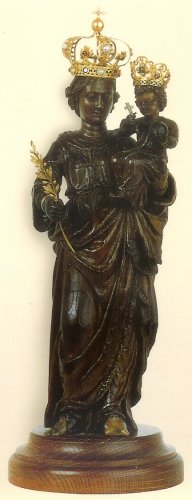
This Queen of Peace is quite an aristocratic lady. It is believed that
she was a wedding gift by Jean de Joyeuse to his wife in 1518. The house
of Joyeuse intermarried with French royalty and according to Ean Begg
this Black Madonna "has more associations with the aims of the Merovingian
blood-line in the 16th and 17th centuries than any other Black Virgin."(1)
I suppose this fact is interesting to those who think that the Black Madonnas
are a secret disguise for Mary Magdalene, the spouse of Christ who bore
his child, from whom the Merovingians descended. Personally, as I explain
in more detail under "Thuret" and in my article on "Mother Mary and Mary
Magdalene", I'm not impressed with this story. Too many royal blood-lines,
from Africa to Tibet and Europe want to trace their origins into Heaven.
If you ask me, it's simple self-aggrandizement with the aim of justifying
an insatiable hunger for power.
In any case, Henri de Joyeuse inherited the statue in 1576. He was a religious
man who wanted to become a monk, but was obliged instead to marry a pious
princess. The two vowed to each other before this Madonna, that should
one of them die, the other would enter monastic life. It didn't take long.
The princess succumbed after giving birth to her first child, a daughter.
Within less than a month Henri joined the Capuchins and built a chapel
for his beloved Madonna in their monastery. Upon his death he left the
Black Virgin and her chapel to the order. And so she became the Madonna
of the Capuchins.
But the order didn't appreciate her nearly as much as her previous owners
did. Soon the monks destroyed the chapel of the Black Madonna in order
to enlarge their monastery. They didn't seem to have room in their inn
for her and relegated her to an outside niche over the entrance. There
she spent about 60 years, almost completely ignored. Only two humble friars
showed her devotion and liked to decorate her with flowers, and a few
noble ladies used to offer her candles.
The hour of the Madonna came during the so called "Thirty Years War"
which was actually a series of wars that stretched from 1610-60. It began
as a war of religion between Protestants and Catholics, but turned into
a struggle for power among almost all the European dynasties. By 1651
the Parisians were really tired of it. In anguish they turned to the Black
Madonna holding the golden olive branch, an old symbol for peace. Her
niche was just a few steps from the King's court. Here the people started
to gather and cry: "Our Lady of Peace, pray for us! Queen of Peace, help
us!" It seems they wanted their calls heard not only in Heaven, but also
on earth, in the palace next door. Just as the wars were a mixture of
religious and secular conflict so these gatherings in the streets also
became a mixture of peace march and processions. Hymns were sung, litanies
recited, and people began to gather from all over Paris. If not the French
King, at least the Queen of Heaven heard her children. During processions
one started hearing the cry: "A miracle!" "A miracle!" as sudden healings
multiplied. And so the people found a measure of peace in their hearts
even as the outer wars raged on.
Since the Madonna of the Capuchins had found her calling as the famous
Queen of Peace she deserved better than a niche in the monastery wall.
As her fame spread people blamed the order of monks for leaving Our Lady
out in the cold, in the street. Several priests offered churches in Paris
that would have been happy to house her more honorably. The archbishop
had to intervene. The quarrel was settled when the Capuchins moved the
statue into a church near the tomb of Henri de Joyeuse, who had loved
her so much. Now that the people had more access to her, Our Lady became
the Parisians' most beloved place of meeting their heavenly Mother. Their
devotion was rewarded with still more miracles. As ever bigger crowds
gathered in her church, the descendents of Henri de Joyeuse remembered
their ties to this sacred treasure and his granddaughter decided to have
a bigger church built for it. In 1657 the new church was inaugurated and
"all of Paris" attended the celebration, including the "Sun King" Louis
XIV.
A year later the king fell gravely ill, his mother prayed the Queen of
Peace to heal him and her prayer was answered. With that the reputation
of the Parisian Black Madonna spread all the way to Rome and the Pope
gave permission to grant plenary indulgences to all who attended mass
in her sanctuary on her special feast day, 9th of July.
Until the Revolution she was invoked for peace in France, peace in the
world, peace in families and individual hearts. But from 1790-1806 she
had to be hidden by several individuals while the Capuchins were chased
from their properties. When peace returned to the city, it was decided
that the nuns of the Sacred Hearts of Jesus and Mary were worthy of housing
the Black Queen. They made her their patron and spread her fame and copies
of her image literally all over the world, on all continents and numerous
islands, wherever they had convents and schools. E.g. the cathedral of
Honolulu, Hawaii is dedicated to her and in Bolivia she is called La Negrita,
the Dear Black One.
She was canonically crowned in 1906 and the 9th of July is still her feast day. Plus every first Saturday of the month a special rite is celebrated in all her convents: each member of the congregation and all present are blessed by having the statue (or a copy of it) touched to the top of their heads.
| This article is based on information taken from the July 1999 issue of "Horizons blancs" the magazine of the Congregation of the Sacred Hearts of Jesus and Mary. Interestingly enough they include this image of Rhea and Pluto (sculpted in Athens in 371 B.C.E.) in an article elucidating the artistic style of the Queen of Peace. She is a renaissance Madonna wearing Greek clothes, hair style, and sandals. The artist was inspired by depictions of Greek goddesses and Italian renaissance madonnas. Generally it seems that European Catholics are not at all afraid of links to pre-Christian cultures. On the contrary, they are proud of their old roots. |
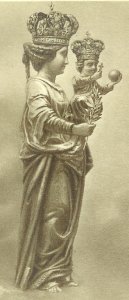 a drawing of the Queen of Peace, showing her hair style |
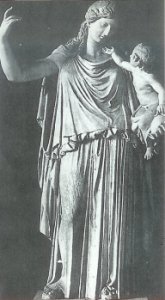 Rhea and her son Pluto |
__________________________________________________________________
*1: Ean Begg, The Cult of the Black Virgin, Arkana/Penguin Books, London:
1985, p.209